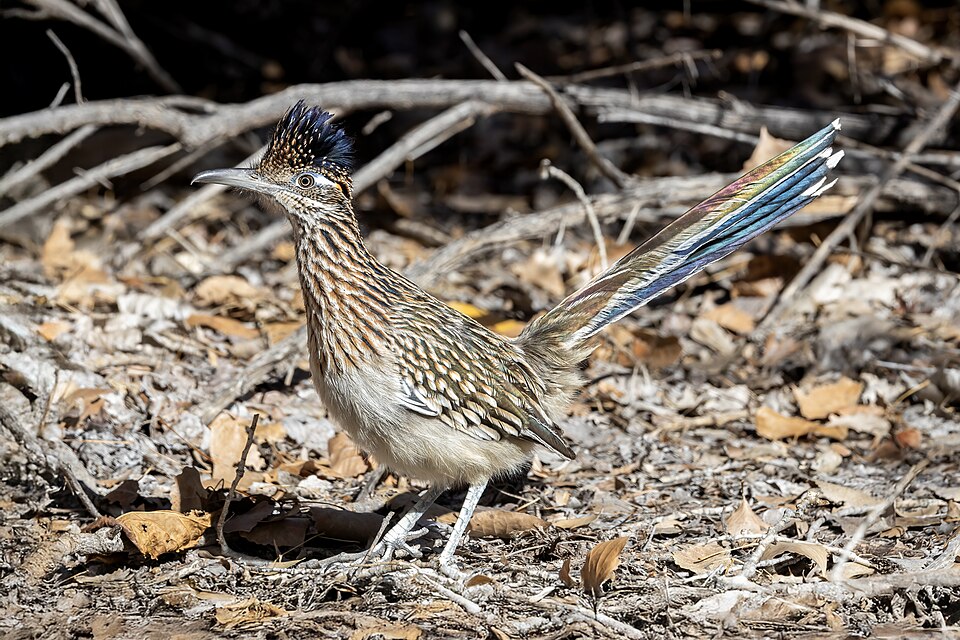
The Greater Roadrunner is one of those birds that nearly everyone recognizes before they have ever seen one in the wild, thanks to a certain cartoon. The real thing is far more interesting than the dust-cloud cartoon would suggest. It is a large, ground-dwelling member of the cuckoo family, built for a life of running rather than flying, and it thrives in the open deserts, scrublands, and grasslands of the American Southwest and central Mexico. A roadrunner streaking across a dirt road with its long tail trailing behind and a lizard dangling from its bill is one of the signature sights of arid North America.
What makes the roadrunner so compelling is how thoroughly it has adapted to a harsh environment. It can sprint at speeds approaching 20 miles per hour, kills and eats venomous prey including rattlesnakes and scorpions, and conserves water and energy through clever behaviors like sunbathing on cold mornings. It is a bird of personality and resourcefulness, and watching one hunt is a small lesson in desert survival.
The Greater Roadrunner is unmistakable once you know the shape: a long, lanky bird with a heavy bill, a shaggy crest it can raise and lower, and a very long tail that it carries cocked or trailing. It spends almost all of its time on the ground, running in a low, horizontal posture with its head and tail held out in line with the body.
| Size & shape | Large and slender, roughly the length of a crow but longer because of the extended tail; long sturdy legs |
| Plumage | Heavily streaked brown and white above and on the breast, giving a mottled, camouflaged look against desert soil |
| Crest | Shaggy dark crest that is raised when alert or excited and flattened when relaxed |
| Eye patch | Bare patch of skin behind the eye, blue toward the front fading to red or orange at the back; brightest in breeding season |
| Bill | Long, heavy, slightly downcurved bill used to grab and batter prey |
| Tail | Very long, dark, often white-tipped, frequently cocked upward or flicked while running and hunting |
Male vs. female
Males and females look essentially identical in the field. Both sexes share the same streaked plumage, shaggy crest, and colorful bare eye patch, and there is no reliable difference in color you can pick out at a distance. Males average slightly larger, but this is not something you can judge on a lone bird. Behavior during courtship is the best clue to sex: it is the male that typically performs the displays, brings food gifts to the female, and offers nest material.
Juveniles
Juvenile roadrunners look much like adults but are duller and softer in appearance. Their streaking is less crisp, the bare skin patch behind the eye is muted rather than the vivid blue and red of a breeding adult, and the overall plumage can look a bit ragged as feathers grow in. Young birds leave the nest before they can fly well and spend their early independent days running and clambering through low cover near where they hatched.
The signature sound of the Greater Roadrunner is a slow, descending series of low cooing notes, often written as coo-coo-coo-coo-cooo, dropping in pitch and slowing toward the end. It is a soft, almost mournful, dove-like sound that carries surprisingly far across open country, and males give it most often in the breeding season, frequently from an elevated perch like a fence post or low branch.
Roadrunners are not the screeching, beeping creatures of cartoons. Besides the cooing song, they make a distinctive mechanical clattering or whirring sound by rapidly rattling the mandibles of their bill together, a bit like a wooden noisemaker. They also give various clucks and growls at close range. The bird does not, of course, say meep meep.
The Greater Roadrunner is a year-round resident across the American Southwest, including much of California, Arizona, New Mexico, Texas, Oklahoma, and southern portions of Nevada, Utah, Colorado, and Kansas, extending well down into central Mexico. In recent decades it has expanded its range somewhat to the north and east, turning up in places like Arkansas, Missouri, and Louisiana.
Roadrunners do not migrate. They hold territories all year, which is part of why they are such reliable residents where they occur. Because they rely on running rather than long flights, individual birds tend to stay within a relatively defined home range, though young birds disperse to establish their own territories.
The Greater Roadrunner is a fierce and opportunistic predator. Its diet is dominated by animal prey: insects, spiders, scorpions, centipedes, lizards, small snakes, mice, and small birds. It is famous for killing snakes, including young rattlesnakes, which it dispatches by seizing them behind the head and beating them against the ground or a rock. Large prey is swallowed whole, sometimes with the tail still dangling from the bill while the front portion is being digested.
Roadrunners hunt almost entirely on foot, walking and dashing through open ground and pausing to flush prey. They are remarkably quick, snatching dragonflies and even hummingbirds out of the air with a sudden leap. In leaner months, especially winter, they will also eat fruits and seeds. Their efficiency as hunters is one reason they survive in habitats where food and water are scarce.
Greater Roadrunners are monogamous and often pair for the long term, defending a territory together year-round. Courtship is elaborate, with the male performing bowing and tail-wagging displays, chasing the female, and offering food and nest material as gifts. The nest is a compact platform of sticks lined with grass, leaves, feathers, and bits of snakeskin, usually placed in a low thorny shrub, cactus, or small tree a few feet off the ground.
The female lays a clutch of eggs that both parents incubate, with the male often taking the night shift. Chicks hatch over several days, so a brood can contain young of noticeably different sizes. Both parents feed the nestlings, and the young leave the nest before they are fully capable of flight, relying on running and their excellent camouflage to stay safe.
The roadrunner is not a typical feeder bird, and you will not lure one with a seed tube or suet cake. It is a ground predator that wants live prey and open hunting habitat. That said, in the right region you can make your yard more roadrunner-friendly, and lucky homeowners in the desert Southwest do get regular visits, sometimes even at a low platform or patio.
- Live in or near the right habitat: roadrunners only visit yards in the arid Southwest and parts of central Mexico, ideally near open desert, scrub, or grassland.
- Skip the seed feeders and instead encourage prey. Native plantings that support lizards, large insects, and ground-dwelling creatures give a roadrunner a reason to patrol your yard.
- Provide cover and perches. Low thorny shrubs and cactus give roadrunners nesting and hiding spots, while fence posts and rock piles serve as hunting lookouts and sunning spots.
- Offer a shallow ground-level water source. In dry country, a low dish or birdbath can draw a roadrunner, especially in summer.
- Keep cats indoors and avoid pesticides. Free-roaming cats threaten ground birds, and insecticides wipe out the prey base a roadrunner depends on.
- Be patient and hands-off. Roadrunners are wary; let them approach on their own terms rather than trying to hand-feed, which can habituate them in unhealthy ways.
- Lesser Roadrunner: A close relative found farther south in Mexico and Central America. It is smaller, has a shorter bill, plainer (less streaked) underparts, and buffier coloration. Range overlap with the Greater is limited.
- Greater Ground-Cuckoo: Another long-tailed, ground-dwelling tropical cuckoo, but it lives in forested habitats of southern Mexico and Central America rather than open desert, and is not found in the U.S.
- Northern Mockingbird: Sometimes confused at a glance because both are gray-brown with long tails, but the mockingbird is much smaller, flies readily, lacks the heavy bill and shaggy crest, and shows white wing patches in flight.
How fast can a roadrunner actually run?
Greater Roadrunners can sprint at roughly 15 to 20 miles per hour over short distances. That is fast enough to run down lizards and large insects on foot, though it is well short of the cartoon image. They prefer running to flying and only fly in short, low glides when they need to.
Do roadrunners really eat rattlesnakes?
Yes, though usually smaller snakes including young rattlesnakes rather than large adults. A roadrunner grabs a snake behind the head and repeatedly slams it against the ground or a rock to kill it, then swallows it whole. They also eat lizards, scorpions, tarantulas, mice, and large insects.
Can roadrunners fly?
They can, but only weakly and briefly. A roadrunner will flutter and glide up to a perch, over a fence, or down from a low tree, but it cannot sustain powered flight for long. It is built for a life on the ground, with strong legs and a long tail that acts like a rudder while running.
What sound does a roadrunner make?
The main song is a slow, descending series of low coos, like coo-coo-coo-cooo, that sounds almost like a mourning dove. Roadrunners also produce a mechanical clattering by rattling their bill. They do not make the beeping meep meep sound from the cartoon, which was a sound effect, not a real bird call.
Where can I see a Greater Roadrunner?
Look in open arid country across the American Southwest, from California and Arizona through Texas and into central Mexico. Scan the edges of dirt roads, desert washes, scrubby fields, and the bases of cactus and mesquite. Early morning is a good time, when birds often sun themselves on fence posts or rocks.
Why do roadrunners sunbathe in the morning?
On cold desert nights, roadrunners lower their body temperature to save energy. In the morning they warm back up by turning their back to the sun and erecting their feathers to expose dark patches of skin that absorb heat. It is an energy-saving adaptation that helps them survive sharp desert temperature swings.