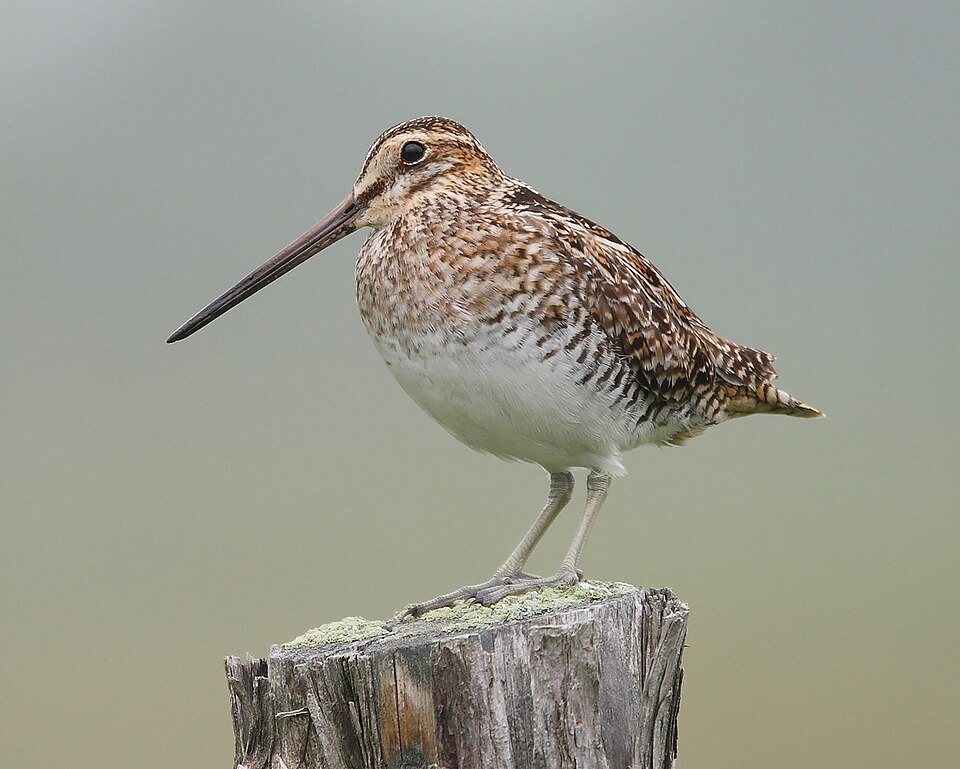
Wilson's Snipe is a stocky, intricately patterned shorebird that spends its life crouched in wet meadows, bogs, and marsh edges, where its streaked brown plumage makes it nearly invisible. Most people never see one until it explodes from underfoot with a harsh, scratchy scaipe and zigzags away on rapid wingbeats. With its absurdly long, straight bill and short legs, it is built for one thing: probing soft mud for hidden invertebrates. It is the very bird that gave us the word "sniper," a nod to how hard these fast, erratic flyers were to shoot in the old market-hunting days.
For a bird so shy on the ground, the snipe puts on a remarkable show in spring. Males climb high over breeding territory and dive, fanning specialized outer tail feathers that vibrate in the airstream to produce an eerie, pulsing, hollow woo-woo-woo-woo known as "winnowing." It is one of the most haunting and recognizable sounds of northern wetlands. Once lumped with the Common Snipe of Eurasia, Wilson's Snipe is now treated as its own species, distinguished partly by its tail feather count and the tone of that winnowing display.
Look for a plump, medium-small shorebird with a very long, straight bill, a short tail, and a low, hunched posture. Bold buff and cream stripes run lengthwise down the dark brown back and crown, breaking up its outline against grass and mud. In flight it looks pointed and fast, often flushing suddenly and twisting away low over the marsh.
| Bill | Very long and straight, roughly twice the length of the head, used to probe deep into mud |
| Head pattern | Bold dark crown split by a pale central stripe, plus a pale stripe over each eye and a dark line through it |
| Back | Dark brown with strong pale buff and cream stripes running lengthwise, like racing stripes |
| Flanks | Heavily barred with brown; belly is whitish and unmarked |
| Legs | Short, yellowish to greenish; the bird sits low to the ground |
| Tail in flight | Short, with a rusty-orange base visible as it flushes and zigzags away |
Male vs. female
Males and females look alike in the field. Both sexes share the same striped, cryptic plumage with no seasonal or sexual color difference, so you cannot reliably tell them apart by sight. Females average very slightly larger with a marginally longer bill, but the overlap is too great to judge in the wild. Behavior is the best clue in spring: the bird performing the high, winnowing aerial display is usually the male, while the bird flushed quietly from cover could be either.
Juveniles
Juvenile Wilson's Snipe look much like adults and are difficult to age in the field. The cleanest difference is in the wing covert feathers, which in young birds show narrow, even pale fringes rather than the broader, buffier edges of adults, a detail usually only visible on a bird in the hand or a very close photo. Freshly fledged young have a slightly softer, less crisp look to their back stripes but are otherwise the same well-camouflaged little marsh bird.
The snipe's signature sound is not vocal at all. During courtship and territorial flights, the male climbs high and makes shallow dives, spreading his stiff outer tail feathers so air rushing past makes them flutter. This produces the famous "winnowing," a hollow, accelerating, tremulous woo-woo-woo-woo-woo that seems to come from everywhere at once. It is often heard at dawn and dusk over breeding meadows, and once you know it you will never mistake it.
Vocally, a flushed snipe gives a harsh, rasping scaipe! or skipe! as it bursts away. On the breeding grounds, a perched bird (often on a fence post) repeats a steady, mechanical chip-a, chip-a, chip-a or wheat, wheat, wheat, sometimes for minutes on end.
Wilson's Snipe breeds widely across the northern United States, Canada, and Alaska, favoring bogs, fens, wet meadows, and marshy edges. It is a migratory bird across most of its range: northern breeders pull south in fall to spend winter across the southern United States, Mexico, and Central America, wherever soft, unfrozen mud is available.
In the milder parts of its range, such as the Pacific Coast and the southern tier of states, snipe can be found year-round. During migration and winter you may encounter them almost anywhere there is shallow water and exposed muck, from flooded fields and ditches to the muddy margins of ponds. Because they are so secretive, they are often present in far greater numbers than casual observers realize.
Wilson's Snipe feeds mainly on invertebrates pulled from soft, saturated ground. The diet is dominated by insect larvae, especially craneflies and other flies, along with earthworms, beetles, snails, small crustaceans, and the occasional seed. It hunts by walking slowly through mud with a slightly bouncing, sewing-machine motion, rhythmically jabbing its long bill straight down.
That bill is a precision tool. The flexible tip can open underground to grasp prey while the base stays closed, and it is packed with sensory pits that let the bird feel buried worms and larvae it cannot see. This lets a snipe forage by touch in opaque mud, often with the whole bill plunged in and only its striped head showing above the surface.
Wilson's Snipe nests on the ground in wet meadows and bog edges, choosing a well-hidden hollow in a clump of sedge or grass, often lined with fine grasses and dead vegetation. The female does the incubating, while the displaying male defends the territory overhead with his winnowing flights. The nest is so concealed that an incubating bird may sit tight until you nearly step on it.
A typical clutch is four eggs, pale olive to brownish and heavily blotched with dark markings, laid in a pointed pyramid with the narrow ends inward. Incubation runs about three weeks. The downy young leave the nest soon after hatching and, in an unusual split, the parents often divide the brood, with the male tending the first chicks and the female taking the rest. Snipe usually raise one brood per year.
Wilson's Snipe is not a feeder bird and will not visit seed or suet, so you cannot lure one with traditional backyard offerings. It is a habitat specialist that needs soft, wet, muddy ground with low cover. That said, if your property includes the right wetland conditions, you can absolutely host snipe, especially during migration.
- Maintain or create wet, muddy ground: a seasonally flooded corner, a boggy low spot, or the muddy margin of a pond is what snipe need most.
- Leave low, grassy cover around water's edge rather than mowing to the shoreline; snipe rely on dense vegetation to hide and nest.
- Avoid draining or filling wet meadows and ditches, which are prime snipe habitat that is easily lost to tidying up.
- Skip pesticides near wet areas so the insect larvae and earthworms snipe feed on stay abundant.
- Watch and listen at dawn and dusk during spring migration, when birds are most active and males may winnow overhead.
- Walk wet edges slowly and scan the mud carefully; snipe are usually spotted by patient watching, not attracted to a yard.
- American Woodcock: Also long-billed and cryptic, but plump and rounded with a rich rufous belly, big eyes set high on the head, and barred (not striped) crown; prefers damp woodlands over open marsh.
- Long-billed Dowitcher: Similar long bill and probing style, but taller, longer-legged, and grayer with a straight steady feeding motion; feeds in flocks in open water rather than skulking in cover.
- Short-billed Dowitcher: Like the Long-billed Dowitcher, it is a sleeker, flock-feeding shorebird of open mudflats, lacking the snipe's bold lengthwise back stripes and hunched, hidden posture.
- Spotted Sandpiper: Shares wet edges but is much smaller and slimmer with a short bill, a teetering tail-bob, and clean (or spotted) underparts rather than heavy barring and stripes.
What does a Wilson's Snipe look like?
It is a stocky, medium-small shorebird with a very long straight bill, short legs, and a low, hunched posture. The back is dark brown with bold buff and cream lengthwise stripes, the head has a striped pattern, and the flanks are heavily barred. In flight you may glimpse a short tail with a rusty-orange base as it zigzags away.
What is the strange winnowing sound snipe make?
That eerie, hollow, pulsing woo-woo-woo is not a vocal call. A displaying male dives through the air and spreads stiff outer tail feathers that vibrate in the wind, producing the sound mechanically. It is a courtship and territorial display heard over breeding wetlands, especially at dawn and dusk.
Where can I see a Wilson's Snipe?
Look in wet, muddy habitats with low cover: bogs, wet meadows, marsh edges, flooded fields, and the muddy margins of ponds and ditches. They are most widespread during migration and winter across the southern U.S. and breed across the northern U.S., Canada, and Alaska. They are common but very easy to overlook.
Will Wilson's Snipe come to a bird feeder?
No. Snipe eat invertebrates probed from soft mud, not seeds or suet, so they will not visit feeders. The only way to host them is to provide the wet, muddy, grassy habitat they need, ideally a boggy low spot or a marshy pond edge.
What is the difference between a Wilson's Snipe and an American Woodcock?
Both are long-billed, superbly camouflaged birds, but the woodcock is plumper and more rounded with a rich rufous belly, large high-set eyes, and a barred crown, and it lives in damp woodlands. The snipe is more streamlined with bold lengthwise back stripes, barred flanks, and a preference for open marshes and wet meadows.