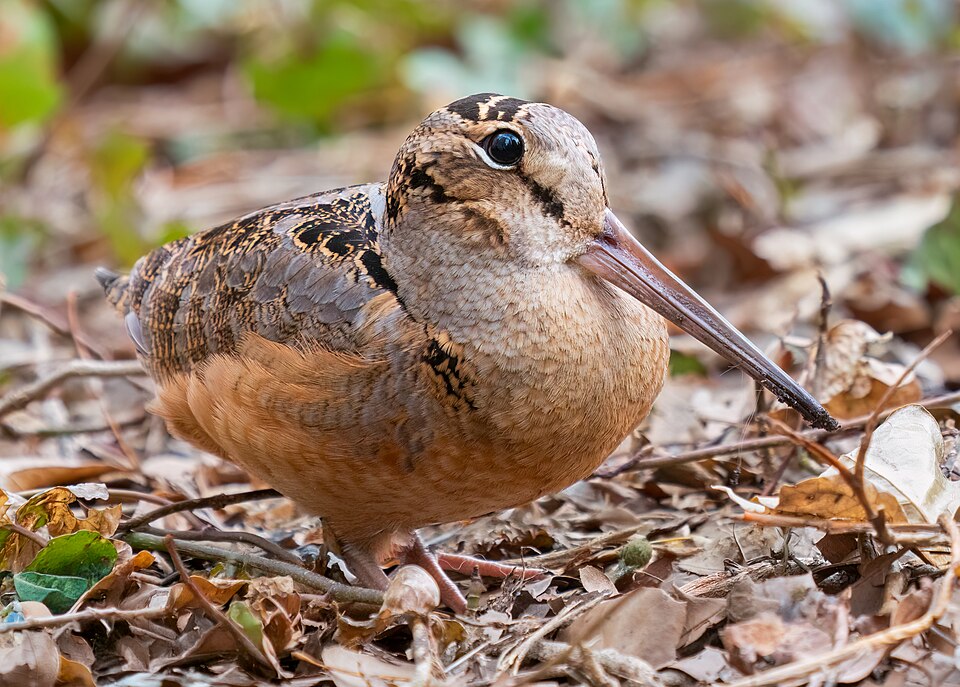
The American Woodcock is one of the most charming oddities in eastern North America. Though it belongs to the sandpiper family, you will almost never see it on a beach. Instead, this chunky, short-legged bird lives in damp woodlands, brushy thickets, and the wet edges of fields, where its dead-leaf camouflage makes it nearly invisible until it flushes from underfoot in a startling whir of wings. Affectionately known as the "timberdoodle," it has inspired generations of birders, hunters, and naturalists with its strange shape and even stranger courtship.
What makes the woodcock unforgettable is its springtime "sky dance." On warm evenings from late winter into spring, males gather in clearings at dusk and dawn to perform a spiraling aerial display, climbing high on twittering wings before tumbling back to earth. Aldo Leopold immortalized this ritual in A Sand County Almanac. Beyond the show, the woodcock is a quiet, secretive bird that spends most of its time probing soft earth for earthworms with its remarkable, flexible-tipped bill.
The woodcock has a silhouette unlike any other land bird: a rotund, neckless body, an oversized head set low on the shoulders, very short legs, and an absurdly long straight bill. On the ground it looks like a russet dead leaf with a stick attached. In flight it appears stubby and rounded, often rising steeply on whistling wings before settling back into cover.
| Bill | Very long, straight, and pinkish-gray; the upper tip is flexible and can open underground to grab worms |
| Plumage | Intricate dead-leaf camouflage of rust, buff, black, and gray; rich cinnamon-orange underparts |
| Head | Large, with three or four bold black bars running crosswise over the rear crown (not lengthwise) |
| Eyes | Large and set high and far back on the head, giving nearly 360-degree vision |
| Body shape | Plump and chunky with a short neck and very short legs; looks tailless and round |
| In flight | Rounded wings produce a twittering whistle; flushes with a zigzag, towering flight |
Male vs. female
Males and females look essentially identical in the field, with the same cryptic plumage and long bill, so you cannot reliably tell them apart by eye. Females do average noticeably larger and heavier than males, and they tend to have a slightly longer bill, but these differences are only obvious when birds are measured in the hand. Behavior is the best clue: it is almost always the male performing the spiraling courtship flight and giving the nasal display calls, while the silent watcher on the ground is typically a female.
Juveniles
Newly hatched woodcock chicks are precocial, covered in mottled buff-and-brown down that mirrors the leaf litter, and they leave the nest within hours of hatching to follow the female on foot. Within a couple of weeks they can make short flights, and by about four weeks they are nearly full grown. Juveniles quickly resemble adults in their intricate dead-leaf pattern, and once fledged they are very difficult to distinguish from adults in the field without close in-hand examination of wing feathers.
The woodcock has no true song, but its display sounds are unmistakable. From the ground, a courting male gives a buzzy, insect-like peent (sometimes written beezp) every few seconds, a low nasal note that carries surprisingly far across a darkening field. After several peents he launches skyward.
The flight itself is musical: the outer primary feathers produce a high, twittering, chirping whistle as the male spirals upward several hundred feet. At the top he pauses, then plummets in a zigzag descent while giving a liquid, bubbling, chirping warble before landing near where he started and resuming his peenting. There is no need to memorize a complex song here, just listen at dusk for the peent-then-twitter sequence.
The American Woodcock is a bird of eastern and central North America. It breeds across the eastern United States and southern Canada, from the Maritimes and the Great Lakes south through the Appalachians and into the Midwest, favoring young forests, thickets, and moist field edges. Wintering birds concentrate in the southeastern United States, especially the Gulf Coast states and the lower Mississippi Valley.
It is a short-distance, mostly nocturnal migrant. Birds move south in autumn, often beginning after the first hard frosts freeze the ground and cut off access to earthworms, and they return north early in spring, with displaying males appearing in northern states as soon as late February or March while snow may still linger. In the milder parts of the range, some woodcock are year-round residents.
Earthworms are the heart of the woodcock's diet, and the bird is beautifully built to find them. It walks slowly through damp soil, sometimes rocking its body forward and back with each step in a comical bobbing motion thought to startle prey into moving. It then drives its long bill straight down into the earth, and the flexible, sensitive tip can open underground to seize a worm without the bird having to swallow soil. Sensory pits in the bill and the high-set eyes let it feel and watch for danger even while feeding head-down.
Besides earthworms, woodcock eat a variety of soil invertebrates including insect larvae, beetles, ants, fly larvae, and millipedes, along with small amounts of plant matter and seeds. Most feeding happens in soft, moist ground at dawn, dusk, and through the night, which is one reason this bird is so rarely seen actively foraging in the open by day.
Woodcock nest on the ground, and the female does all the work of incubation and chick care. She makes a simple shallow scrape in the leaf litter, usually in young woods, brushy cover, or a thicket near the male's display grounds, lined with a few dead leaves and twigs. Her camouflage is so effective that an incubating hen will often sit tight until an intruder is almost on top of her.
A typical clutch is four buff, brown-blotched eggs, and the female incubates them for roughly three weeks. The downy chicks hatch ready to walk and follow her almost immediately, feeding themselves under her guidance within days. Woodcock generally raise a single brood per year, though a female may renest if an early clutch is lost. Males take no part in nesting and continue displaying to attract additional mates.
The American Woodcock is not a feeder bird and will not visit seed or suet, but you can absolutely attract it if you have the right habitat. It is drawn to land, not feeders, so think about the ground rather than the bird table.
- Provide young, brushy woodland and thickets rather than manicured open lawn; woodcock love early-successional cover with shrubs and saplings.
- Keep damp, soft soil rich in earthworms by leaving leaf litter, avoiding pesticides, and not over-tidying low wet corners of the property.
- Maintain a small clearing or field opening adjacent to cover, which males use as singing grounds for their spring sky-dance display.
- Go out at dusk or dawn in late winter and spring and listen for the nasal peent to locate displaying males rather than hoping to see one by day.
- Avoid mowing and disturbance in spring near suitable cover, since woodcock nest on the ground and are very vulnerable to mowers and off-leash dogs.
- Wilson's Snipe: Also a long-billed, cryptic wetland bird, but slimmer with bold buff stripes down the back, striped head, and a preference for open marshes rather than woods.
- Spotted Sandpiper: A common shorebird with a much shorter bill, slender body, and shoreline habitat; it teeters its tail rather than bobbing its whole body in the woods.
- Mourning Dove: Sometimes confused at a glance for a plump ground bird, but it has a short bill, long pointed tail, and feeds in open areas, never probing soil for worms.
Why does the American Woodcock bob or rock back and forth when it walks?
The slow forward-and-back rocking, often called the woodcock walk, is thought to send vibrations into the ground that startle earthworms into moving, making them easier to detect and probe for. It may also help the bird judge distances. It is a normal feeding behavior, not a sign of distress.
What is the woodcock's 'sky dance'?
It is the male's spring courtship display. At dusk and dawn he gives nasal peent calls from a clearing, then spirals high into the air on twittering wings before tumbling back down with a bubbling, chirping warble. He repeats this for many minutes to attract females.
Where and when can I see an American Woodcock?
Look and listen at dusk or dawn from late winter into spring at the edges of young woods, thickets, and wet field margins. Displaying males are easiest to find by ear, listening for the buzzy peent. By day the birds are extremely well camouflaged and usually hidden in leaf litter.
Is the American Woodcock a shorebird?
Yes, surprisingly. It belongs to the sandpiper family, which makes it a shorebird by classification, but unlike most of its relatives it lives in damp woodlands and thickets instead of beaches and mudflats. Its worm-probing bill and cryptic plumage reflect that woodland life.
Are American Woodcock populations declining?
Overall the species is still common and listed as Least Concern, but long-term surveys show a slow, steady decline tied largely to the loss of young forest and brushy habitat as land matures or is developed. Maintaining early-successional cover is the main way to help them.