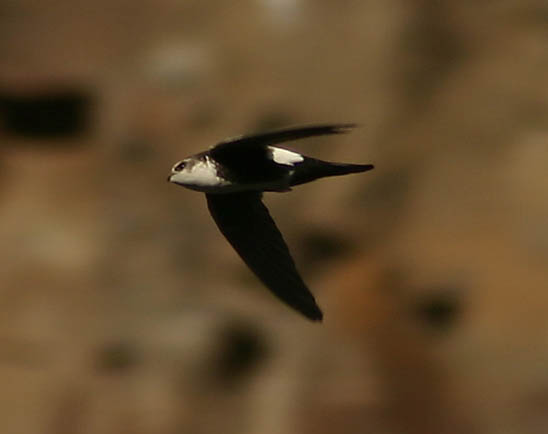
The White-throated Swift is one of the fastest, most acrobatic birds in western North America, a streamlined black-and-white missile that lives its waking life almost entirely on the wing. Look for it knifing along sheer cliff faces, canyon walls, and rocky bluffs from the Pacific coast to the Rocky Mountains, often in noisy, fast-moving flocks that wheel and swoop with breathtaking speed. Where other swifts can look like flying cigars, this species shows a bold pattern of dark above and a clean white throat and belly that flashes as it banks against the rock.
For many birders, the White-throated Swift is a signature bird of the desert Southwest and the mountain West, inseparable from dramatic scenery like the rims of canyons and the walls of dams and bridges that it has happily adopted as artificial cliffs. It is a bird of the sky rather than the perch, and learning to identify it is mostly about reading shape, flight, and that ringing, descending call that echoes off stone long before you find the bird itself.
This is a medium-sized swift built for speed: a slim, torpedo-shaped body, a relatively long and slightly forked tail, and long, stiff, scythe-shaped wings that taper to sharp points. In flight it looks all wings, beating in rapid bursts and then sailing on bowed, swept-back wings. The key is the strong contrast between a dark upperside and a pattern of white below.
| Overall pattern | Blackish to dark brown above; bold white throat that extends down the center of the breast and belly in a long white stripe, with dark flanks |
| Flanks & rump | White patches on the sides of the rump and along the flanks that flash conspicuously as the bird banks |
| Wings | Long, narrow, sharply pointed and swept back; very fast, stiff wingbeats alternating with glides |
| Tail | Long for a swift and noticeably forked, often held closed to a point but fanned when maneuvering |
| Size & shape | Slim and torpedo-shaped; larger and longer-tailed than a Vaux's Swift, with obvious black-and-white contrast |
| Behavior | Lives on the wing near cliffs and canyons; rarely seen perched except clinging to vertical rock |
Male vs. female
Males and females look alike in the field. There is no visible difference in plumage, size, or pattern between the sexes, so you cannot reliably tell a male from a female by sight. In the hand, breeding birds can sometimes be sexed by a brood patch or cloacal differences, but for ordinary field observation both sexes appear identical.
Juveniles
Juveniles closely resemble adults but tend to look slightly duller and browner, with pale edges to the body and wing feathers giving a faintly scaled or fresh-edged appearance up close. The white throat and underparts may be a touch less crisp than on a clean adult. In flight, young birds are essentially impossible to separate from adults; the same shape, contrast, and flight style apply.
The White-throated Swift does not sing in the musical sense, but its call is one of the most distinctive sounds of western cliffs. It gives a loud, harsh, descending series often written as a shrill jee-jee-jee-jee-jee-jee that tumbles downward and runs together into a chattering, laughing rattle. The sound carries far and bounces off rock walls, so you often hear the flock before you spot it.
Birds call frequently in flight, especially in fast-moving groups and during their spectacular aerial chases and courtship tumbles. The overall effect is a high, scratchy, excited cackle that, once learned, instantly flags swifts overhead even when they are too high or too fast to identify by shape alone.
The White-throated Swift is a bird of western North America, breeding from southern British Columbia and the northwestern United States south through the mountains and deserts of the West to the southwestern states, and on into Mexico and Central America. Its strongholds are the canyon country, mountain ranges, and cliff-lined river systems of the interior West and the Pacific states, wherever there are tall vertical rock faces or large structures for nesting.
Across the colder, northern part of its range it is migratory, arriving in spring and leaving in fall to winter farther south. In the warmer Southwest and along parts of the California coast, some birds linger year-round, and flocks may temporarily go quiet or move to lower, warmer areas during cold snaps. Outside the West it is a rare stray, so a White-throated Swift well to the east is a notable find.
Like all swifts, this species is an aerial insectivore that catches everything it eats on the wing. Its diet is made up of flying insects and ballooning spiders snapped up in midair, including flies, beetles, true bugs, flying ants, bees and wasps, and other small invertebrates swept from the column of drifting insects known as aerial plankton. The bird flies with its mouth open, funneling prey into its wide gape as it cruises.
White-throated Swifts forage at high speed over canyons, ridgelines, and open country, often gaining altitude on warm afternoons to chase insects carried aloft on rising air. They frequently feed in mixed flocks with swallows, and because they pluck pests straight from the air, they are quietly beneficial to the landscapes they patrol.
White-throated Swifts nest in colonies tucked into deep, narrow crevices in cliffs, canyon walls, and rock outcrops, and they readily use the artificial equivalents: the expansion joints and crannies of highway bridges, overpasses, dams, and tall buildings. The nest is a shallow, cup-shaped structure of feathers and plant material that the birds gather in flight, glued together and cemented to the rock with their sticky saliva, hidden well back in a sheltered fissure.
The female typically lays a small clutch of white eggs, and both parents share incubation and feeding duties. The young are fed compacted balls of insects and remain in the crevice for a relatively long nestling period before launching directly into a life on the wing. Because nests are deep in inaccessible cracks, the breeding biology is harder to observe than in many backyard birds, and pairs often return to traditional colony sites year after year.
The White-throated Swift is not a backyard or feeder bird, and there is no food or feeder that will draw one in. It eats only flying insects, never visits seed or suet, and nests in cliff crevices rather than boxes or yards. Instead of attracting it, the goal is to go where it lives and learn to recognize it overhead.
- Visit the right habitat: cliffs, canyons, rocky bluffs, and large bridges or dams in the western U.S. are where this swift is reliably found.
- Scan the sky near vertical rock faces, especially on warm afternoons when swifts climb high to chase rising insects.
- Learn the descending, laughing call so you can pick the flock out by ear before you ever see the birds.
- Bring binoculars and watch for the black-and-white contrast and white flank patches as birds bank against the rock.
- Birding overlooks at canyon rims, river gorges, and tall highway bridges offer the best chances to study them at eye level or below.
- If you manage cliffside structures, leaving crevices and expansion joints intact helps preserve the nesting sites these colonies depend on.
- Vaux's Swift: Smaller and more uniformly dusky with no bold black-and-white pattern; shorter, more rounded tail and a fluttery, cigar-shaped look.
- Chimney Swift: An eastern bird overall; uniform sooty-gray with no white underparts, smaller, and lacks the long forked tail and cliff habitat.
- Black Swift: Larger and entirely blackish with no white below; slower, more soaring flight, often near waterfalls.
- Violet-green Swallow: A swallow, not a swift, with broader wings, slower wingbeats, green-and-violet sheen, and clean white that wraps onto the sides of the rump.
How do you tell a White-throated Swift from a swallow?
Swifts have stiffer, faster, more flickering wingbeats and longer, narrower, sharply pointed wings that look swept back. Swallows flap more slowly with broader wings and glide more gracefully. The White-throated Swift's bold black body with a long white throat-to-belly stripe and white flank patches is also distinctive; the similar Violet-green Swallow shows green-and-violet tones and white that wraps up the sides of the rump.
Where is the best place to see a White-throated Swift?
Head to cliffs, canyons, rocky bluffs, and large bridges or dams in the western United States. Canyon-rim overlooks, river gorges, and tall highway bridges are classic spots, since the birds nest and forage along vertical rock faces and their artificial equivalents.
What sound does a White-throated Swift make?
It gives a loud, harsh, descending chatter often written as a shrill jee-jee-jee-jee that tumbles downward into a laughing rattle. The call carries far and echoes off rock, so you frequently hear a flock before you see it.
Do White-throated Swifts ever land or perch?
They almost never perch on branches or wires like other birds. Their tiny legs are built for clinging to vertical surfaces, so when they do rest it is by clinging to rock crevices or their nest sites. They spend nearly all their active hours flying, even drinking and bathing on the wing.
Will a White-throated Swift come to my yard or feeder?
No. It eats only flying insects caught in midair and never visits seed, suet, or nectar feeders. It nests in cliff and bridge crevices rather than yards or nest boxes, so the way to enjoy it is to seek it out in cliff and canyon habitat rather than attract it home.