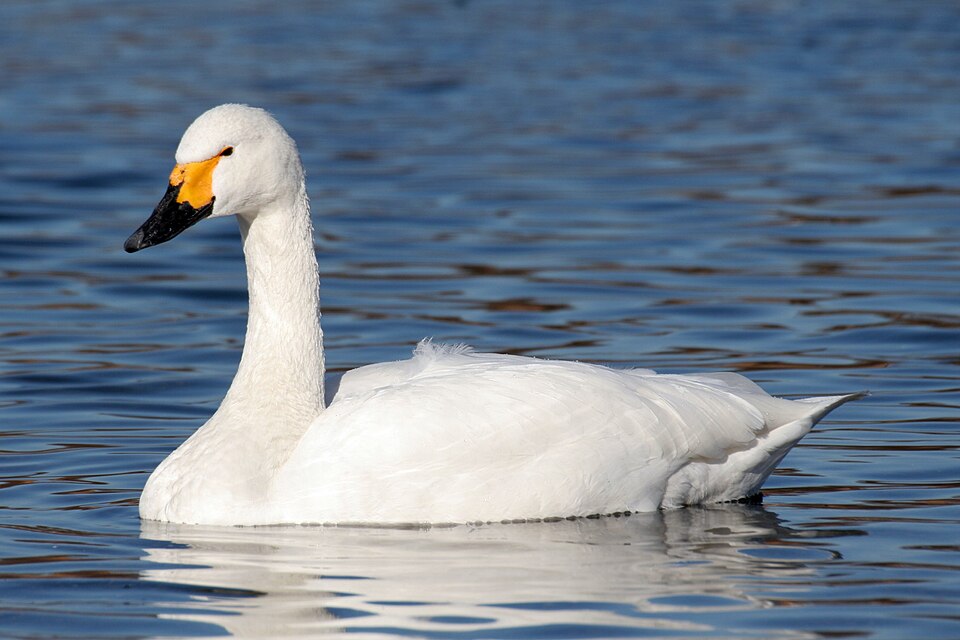
The Tundra Swan is the most widespread and numerous swan in North America, a true Arctic bird that nests on the open tundra above the tree line and then funnels south each fall in long, talkative skeins to spend winter on shallow lakes, estuaries, and flooded fields. For most birders south of Canada, it is a cold-weather spectacle: hundreds or even thousands of brilliant white birds resting on gray water, filling the air with a soft, almost musical clamor that sounds more like distant baying hounds than honking geese.
Once widely called the Whistling Swan in North America (a name that still lingers), it belongs to the same species as the Old World's Bewick's Swan. It is smaller and shorter-necked than the imposing Trumpeter Swan it shares parts of its range with, and far wilder and less familiar than the introduced Mute Swan of park ponds. Telling these three apart is one of the classic identification puzzles of North American winter birding, and the Tundra Swan rewards anyone willing to look closely at its bill.
A huge, all-white waterbird with a long, straight neck held vertically and a wedge-shaped black bill. In flight it shows a long neck fully extended, slow deep wingbeats, and surprisingly pointed wings for such a big bird. Size and the shape of the bill and face are the keys to separating it from other swans.
| Plumage | Entirely white at all ages once adult; head and neck can be stained rusty-orange from iron-rich feeding waters. |
| Bill | Black, with a straight-to-slightly-concave culmen; most adults show a small yellow teardrop spot in front of the eye, though some have none. |
| Face shape | Black skin meets the eye in a way that makes the eye stand out as a distinct dot; the border where bill meets face is rounded, not sharply pointed. |
| Size | Large but noticeably smaller and shorter-necked than a Trumpeter Swan; about the size of a small Trumpeter or large goose-plus. |
| Legs and feet | Black. |
| In flight | Neck extended, slow wingbeats, flocks in long lines and shifting V formations; wings appear pointed. |
Male vs. female
Males (cobs) and females (pens) look essentially identical in plumage, both pure white with black bills and legs. The male averages slightly larger and heavier with a marginally thicker neck, but the overlap is so great that you cannot reliably sex a lone bird in the field. The best clue is behavior within a pair or family group: the male tends to be the more aggressive partner, leading defense displays and posturing toward intruders, while the pair stays closely bonded year after year.
Juveniles
First-winter Tundra Swans are easy to pick out from the adults they travel with. Instead of pure white, juveniles are a dingy pale gray-brown, palest on the underparts and dirtiest across the head and upper neck. Their bills start out pinkish to dull flesh-colored with a dark tip, gradually darkening toward black through the first winter and spring. By late spring and summer most of the gray feathering has molted away to white, though some immatures keep scattered grayish feathers into their second year. Seeing gray youngsters tucked among the white adults is a good sign you are looking at family groups that nested together that summer.
The flight call is a high, soft, quavering whoop or bugle, often rendered as woo-woo-woo or wow-wow-wow, with a mellow, almost yodeling quality. A flock on the move produces a continuous, rolling clamor that many describe as sounding like a distant pack of baying hounds or far-off voices, gentler and more musical than the harsh honking of Canada Geese.
On the water, resting flocks keep up a constant low murmur of conversational notes. The old name Whistling Swan comes not from the voice but reportedly from the whistling sound the wings make in flight, though the calls themselves are the most memorable sound. Compared with the Trumpeter Swan's deep, brassy, single-note oh-OH that recalls a old car horn or French horn, the Tundra's voice is higher pitched, more broken up, and noticeably less resonant.
Tundra Swans nest across the high Arctic of North America, from western and northern Alaska east along the Canadian coast to the Hudson Bay region and the eastern Arctic. The continent's birds split into two largely separate populations. The Western Population winters mainly in California's Central Valley and the Pacific Northwest, while the Eastern Population makes a long cross-continental flight to winter along the mid-Atlantic coast, especially Chesapeake Bay and the Carolinas, with major staging stops at places like the Great Lakes and the marshes of the upper Midwest.
Migration is one of the great wildlife events of the season. Flocks move in spring and fall in long V-formations and undulating lines, often very high and calling steadily, covering huge distances between Arctic breeding grounds and temperate wintering waters. Spectacular concentrations gather at traditional staging areas in late fall and early spring, where thousands may rest and feed together before pressing on.
Tundra Swans are vegetarians for most of the year, feeding on the leaves, stems, roots, and tubers of aquatic plants. On shallow water they feed much like dabbling ducks, tipping forward with tail up to reach submerged vegetation, and they use their long necks and big feet to dig and uproot tubers from soft pond bottoms. On the breeding grounds and during migration they also take some aquatic invertebrates, which are especially important for fast-growing cygnets.
In recent decades wintering swans have shifted heavily to agricultural fields, where they graze on waste grain, corn, soybeans, and the green shoots of winter wheat and pasture. This switch to farmland foraging has helped the population thrive but sometimes brings them into conflict with growers. Family groups and flocks feed together, often alongside geese, and rest on open water at night for safety.
Tundra Swans nest on the open Arctic tundra, usually near water on a slightly raised hummock, island, or ridge with a good view of approaching predators. Both members of the pair build a large mound nest of moss, grasses, sedges, and other plant material, often reusing and adding to the same site in successive years. Pairs are monogamous and form long-lasting bonds, and they defend a large territory aggressively against other swans.
The pen lays a clutch of usually three to five creamy-white eggs and does most of the incubation over roughly a month while the cob stands guard nearby. The cygnets hatch covered in gray down and leave the nest within a day or two, swimming and feeding themselves under close parental watch. They fledge before the brief Arctic summer ends, and the family stays together through the southbound migration and the entire first winter, which is why you so often see gray youngsters among the white adults on wintering grounds.
The Tundra Swan is not a backyard or feeder bird, and there is no realistic way to draw one to a typical yard. It is a wild, wary species of large open wetlands and farm fields, and it needs space and water rather than seed. The good news is that it is one of the easier large waterbirds to go and see if you live within its range.
- Visit large national wildlife refuges and wetland reserves in late fall through early spring, when wintering flocks concentrate on shallow lakes and impoundments.
- Check flooded agricultural fields, especially corn and winter-wheat country, near major rivers and bays where swans graze by day.
- Look and listen during migration: high, V-shaped flocks giving soft yodeling calls overhead are often Tundra Swans on the move.
- If you keep a large pond on rural acreage, leaving shallow margins and aquatic vegetation undisturbed can occasionally attract resting migrants, though they will not stay like resident waterfowl.
- Bring a spotting scope. Swans rest far out on open water, and a scope lets you study bill color and the yellow eye-spot to confirm the identification.
- Never feed bread or handouts to wild swans; it harms their health and habituates them to people.
- Trumpeter Swan: Larger and longer-necked with an all-black bill that lacks the yellow eye-spot; the black on the face forms a broad, V-shaped wedge meeting the eye, and its voice is a deep, brassy, single-note bugle rather than a soft yodel.
- Mute Swan: An introduced park-pond bird with an orange bill, a prominent black knob at the base, and a habit of holding its neck in a graceful S-curve with wings arched over the back; it is largely silent.
- Snow Goose: Much smaller with a far shorter neck and a pink bill showing a black grin patch; white-morph birds have black wingtips visible in flight, which swans never show.
How can I tell a Tundra Swan from a Trumpeter Swan?
Look at the bill and face. Most Tundra Swans show a small yellow teardrop spot in front of the eye and have a rounded border where the black bill meets the face, leaving the eye looking like a separate dot. Trumpeter Swans have an all-black bill, a broader black wedge that runs straight into the eye, a larger overall size, and a deep, brassy, single-note call versus the Tundra's higher, softer yodel.
Why is the Tundra Swan also called the Whistling Swan?
Whistling Swan is the old North American name for this species, said to come from the whistling sound its wings make in flight. The two names refer to the same bird, Cygnus columbianus. The Old World form is known as Bewick's Swan.
When and where can I see Tundra Swans?
They are winter and migration birds across most of the United States. Look for them from late fall through early spring on large shallow lakes, coastal estuaries like Chesapeake Bay, and flooded farm fields, especially in California's Central Valley, the Pacific Northwest, the Great Lakes region, and the mid-Atlantic coast.
What do Tundra Swans eat?
They are mostly vegetarian, eating the leaves, stems, roots, and tubers of aquatic plants and increasingly grazing waste grain and green shoots in farm fields during winter. Growing cygnets also eat aquatic invertebrates for protein.
Why do some Tundra Swans have rusty-orange heads?
The stain comes from feeding in water and mud rich in iron compounds, which discolor the feathers of the head and neck. It is not a sign of a different species, age, or sex; the underlying plumage is still pure white.