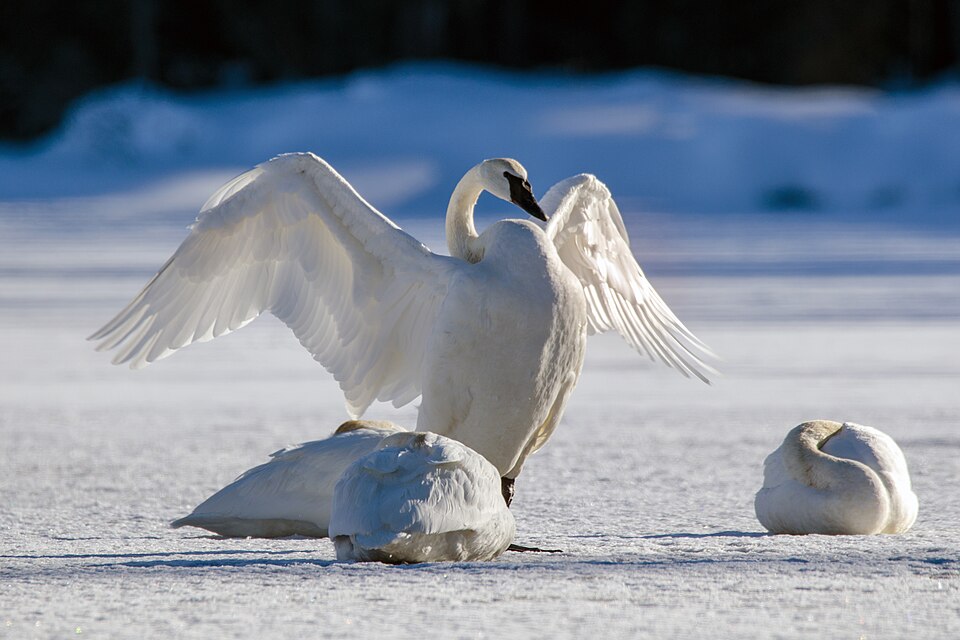
The Trumpeter Swan is the heaviest flying bird native to North America and one of its great conservation comeback stories. A big male can tip the scales at well over 25 pounds and stretch nearly six feet from bill to tail, with a wingspan wide enough to make a Bald Eagle look modest. All-white as an adult, with a long, straight neck held more rigidly than its smaller cousins, it has a presence on the water that is hard to mistake once you know what you are looking at.
A century ago this swan was nearly wiped out by hunting for its skins, feathers, and meat, with only a few dozen birds thought to survive in the Lower 48 outside Alaska. Careful protection, reintroduction programs, and the discovery of a healthy Alaskan population pulled it back. Today Trumpeters breed across Alaska, much of western and central Canada, and a scattering of recovering populations in the upper Midwest and Mountain West. Seeing one means watching a species that almost vanished, now reclaiming wetlands across the continent.
This is an enormous, pure-white swan with a very long neck and a heavy, wedge-shaped black bill. On the water it sits high and bulky; in flight the neck is fully extended and the wingbeats are slow and powerful. Size alone narrows it down, but the key to confirming a Trumpeter is almost always the bill and the shape of the face.
| Overall | Massive all-white swan, the largest native waterfowl in North America; long, often straight or kinked neck |
| Bill | Entirely black, large and wedge-shaped, blending smoothly into the forehead in a straight line |
| Eye | The black of the bill surrounds and connects to the eye, so the eye seems lost in the dark face |
| Bill base | Often a thin salmon-red line along the edge where the bill meets the lower mandible (the "grin patch") |
| Legs/feet | Black; held trailing in flight |
| Voice | Deep, resonant, brassy honk unlike the higher whistles of other swans |
Male vs. female
Males (cobs) and females (pens) look alike in plumage, both clean white with the same black bill and face. The main difference is size: cobs average noticeably larger and heavier, with thicker necks, though this is only obvious when a pair stands together. There is no seasonal or breeding plumage change. Behavior offers a clue during nesting season, when the more aggressive partner driving off intruders is usually the male.
Juveniles
Young Trumpeters, called cygnets, are a soft sooty gray-brown through their first fall and winter, gradually whitening over the following year and not becoming fully white until well into their second year. The bill of a juvenile is pinkish to dull gray with a black tip, darkening to all black as the bird matures. A gray immature swimming with white adults in late winter is a classic sight on wintering wetlands.
The Trumpeter is named for its voice, and it lives up to it. The call is a deep, loud, brassy honk, often rendered as oh-OH or ko-hoh, with a quality that genuinely recalls a French horn or an old car horn. It is lower-pitched and more resonant than the bugling of a Tundra Swan, carrying a long way across open water and marsh.
Pairs and families are vocal, especially in flight and during the loud, head-bobbing greeting displays that mates perform when reuniting. You may also hear softer conversational grunts and bleats among family groups, and an angry trumpeting blast when a swan is defending territory.
Trumpeter Swans breed across Alaska, the Yukon, much of western and central Canada, and in recovering populations through the upper Midwest (Minnesota, Wisconsin, Michigan, Iowa) and parts of the Mountain West and Pacific Northwest. They favor shallow freshwater lakes, marshes, beaver ponds, and slow rivers with abundant aquatic vegetation.
In winter, northern breeders move south and to the coast in search of open, ice-free water, gathering on rivers, reservoirs, and coastal estuaries. Birds in milder regions, including parts of the Greater Yellowstone area and the Pacific Northwest, may stay year-round wherever water remains unfrozen. Reintroduced flocks in the Midwest are increasingly resident or only short-distance migrants.
Trumpeter Swans are mainly vegetarian, feeding on the leaves, stems, roots, and tubers of aquatic plants such as pondweeds, sedges, water milfoil, and wild celery. They feed by dabbling at the surface and by tipping forward, tail-up, to reach plants on the bottom, and their long necks let them graze deeper water than most ducks can reach. They will also paddle and tread the bottom to stir loose roots and tubers.
In fall and winter, especially in the Midwest, they increasingly graze on land, feeding in harvested grain fields and on waste corn, and in some areas pulling up roots in shallow flooded fields. Cygnets eat large amounts of aquatic insects and other invertebrates early in life for the protein they need to grow quickly before their first winter.
Trumpeter Swans form long-term pair bonds, often mating for life, and defend a sizable territory on a marsh or pond. The pair builds a large mound nest of grasses, sedges, and other vegetation, frequently atop a muskrat or beaver lodge, an old dam, or a small island where it is protected by surrounding water. The same nest site may be reused and rebuilt year after year.
The female lays a clutch of roughly four to six creamy or dull-white eggs and does most of the incubation over about five weeks, while the male stands guard nearby and aggressively drives off intruders. There is one brood per year. The downy cygnets leave the nest within a day or two and follow their parents, who stay with them through their first fall and winter and lead them on migration, an unusually long period of family care among birds.
The Trumpeter Swan is not a backyard or feeder bird, and you should not try to feed one. It needs large, undisturbed wetlands and natural aquatic vegetation, so the way to "attract" it is to protect and visit good habitat rather than to lure it to a yard.
- Visit large shallow wetlands, marshes, beaver ponds, and slow rivers, especially in the Upper Midwest, Mountain West, and Pacific Northwest, to find them.
- In winter, look on rivers, reservoirs, and estuaries that stay ice-free, where swans gather to feed and rest.
- If you own wetland or pond property, protect aquatic plants and shoreline vegetation and minimize disturbance during the nesting season.
- Support local wetland conservation and reintroduction programs, which are the real reason this swan is recovering.
- Do not feed bread or corn to wild swans; handouts cause crowding, poor nutrition, and habituation, and can keep birds on dangerous frozen-over water.
- Bring a spotting scope or good binoculars and keep your distance; nesting and wintering swans are easily stressed by people approaching too closely.
- Tundra Swan: Smaller with a rounder head and shorter neck; most show a yellow teardrop spot in front of the eye, and the call is a higher, softer bugle rather than a deep honk.
- Mute Swan: Introduced; has an orange bill with a black knob at the base, often holds its neck in a graceful S-curve, and is largely silent.
- Snow Goose: Far smaller with a much shorter neck, a pink bill with a dark "grin patch," and obvious black wingtips visible in flight.
What is the difference between a Trumpeter Swan and a Tundra Swan?
Trumpeters are larger with a longer, often straight neck and an all-black bill that meets the forehead in a straight line and surrounds the eye. Most Tundra Swans show a small yellow spot in front of the eye and have a rounder head, shorter neck, and a higher, more whistling call. Voice is the most reliable field mark: the Trumpeter gives a deep, brassy honk.
How big is a Trumpeter Swan?
It is the largest native waterfowl in North America, measuring roughly 54 to 62 inches long with a wingspan of about 7 to 8 feet. Large males can weigh well over 25 pounds, making the Trumpeter one of the heaviest flying birds in the world.
Are Trumpeter Swans endangered?
Not anymore. They were nearly wiped out by the early 1900s, but protection, reintroduction, and the discovery of a healthy Alaskan population brought them back. They are now listed as Least Concern and are locally common and increasing, though they still depend on protected wetlands.
What do Trumpeter Swans eat?
Mostly aquatic plants, including the leaves, stems, roots, and tubers of pondweeds, sedges, and similar vegetation, reached by dabbling and tipping up. In fall and winter, especially in the Midwest, they also graze in harvested grain fields. Cygnets eat insects and other invertebrates for protein while growing.
Why is it called a Trumpeter Swan?
For its loud, deep, brassy call, which sounds like a trumpet or French horn. The resonant honk is lower and louder than the bugling of the smaller Tundra Swan and carries far across open water and marshland.