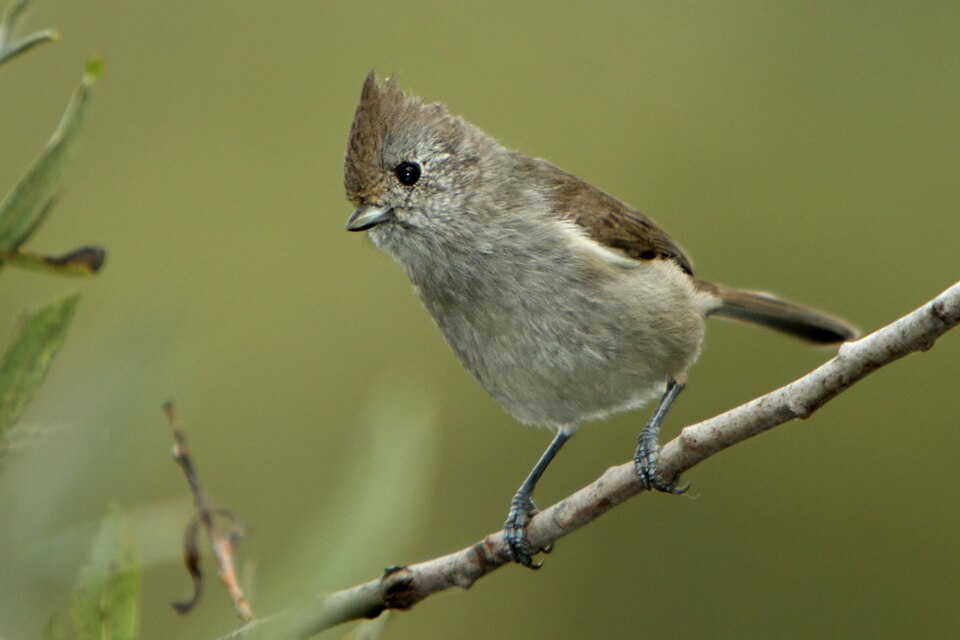
The Oak Titmouse is one of the plainest birds in North America, and that is exactly what makes it charming. There are no flashy colors here, no bold patterns to puzzle over, just a small, drab gray songbird with a jaunty pointed crest and big dark eyes. What it lacks in plumage it more than makes up for in personality. Acrobatic, vocal, and endlessly curious, this little bird is a permanent fixture of the oak woodlands that give it its name, from southern Oregon down through California's foothills and into Baja.
For birders, the Oak Titmouse is a textbook example of how voice and habitat can identify a bird that field marks barely can. Where you find dry oak and oak-pine woodland in the West, you find these birds working the canopy in noisy little family groups, hanging upside down from twigs, and scolding anything that wanders too close to their nest. Once familiar, its loud, whistled song becomes one of the defining sounds of the California foothills.
This is a small, compact songbird with a short bill, a noticeably crested head, and a long-ish tail it often holds cocked. The crest is the giveaway: when raised it gives the bird a perky, tufted profile unlike any sparrow or wren. There is essentially no color to work with, so focus on shape, the crest, and the overall uniform gray-brown wash.
| Overall color | Uniform plain gray-brown above and slightly paler grayish below, with no streaks, bars, or wing markings |
| Crest | Distinct pointed crest, raised when alert or agitated and lowered when relaxed |
| Face | Plain face with large dark eyes that stand out against the bland gray, no mask or eyeline |
| Bill | Short, stout, dark conical bill suited to seeds and insects |
| Size and shape | Sparrow-sized but rounder and chunkier, with a relatively long tail often held cocked |
| Legs | Dark gray legs and feet, strong for clinging and hanging acrobatically |
Male vs. female
Males and females look identical in the field. The sexes share the same plain gray plumage, crest, and dark-eyed face, so you cannot reliably tell them apart by sight. Behavior offers only loose hints: males do most of the singing, especially in late winter and spring, while the female does the incubating. If you watch a pair at a nest cavity, the bird sitting inside is almost certainly the female, but plumage alone will never separate them.
Juveniles
Juvenile Oak Titmice look much like adults, which is fitting for such a plain bird. Freshly fledged young are a slightly softer, fluffier gray with a shorter, less developed crest and a paler, sometimes yellowish gape at the corners of the bill. They beg loudly and follow adults closely through the canopy in summer. Within a few months they are essentially indistinguishable from their parents.
The Oak Titmouse is far easier to hear than to see. The male's song is a loud, ringing, repeated series often written as peter-peter-peter or a scratchy tweedle-tweedle-tweedle, with a slightly burry, whistled quality. Songs are highly variable, and individual birds may have several different versions in their repertoire, so do not expect every singer to sound the same.
Calls are equally distinctive once learned. The most common is a fast, scolding, raspy tsicka-dee-dee or dry chick-a-dee-like scold, harsher and more grating than a true chickadee. Agitated birds give a rapid, churring rattle. This scolding, fussy chatter often reveals the bird's presence long before you spot the gray shape moving through the oaks.
The Oak Titmouse is a West Coast specialty with a fairly narrow range. It is found from southwestern Oregon south through almost all of California west of the deserts and Sierra crest, and into the northern Baja California peninsula in Mexico. It is closely tied to oak and oak-pine woodlands, foothill canyons, and shaded streamside groves, and it readily uses suburban neighborhoods and parks that retain mature oaks.
This is a non-migratory, year-round resident. Pairs hold territories and stay in the same general area their whole lives, with only minor local wandering by young birds after the breeding season. Where its range meets that of the very similar Juniper Titmouse to the east, the two largely separate by habitat, with Oak Titmouse keeping to oak country and Juniper Titmouse to pinyon-juniper.
Oak Titmice are omnivores with a strong seasonal split. In the warmer months they eat mostly insects and spiders, gleaning caterpillars, beetles, leafhoppers, and other small invertebrates from bark, twigs, and foliage. They are nimble foragers, hanging upside down and probing crevices, and they will hammer open tough items by holding them against a branch with their feet, much like a chickadee or nuthatch.
In fall and winter the diet shifts toward plant food, especially acorns, along with other seeds and berries. Like many woodland birds, they cache food, tucking seeds into bark crevices to retrieve later. At feeders they readily take sunflower seeds, peanut bits, and suet, often grabbing a single seed and flying off to a perch to open it rather than lingering at the feeder.
Oak Titmice are cavity nesters. They use natural tree holes, old woodpecker holes, and readily accept nest boxes. The female does most of the nest building, lining the cavity with grass, moss, fur, feathers, and other soft material to form a cup. Pairs are monogamous and typically stay together year-round, defending the same territory across seasons.
A clutch is usually around 6 to 8 eggs, white and sometimes lightly spotted. The female alone incubates for roughly two weeks while the male brings her food, and both parents feed the nestlings once they hatch. Young leave the nest about two and a half weeks after hatching and stay with the adults for several weeks afterward. Most pairs raise a single brood per year.
Yes, within its range the Oak Titmouse is a reliable and welcome backyard bird, especially if you live near or among oaks. It is bold and inquisitive, often among the first birds to investigate a new feeder, and it readily uses nest boxes, making it one of the more rewarding small natives to attract.
- Offer black-oil sunflower seeds, hulled sunflower chips, and peanut pieces, which titmice will grab and carry off to open on a perch.
- Hang a suet feeder, especially in cooler months, to draw them in alongside chickadees, nuthatches, and woodpeckers.
- Put up a small nest box with a roughly 1.25 inch entrance hole mounted in or near oaks; they will use it for both nesting and winter roosting.
- Keep mature oaks and native shrubs on your property, since acorns and the insects oaks support are the backbone of this bird's diet.
- Provide a shallow birdbath or moving water source, which titmice use eagerly for drinking and bathing.
- Skip pesticides so the caterpillars and other insects that adults feed to nestlings remain available.
- Juniper Titmouse: Nearly identical but grayer and paler; separated mainly by range and habitat (pinyon-juniper rather than oak) and by a faster, more rolling song. The two were once lumped as the Plain Titmouse.
- Tufted Titmouse: An eastern bird that does not overlap in range; larger, with clean gray upperparts, rusty flanks, and a black forehead patch the plain Oak Titmouse lacks.
- Bridled Titmouse: A Southwestern species with a bold black-and-white facial pattern and outlined crest, far more strikingly marked than the featureless Oak Titmouse.
- Bushtit: Tiny, drab, and crestless, traveling in large flocks; much smaller and rounder with a stubby bill and no crest, unlike the perky crested titmouse.
How do I tell an Oak Titmouse from a Juniper Titmouse?
They look almost the same, so use range and habitat first. Oak Titmice live in oak and oak-pine woodlands along the West Coast, while Juniper Titmice live in pinyon-juniper country farther inland and east. Where you cannot use location, the Juniper Titmouse is a touch grayer and paler with a faster, rolling song, but habitat is your most reliable clue.
Why is the Oak Titmouse so plain looking?
It simply lacks the bold markings of many relatives, with uniform gray-brown plumage and no streaks, bars, or facial pattern. Its plainness is actually a useful field mark: a small, crested, dark-eyed gray bird with no other markings, in West Coast oak woodland, is almost certainly an Oak Titmouse.
Will Oak Titmice come to backyard feeders?
Yes, readily. They favor black-oil sunflower seeds, peanut pieces, and suet, and they tend to grab one seed at a time and carry it off to a perch to open. They are bold and curious, often among the first birds to check out a new feeder if you live near oaks.
Do Oak Titmice use nest boxes?
They do. As cavity nesters they accept small nest boxes with an entrance hole around 1.25 inches, placed in or near oaks. They will also roost in boxes during cold weather, so leaving a box up year-round benefits them in both seasons.
Where can I find an Oak Titmouse?
Look in oak and oak-pine woodlands, foothill canyons, and oak-shaded suburbs from southwestern Oregon through California and into northern Baja California. They are year-round residents, so they can be found in suitable habitat in any season, and their loud whistled song often reveals them first.