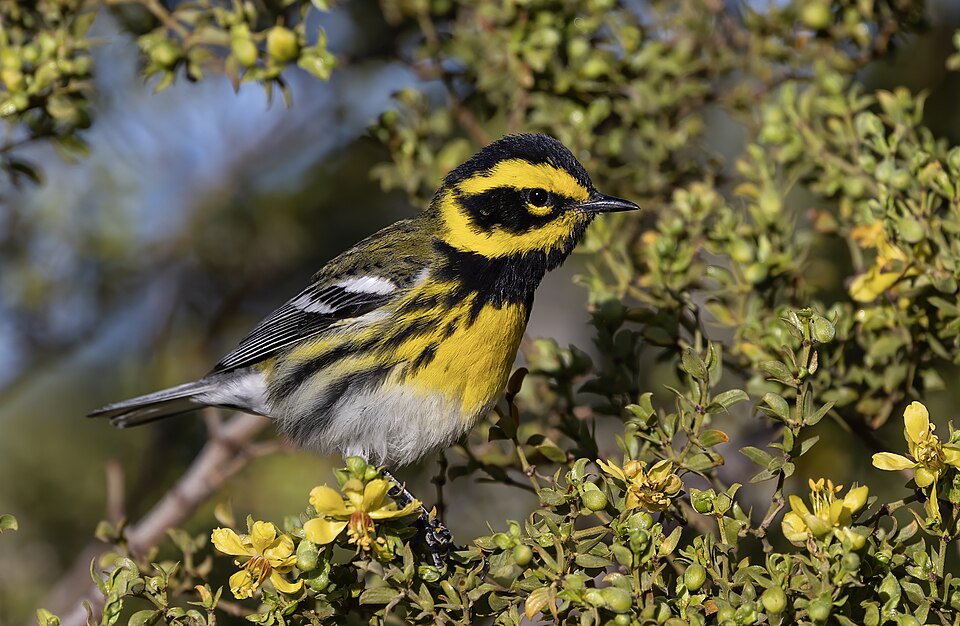
Townsend's Warbler is one of the great prizes of birding in the tall conifer forests of the Pacific Northwest and the mountain West. Small, round-headed, and patterned in striking yellow, black, and olive-green, it spends most of its breeding life high in the canopy of Douglas-fir, hemlock, and spruce, where it can be maddeningly hard to see despite its bold colors. Birders often locate it first by ear, then crane their necks to find the bright yellow face flashing among the dark needles.
Named for the 19th-century naturalist John Kirk Townsend, this warbler is a member of the wood-warbler family and a close relative of the Black-throated Green and Hermit Warblers. It is a long-distance migrant, abandoning its northern breeding forests each fall to winter in the pine-oak highlands of Mexico and Central America, with a smaller group lingering along the milder Pacific coast. For backyard birders in the West, it is most likely to appear as a brief, exciting visitor during spring and fall migration.
This is a compact, active warbler with a fairly stout body, a short tail, and a thin pointed bill. The single most useful field mark is the face pattern: bright yellow cheeks framed by a bold dark mask through the eye and a dark crown, giving the bird a distinctive "goggled" or masked look unlike almost any other North American warbler.
| Face | Bright yellow cheeks enclosing a dark olive-black ear patch, with a dark crown and a yellow eyebrow stripe, the signature masked look |
| Throat & breast | Black throat and upper breast on males; yellow breast streaked with black along the sides |
| Upperparts | Olive-green back streaked with black; two bold white wing bars |
| Underparts | Yellow chest fading to white belly and undertail |
| Tail | Dark with large white patches in the outer tail feathers, flashed in flight |
| Size & shape | Small and chunky for a warbler, round-headed, short-tailed, thin bill |
Male vs. female
The sexes look similar but differ in boldness. Breeding males are the most striking, with a solid jet-black throat and upper breast, a fully dark crown and ear patch, and crisp black streaking. Females are softer: the throat is yellow or only mottled with dusky black rather than solid, the crown and face mask are duller olive rather than black, and the overall contrast is more muted. A female can look like a faded, washed-out version of the male, but the basic yellow-cheek-and-dark-mask pattern still shows clearly.
Juveniles
Juveniles and first-fall immatures are duller still, with grayish-olive faces, yellow throats, and only faint or absent black on the breast and crown. Young females in particular can be quite plain, but they keep the yellow eyebrow, the dark cheek patch surrounded by yellow, and the two white wing bars, which together remain diagnostic. By spring, young males begin showing the bolder black markings of adults.
The song is a high, buzzy, slightly wheezy series often written as weazy-weazy-weazy-twea or dzeer dzeer dzeer dzee, rising or accelerating toward the end. It has the lazy, hissing quality typical of its group and closely recalls the songs of the Black-throated Green and Hermit Warblers, which can make ear identification tricky where ranges overlap.
The most common call is a sharp, flat tup or tик chip note, given as the bird forages. In flight and migration you may also hear a thin, high seet. Because these birds feed so high in the canopy, learning the buzzy song is often the most reliable way to detect them.
Townsend's Warbler breeds in the cool, moist coniferous forests of the Pacific Northwest and the northern Rockies, from southern Alaska and the Yukon south through coastal British Columbia, Washington, Oregon, Idaho, and western Montana, favoring mature and old-growth stands of fir, hemlock, and spruce.
It is a true migrant. Most birds head south in fall to winter in the pine-oak and cloud-forest highlands of Mexico and Central America, as far as Costa Rica and Panama. A separate, smaller wintering population stays along the milder Pacific coast from northern California to southern Washington, where mild winters and coastal conifers let it survive. During spring and fall migration it passes widely through the western United States, turning up in lowland woods, parks, and yards far from its breeding haunts.
Townsend's Warbler is primarily an insect eater. In the breeding season it gleans caterpillars, beetles, true bugs, leafhoppers, aphids, and spiders from the needles and outer branches of conifers, often working methodically through the high canopy. It hovers to pick prey from foliage and occasionally sallies out to snatch flying insects.
On its wintering grounds it has a notable trick: it feeds heavily on the sugary "honeydew" excreted by scale insects in oak forests, a rich energy source that helps fuel the cold season. Wintering and migrant birds will also take small berries and, occasionally, suet or other offerings at feeders.
Nesting takes place high in conifers, frequently 20 to 50 feet or more above the ground, well out on a horizontal limb against the trunk or among dense foliage where the nest is hidden from view. The female builds a compact open cup of grasses, plant fibers, bark strips, and moss, lined with finer material such as hair and feathers.
She typically lays four to five eggs, white speckled with brown, and does the incubating for roughly twelve days. Both parents feed the nestlings, which leave the nest after a week and a half or so. Pairs generally raise a single brood per season, fitting the short, cool summers of their northern range.
Townsend's Warbler is mainly a canopy-dwelling insect eater, not a typical feeder bird, so you can't really lure it the way you would a chickadee. That said, Western birders do see it in yards, especially during migration and in winter along the Pacific coast, and a few habits make a visit more likely.
- Plant or keep conifers and mature native trees, firs, hemlocks, and pines provide the insect-rich foliage these warblers hunt in.
- Offer a clean water source such as a dripper or shallow birdbath; migrating warblers are far more drawn to moving water than to seed.
- Try suet or a suet-based bark butter in fall and winter, especially in coastal areas where some birds linger, they occasionally take soft fat foods.
- Avoid pesticides so caterpillars, aphids, and other small insects remain available as natural food.
- Watch closely during spring and fall migration, when birds drop into lowland yards and parks far from breeding forests.
- Keep cats indoors and offer cover, warblers feel safer foraging where shrubs and trees give quick escape.
- Black-throated Green Warbler: Very similar masked relative, but has a plain yellow face with only a faint olive cheek smudge, it lacks Townsend's bold dark ear patch and dark crown.
- Hermit Warbler: Has a clean bright yellow head with no dark mask and a gray (not green-streaked) back; the two interbreed where ranges meet in Oregon and Washington.
- Black-throated Gray Warbler: Shares a black throat and bold head pattern but is gray-and-white overall with no yellow except a tiny spot before the eye.
- Yellow-rumped Warbler: Common Western lookalike with yellow patches, but shows a bright yellow rump and side patches and lacks the yellow-cheeked dark mask.
How do I tell a Townsend's Warbler from a Black-throated Green Warbler?
Look at the face. Townsend's has a distinct dark olive-black ear patch surrounded by yellow, plus a dark crown, giving a strong masked look. The Black-throated Green has a much plainer yellow face with at most a faint olive smudge on the cheek and no dark mask. Range helps too: Townsend's breeds in the West, while Black-throated Green is an eastern and boreal bird.
Where can I see a Townsend's Warbler?
In summer, look in mature conifer forests of the Pacific Northwest, southern Alaska, British Columbia, and the northern Rockies, scan high in the canopy of firs and hemlocks. In winter, they are found in Mexican and Central American highlands and along the mild Pacific coast from California to Washington. During migration they pass widely through the western U.S., including lowland parks and yards.
What does a Townsend's Warbler sound like?
Its song is a high, buzzy, wheezy series often written as weazy-weazy-weazy-twea that rises toward the end. The common call is a sharp, flat tup chip note. Because the birds feed so high in the trees, learning the buzzy song is usually the easiest way to find them.
Will Townsend's Warblers come to a bird feeder?
Not usually, they are insect-eating canopy birds rather than seed feeders. However, in fall and winter, especially along the Pacific coast, some will visit yards and may sample suet or bark butter. A water feature with a dripper is often more effective than any food for attracting migrating warblers.
Are male and female Townsend's Warblers different?
Yes, though subtly. Males have a solid black throat and a bold black crown and face mask. Females are duller, with a yellow or only partly black throat and softer olive markings on the head. Both sexes share the signature yellow cheek enclosing a dark ear patch and two white wing bars.