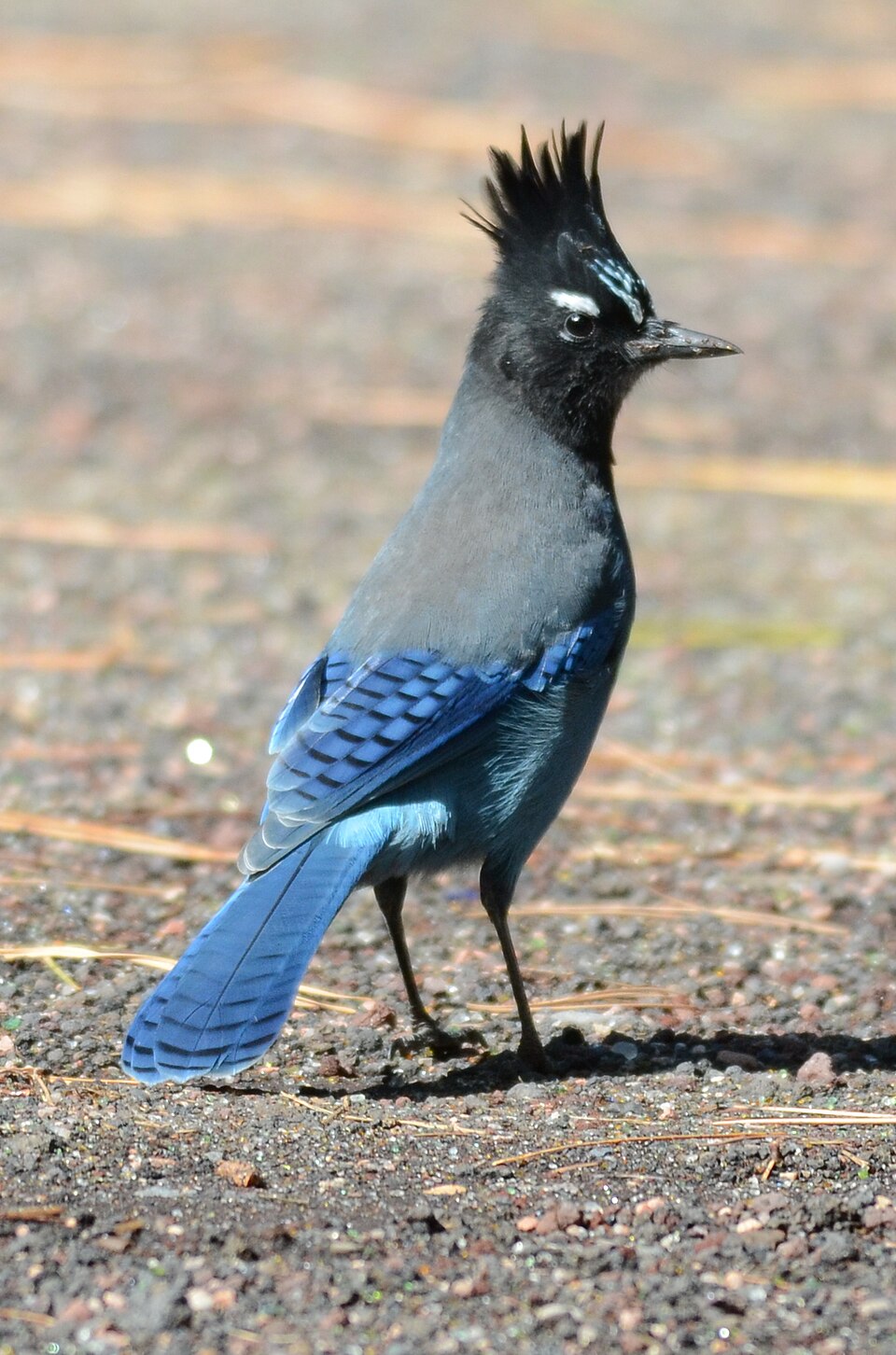
The Steller's Jay is the bold, charcoal-and-blue jay of western North America's evergreen forests, and once you've met one you don't forget it. With its tall, shaggy crest and a smoky black head fading into vivid cobalt underparts, it looks like a Blue Jay that wandered into a darker, more dramatic story. It's a bird of mountain campgrounds, coastal conifers, and pine-clad slopes, where it patrols the canopy with loud calls and an unmistakable swagger.
This is the only crested jay you'll find across most of the West, which makes identification refreshingly simple in much of its range. Intelligent, curious, and notoriously fond of an unattended picnic, Steller's Jays are members of the corvid family alongside crows, ravens, and magpies, and they share that group's cleverness and boldness. Whether they're caching acorns, raiding a feeder, or perfectly imitating a hawk to clear competitors off the food, they bring a lot of personality to any western woodland.
Steller's Jay is a large, long-tailed songbird, noticeably bigger and chunkier than a robin, with a prominent triangular crest that it raises and lowers with its mood. The combination of a dark, sooty front half and a deep blue rear half is diagnostic across nearly all of its range.
| Crest | Tall, shaggy black crest, raised when alert or agitated and laid flat when relaxed |
| Head & breast | Sooty black to charcoal-gray, contrasting sharply with the blue body |
| Body & wings | Rich deep blue to azure on the back, wings, belly, and tail, with fine black barring on the wings and tail |
| Face marks | Subtle pale streaks above the eye and on the forehead; interior birds show bolder blue or white eyebrow marks |
| Bill & legs | Stout black bill and black legs, typical of a jay |
| Size | About 12-13 inches long with a long tail; clearly larger than a songbird, smaller than a crow |
Male vs. female
Males and females look essentially identical, with the same black crest, dark hood, and blue body, so you can't reliably tell them apart in the field by plumage. Males average slightly larger, but the difference is too small to judge on a single bird. In a mated pair, behavior is often the better clue: the female does the incubating and may beg to be fed by the male near the nest.
Juveniles
Juvenile Steller's Jays are duller and sootier overall, with a grayer, less glossy blue and a shorter, floppier crest than adults. Their plumage looks slightly fluffy and unkempt through their first summer, and the crisp black-on-blue contrast develops as they molt into adult feathers. Begging youngsters following noisy adults through the canopy in mid to late summer are a common sight at higher elevations.
Steller's Jays are loud and varied, and their signature call is a harsh, descending shaack-shaack-shaack or shook-shook-shook, often repeated in rapid series as the bird flies through the trees. They also give a softer, grating kresh and a rattling churr. Like many jays, they are accomplished mimics and frequently imitate the scream of a Red-tailed or Red-shouldered Hawk, a trick that can scatter other birds from a feeder or simply confuse the listener.
Around the nest and among pairs, they switch to quieter, more musical notes, including soft warbles, clicks, and gurgles that are surprisingly gentle for such a brash bird. If you hear a hawk scream in dense conifers but never see a hawk, suspect a jay.
Steller's Jay is a western specialty, found from coastal Alaska and western Canada south through the Pacific states and the Rocky Mountains, and on into the mountains of Mexico and Central America. It favors coniferous and mixed evergreen forests, including pine, fir, spruce, and Douglas-fir, as well as oak-conifer woodlands at mid to high elevations.
Most populations are year-round residents and do not truly migrate, but many mountain birds move downslope in winter, drifting to lower valleys, foothills, and even suburban neighborhoods when high-country snow makes food scarce. In years of poor cone and acorn crops, larger numbers may wander to unexpected lowland spots, occasionally turning up east of their usual range.
Steller's Jays are true omnivores with a strong vegetarian streak. A large share of their diet is plant matter, especially pine seeds, acorns, and other nuts, along with berries and fruit. Like other jays, they cache food, burying acorns and seeds in the ground and tucking them into bark crevices, and the seeds they forget help plant the next generation of oaks and pines.
They round out the menu with insects, spiders, and other invertebrates, and they'll readily take eggs and nestlings of smaller birds when the chance arises. Bold and opportunistic, they are famous for scavenging human food at campgrounds and picnic areas, grabbing scraps, bread, and anything left unguarded with brazen confidence.
Steller's Jays nest in conifers, usually placing a bulky cup well off the ground on a horizontal branch close to the trunk. Both members of the pair help build it, constructing a foundation of twigs and a sturdy middle layer often cemented with mud, then lining the cup with fine rootlets, pine needles, and grasses. They are secretive around the nest, going quiet and discreet in a way that contrasts sharply with their usual noise.
The female typically lays three to four pale blue-green eggs lightly speckled with brown, and she does most or all of the incubation while the male brings her food. After hatching, both parents feed the young, which fledge after about three weeks and then trail the adults noisily as they learn to forage.
Yes, Steller's Jays will happily visit yards within or near western forests, and they're easy to draw in if you live in the right habitat. They're large, hungry, and not shy, so expect them to dominate the feeder when they arrive.
- Offer peanuts (in or out of the shell), suet, and black oil sunflower seeds, which are jay favorites and easy for them to carry off and cache.
- Use a sturdy platform or hopper feeder rather than small perches, since these big birds need room to land and feed comfortably.
- Provide fresh water in a wide, sturdy birdbath; jays drink and bathe readily, especially in dry mountain summers.
- Keep nearby conifers and oaks if you can, as they supply natural seeds, acorns, and secure cover and nesting sites.
- Expect them to arrive in winter when mountain birds move downslope, so keep feeders stocked through the cold months.
- Don't fight their boldness; if they're emptying feeders fast, a separate peanut or whole-corn station can keep them busy and away from your smaller-bird feeders.
- Blue Jay: Has a blue (not black) crest and head, white face and underparts, and bold white wing and tail spots; mainly eastern, but the ranges now overlap on the Great Plains where the two can even hybridize.
- California Scrub-Jay: Lacks any crest, has a clean white throat and gray back, and prefers oak scrub and suburbs at lower elevations rather than dense conifer forest.
- Woodhouse's Scrub-Jay: Also crestless and duller blue-gray, an interior bird of pinyon-juniper and arid scrub; never shows the black crest or sooty hood of a Steller's.
- Pinyon Jay: Crestless, uniformly dusty blue all over, with a longer spike-like bill; travels in large flocks through pinyon-juniper country.
What is the difference between a Steller's Jay and a Blue Jay?
Steller's Jays have a black head and crest with a deep blue body and live in western forests, while Blue Jays have a blue crest, a white face and belly, and bold white wing spots and are mainly eastern birds. Their ranges meet on the Great Plains, where they occasionally interbreed, but in most places only one species occurs.
Why does a Steller's Jay sound like a hawk?
Steller's Jays are skilled mimics and often imitate the scream of Red-tailed and Red-shouldered Hawks. They may do this to startle other birds away from food or to investigate a real predator, so a hawk scream coming from deep in conifers with no hawk in sight is very often a jay.
Are Steller's Jays aggressive toward other birds?
They can be pushy at feeders, dominating the food and chasing off smaller birds, and like other jays they sometimes raid nests for eggs and nestlings. This is natural behavior. Offering a separate peanut or corn station can keep them occupied and ease pressure on your other feeders.
What do Steller's Jays eat?
They are omnivores that rely heavily on pine seeds, acorns, nuts, berries, and fruit, supplemented with insects, spiders, and occasionally eggs or nestlings. They cache surplus seeds and nuts in the ground and bark, and they readily scavenge human food at campgrounds and picnic areas.
Where do Steller's Jays live?
They live in coniferous and mixed evergreen forests across western North America, from coastal Alaska and western Canada south through the Pacific states, the Rockies, and the mountains of Mexico and Central America. Most stay year-round, though many mountain birds move to lower elevations in winter.