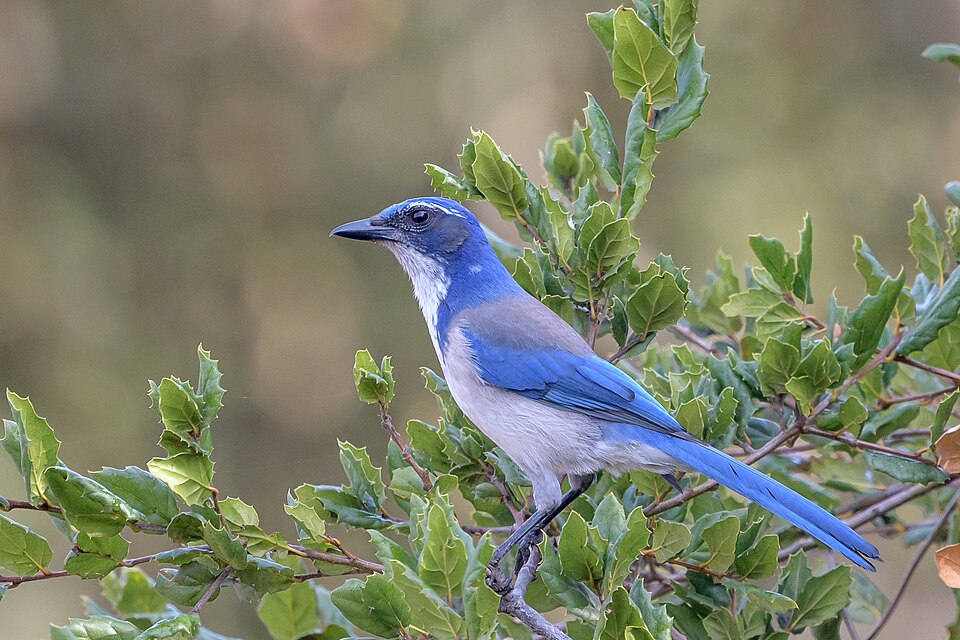
The California Scrub-Jay is one of the West Coast's most recognizable backyard birds, a long-tailed, deep-blue jay with a saucy attitude and a loud voice to match. From Washington south through Oalifornia and into Baja, it thrives in oak woodlands, chaparral, suburban gardens, and city parks. If you live west of the Sierra Nevada and Cascades and you have shrubs and a few oaks nearby, there is a good chance one of these jays already considers your yard part of its territory.
For decades this bird was lumped with its Rocky Mountain and Great Basin cousins as the single "Western Scrub-Jay," but in 2016 ornithologists split that species into two: the California Scrub-Jay of the wetter Pacific slope and the Woodhouse's Scrub-Jay of the drier interior. The California bird is the brighter, bluer, more boldly marked of the pair. Crestless (unlike the familiar Blue Jay and Steller's Jay), it relies on color, a long tail, and a forward, curious personality to make its presence known.
A medium-large songbird with a notably long tail, a stout black bill, and a slim, alert posture. It often perches up high on a wire, fence post, or shrub top, tail cocked, scanning its surroundings. In flight it shows an undulating, somewhat labored style with quick wingbeats between glides.
| Head & upperparts | Rich azure-blue crown, wings, and tail, with no crest |
| Back | Distinct gray-brown ('saddle') patch on the upper back contrasting with the blue |
| Underparts | Clean pale gray to whitish below, with a faint to bold blue band ('necklace') across the upper chest |
| Throat | Whitish throat set off by a blue partial collar |
| Face | Blue face with a thin whitish eyebrow stripe and darker mask through the eye |
| Bill & legs | Heavy straight black bill; dark legs |
Male vs. female
Males and females look alike to the eye, with the same blue-and-gray pattern, so you cannot reliably tell them apart in the field by plumage. Males average slightly larger and heavier-billed, but the difference is subtle and only obvious with a bird in the hand. In a bonded pair, behavior is often a better clue than appearance: the female does the incubating, and the male frequently feeds her on or near the nest.
Juveniles
Recently fledged young look noticeably duller and grayer than adults, lacking the clean blue hood and the crisp chest band. They show a muted, smoky gray head and back with only a wash of blue in the wings and tail, and the plumage can look slightly fluffy and disheveled. Juveniles also have a paler, fleshier gape at the base of the bill. By their first fall they molt into adult-like blue plumage and become hard to separate from older birds.
California Scrub-Jays are loud and hard to ignore. The signature call is a harsh, rising shreeenk or kwesh-kwesh-kwesh, often delivered in a rapid series that rasps upward at the end. They also give a rough, scolding check-check-check when a hawk, cat, or human gets too close, and pairs keep in touch with softer, gravelly notes around the territory.
True song is rarely heard and easy to miss. Mostly during quieter moments a bird may produce a long, low, halting series of soft warbles, squeaks, and mimicked sounds, sometimes called a "whisper song." For most backyard birders, the rasping rising call is the sound they will learn first and hear most.
This is a Pacific-slope bird, found from southwestern Washington and western Oregon south through California west of the high mountains, and on into northwestern Baja California, Mexico. It favors lower and middle elevations: oak woodlands, chaparral, streamside thickets, orchards, and especially residential neighborhoods with mature shrubs and trees.
California Scrub-Jays are essentially non-migratory. Pairs and family groups hold territories year-round, and most individuals spend their entire lives within a small home range. Some upslope or local wandering can happen in fall and winter, particularly among young birds dispersing to find their own territory, but you will not see large seasonal movements. Where the range edges toward the dry interior, it meets and occasionally overlaps with the very similar Woodhouse's Scrub-Jay.
Scrub-jays are true omnivores and opportunists. Acorns are a cornerstone of the diet, and in fall a single jay may cache thousands of them, burying acorns one at a time across its territory and relying on a remarkable spatial memory to recover them later. Those forgotten caches help plant oaks, making the jay an important seed disperser. Beyond acorns they eat other nuts, seeds, berries, and fruit, and in the warm months they hunt insects, spiders, snails, small lizards, and even the occasional small frog or nestling bird.
They forage actively on the ground and in shrubs, hopping with that long tail held high, flipping leaves and probing bark. Like other corvids they are clever and bold around people, quickly learning to raid garden fruit, snatch food from outdoor tables, and visit feeders. They will also pluck ticks and parasites off the backs of mule deer, which tolerate the service.
California Scrub-Jays are monogamous and strongly territorial, with pairs often staying together year after year. The nest is a bulky but well-hidden cup built low to mid-height in a dense shrub, oak, or small tree, typically within about 6 to 15 feet of the ground. Both members of the pair build it, weaving an outer basket of twigs and lining the inside with rootlets, fine grasses, and animal hair.
The female lays a clutch of roughly 3 to 5 pale greenish or grayish eggs marked with olive and brown spotting, and she does the incubating for about 17 to 19 days while the male brings her food. Young leave the nest around 18 to 20 days after hatching but stay dependent on the parents for several more weeks. Most pairs raise a single brood per year, though they may re-nest if an early attempt fails.
Yes, this is very much a backyard bird across its range, and one of the easier western jays to draw in. They are bold, adaptable, and quick to learn where an easy meal is, so a little offering goes a long way.
- Offer whole or shelled peanuts on a platform feeder or tray, scrub-jays love them and will carry them off to cache.
- Provide sunflower seeds (black-oil or striped) and suet, which they readily take from platform and hopper feeders.
- Plant native oaks if you have the space; acorns are a primary natural food and the trees double as nesting and cover habitat.
- Keep some dense native shrubs for cover and potential nest sites, they avoid wide-open, shrubless yards.
- Add a birdbath or shallow water source; jays drink and bathe readily, especially in California's dry summers.
- Expect them to dominate the feeder and bully smaller birds, so spread food across several stations if you want variety.
- Woodhouse's Scrub-Jay: The interior, drier-country counterpart. Duller and grayer-blue with a much fainter or absent chest band; ranges meet in the interior West but rarely overlap broadly.
- Steller's Jay: Has a tall dark crest and a blackish head and breast; favors conifer and mountain forests rather than open scrub and suburbs.
- Blue Jay: An eastern bird (expanding west) with a crest, bold black-and-white wing barring, and a black necklace; rare in California Scrub-Jay range.
- Florida Scrub-Jay: Looks similar but lives only in Florida scrub oak; no range overlap, so location alone separates them.
What's the difference between a California Scrub-Jay and a Blue Jay?
Blue Jays are an eastern species with a prominent crest, black-and-white bars on the wings and tail, and a black necklace. California Scrub-Jays have no crest, a gray-brown back patch, and a cleaner blue-and-gray look. In most of California, any 'blue jay' you see is actually a scrub-jay.
Why does the scrub-jay in my yard scream so much?
That harsh, rising rasp is their main contact and alarm call. They get especially loud when a hawk, cat, owl, or person comes near, scolding to warn family members and mob the threat. It's normal behavior and a sign a pair is holding a territory in your yard.
Do California Scrub-Jays really remember where they bury food?
Yes. In fall they cache thousands of acorns and seeds one at a time and recover them later using exceptional spatial memory. They even re-hide food if they think another jay watched them, which is a sign of impressive cognitive ability for a bird.
What should I feed scrub-jays at my feeder?
Peanuts (whole or shelled), sunflower seeds, and suet are favorites. Use a sturdy platform or tray feeder since they're larger birds, and expect them to grab a peanut and fly off to cache it before returning for more.
Are California Scrub-Jays bad for other backyard birds?
They can be pushy at feeders and will occasionally raid nests for eggs or nestlings, which is natural corvid behavior. They rarely harm overall songbird populations, but if you want to protect nesting birds, place nest boxes with proper hole sizes and offer feeder food in several spots to spread the jays out.