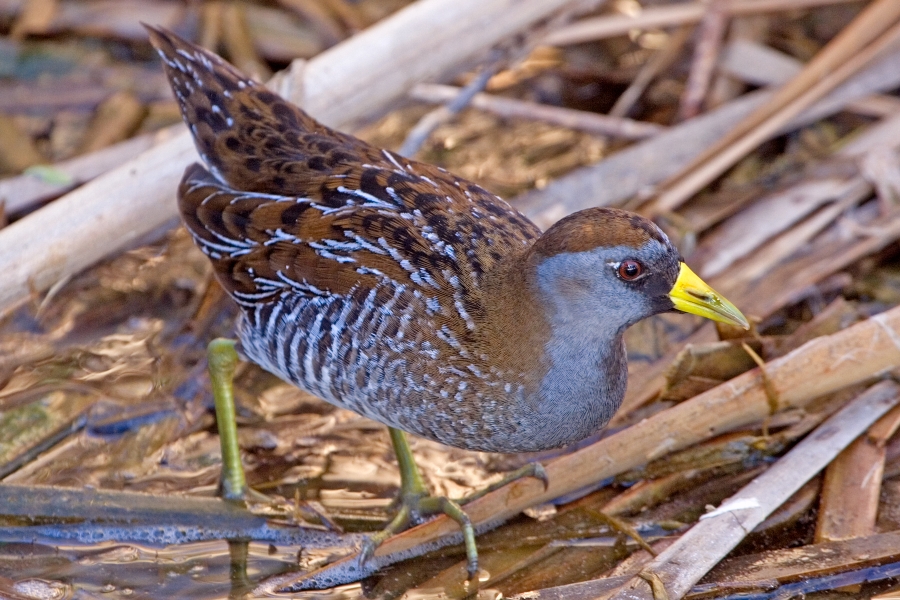
The Sora is the most widespread and abundant rail in North America, yet most birders hear far more Soras than they ever see. This plump, chicken-shaped marsh bird is built for a life among dense cattails and sedges, where it threads its way through flooded vegetation on long greenish toes, flicking its short tail to flash white undertail coverts. Compact and slate-gray with a stubby, candy-yellow bill, it looks almost comically rotund when it does step into the open at the edge of a reed bed.
For all its abundance, the Sora is a master of staying hidden. It is far easier to detect by its distinctive descending whinny and sharp upslurred whistle drifting out of a marsh at dawn or dusk. Soras breed across much of the United States and Canada and migrate to the southern states, Mexico, and Central America for winter, making freshwater and brackish wetlands their home year-round somewhere on the continent. Where wetlands are healthy, Soras are usually present, which makes them a quiet barometer of marsh health.
Think of a small, dumpy chicken shrunk to robin-plus size, with a short cocked tail and a stubby triangular bill. Soras are most often seen low at the marsh edge, walking deliberately or flushing weakly with dangling legs before dropping back into cover. The combination of a bright yellow bill, black face mask, and slate-gray breast is diagnostic on adults.
| Bill | Short, thick, and triangular; bright yellow, sometimes with an orange base. Stubbier than the long red bill of larger rails. |
| Face & throat | Adults have a black mask and black throat patch set against gray cheeks and breast. |
| Body | Slate-gray below, warm brown above streaked with black and edged white; flanks barred black-and-white. |
| Tail | Short and often cocked, revealing white undertail coverts that flash when the bird flicks its tail. |
| Legs & feet | Long, slender, yellowish-green legs with long unwebbed toes for walking on floating vegetation. |
| Size & shape | Plump and rounded, about the size of a small chicken or large dove; appears tailless and front-heavy. |
Male vs. female
Males and females look essentially alike, and you cannot reliably separate them in the field. Both adults share the yellow bill, black face and throat, gray breast, and barred flanks. Males average very slightly larger and can show a marginally more extensive black throat patch, but the overlap is great enough that this is not a practical field mark. Pairs are usually identified by behavior during the breeding season rather than plumage.
Juveniles
Juvenile Soras look noticeably different and are a common source of confusion. They lack the black face mask and throat entirely, showing instead a plain buffy-tan face, throat, and breast with no gray and no black. The bill is duller, more olive or dusky than bright yellow. This warm, washed-out look causes some observers to mistake young Soras for a different species; the giveaway is the same plump shape, short cocked tail, and white undertail coverts. Downy chicks are jet black with a tuft of orange bristly feathers at the throat, an odd ornament unique to rail chicks.
The Sora's voice is its calling card. The classic advertising call is a clear, sharp two-note whistle, ker-WEE, rising abruptly at the end and often rendered as sor-AH (the likely source of its name). The most memorable sound is the whinny: a descending, accelerating series of musical notes that tumbles down the scale like a horse's whinny, whee-hee-hee-hee-hee-hee, fading as it falls. Marshes can erupt with overlapping whinnies at dusk.
Soras also give a sharp, explosive keek when alarmed or curious, a note that can be coaxed out by tossing a pebble into the reeds or making a soft squeak. Birds call most actively at dawn, dusk, and through the night during spring migration and breeding, which is by far the best time to confirm their presence.
The Sora breeds across a vast swath of North America, from much of Canada south through the northern and central United States, favoring freshwater marshes with dense emergent vegetation. It is a true long-distance migrant: in fall, Soras leave northern wetlands and move to the southern United States, the Gulf and Atlantic coasts, Mexico, the Caribbean, and Central America, with some reaching northern South America.
Migration is mostly nocturnal, and Soras turn up in surprising places during passage, including small ponds, ditches, flooded fields, and even urban wetlands far from typical breeding habitat. Spring and fall are the peak times for chance encounters, when displaced migrants may forage briefly in the open before resuming their journey.
Soras are omnivores with a strong seasonal swing in their diet. Through much of the year they feed heavily on the seeds of wetland plants, especially smartweeds, sedges, and wild rice, picking them from the mud and water surface or stripping them directly from seed heads. This seed-eating habit historically made them a popular target for marsh hunters, particularly in wild rice country.
During the breeding season they take far more animal matter, gleaning aquatic insects, snails, small crustaceans, and other invertebrates from vegetation and shallow water. Soras forage by walking slowly along the marsh edge and through floating mats, probing and pecking with that short bill, occasionally flicking aside leaves and debris to expose hidden prey.
Soras nest in dense emergent vegetation over shallow water, typically among cattails, bulrushes, or sedges. Both members of the pair build the nest, a basket-like cup woven from the surrounding plant stems and leaves, often anchored to standing vegetation a few inches above the waterline. Many pairs also construct a canopy of bent-over stems and a ramp leading down to the water, helping conceal the nest and the incubating bird.
Clutches are large for a bird this size, and both parents share incubation. The eggs hatch asynchronously over several days, so a nest may hold both eggs and newly hatched chicks at once. The downy black chicks are precocial, leaving the nest within a day or two to follow their parents through the marsh, where the adults feed them until they can forage on their own.
The Sora is not a backyard or feeder bird in any practical sense, and there is no seed blend or feeder that will bring one to a typical yard. It is a habitat specialist tied to wetlands, so the only meaningful way to "attract" Soras is to protect or create the marsh habitat they depend on. If you have wet acreage or a pond margin, the following steps genuinely help.
- Protect existing wetlands. The single most effective thing you can do is leave marshy edges, cattail stands, and seasonally flooded ground undrained and undisturbed.
- Maintain shallow water with dense emergent plants. Soras need cattails, bulrushes, sedges, and similar cover standing in just a few inches of water, not open ponds.
- Encourage native seed-bearing marsh plants like smartweed, sedges, and wild rice, which provide both food and nesting material.
- Avoid herbicides and heavy mowing near wet areas, which strip away the cover and food Soras require.
- Listen at dawn and dusk in spring rather than expecting to see one; a recording or a soft squeak near the reeds may draw a curious keek in response.
- Virginia Rail: Shares the same marshes but has a long, slightly downcurved reddish bill, rusty underparts, and gray cheeks; lacks the Sora's stubby yellow bill and black face.
- Yellow Rail: Much smaller, buffier, and even more secretive, with a striped back and white wing patches visible in flight; favors drier sedge meadows.
- Common Gallinule: Larger and darker with a red bill and frontal shield; swims openly in the water rather than skulking in dense cover like a Sora.
What does a Sora sound like?
Two signature sounds. A sharp, rising two-note whistle, ker-WEE or sor-AH, and a descending, accelerating whinny that tumbles down the scale like a horse's whinny. They also give an explosive keek when alarmed. You'll almost always hear a Sora before you see one, especially at dawn, dusk, and at night in spring.
Is the Sora a type of duck?
No. The Sora is a rail, a member of the family Rallidae, not a duck. Rails are marsh birds with chicken-like bodies, long toes, and slender legs. The Sora's plump shape and short cocked tail set it apart from any duck, and it walks through vegetation far more than it swims.
Why are Soras so hard to see?
Soras live deep inside dense cattails and sedges and rarely step into the open. They are shaped to slip through vertical reeds, and they freeze or melt back into cover at the slightest disturbance. Patience at a marsh edge during quiet hours, and learning their calls, are the keys to actually spotting one.
What's the difference between a Sora and a Virginia Rail?
The easiest mark is the bill. A Sora has a short, thick, bright yellow bill and a black face and throat, while a Virginia Rail has a long, slim, slightly downcurved reddish bill and rusty underparts. Both share the same marshes and are often heard together, but the bill shape settles it instantly.
Where and when can I find a Sora?
Look in freshwater and brackish marshes with dense emergent vegetation. They breed across Canada and the northern and central U.S. and winter in the southern states, Mexico, and Central America. Spring and fall migration are the best times to catch one in the open, often at unexpected small ponds and flooded fields.