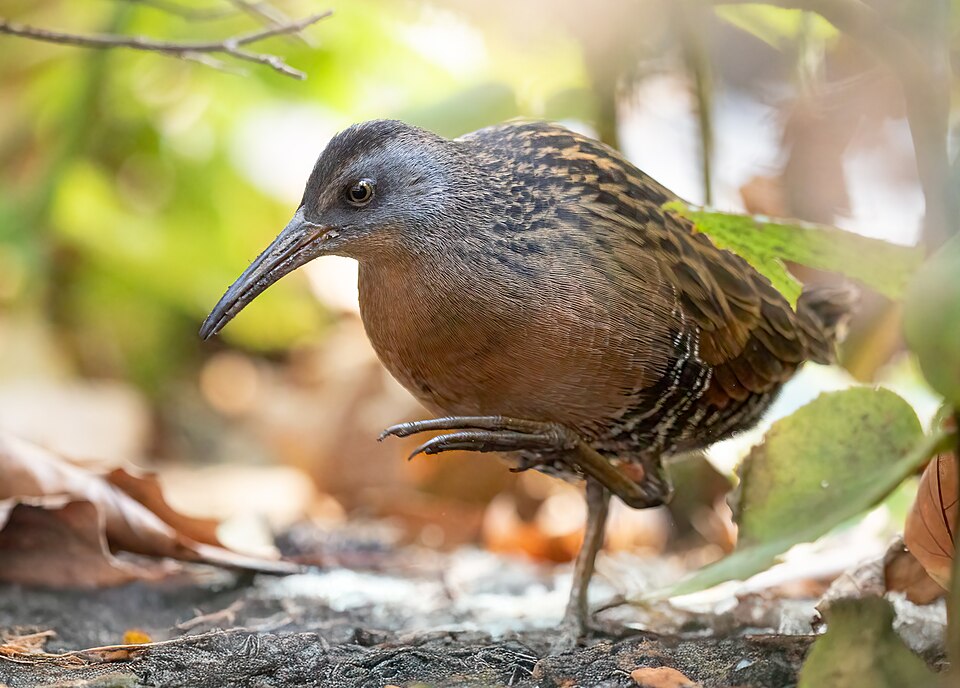
The Virginia Rail is one of North America's most elusive marsh birds, a chicken-shaped wader built to slip through dense cattails and bulrushes like a ghost. Despite being fairly common across freshwater and brackish wetlands, it is so retiring that most birders learn it by ear long before they ever lay eyes on one. Its body is famously narrow and laterally compressed, an adaptation that lets it squeeze between stems of reeds, which is exactly why the old expression "thin as a rail" describes anything skinny.
For the patient observer, this rail rewards persistence. It is rusty-cinnamon below, slate-gray on the cheeks, with a long, slightly downcurved reddish bill and a stubby, often-cocked tail. It probes the muck for invertebrates, threads its way along the edge of open water at dawn and dusk, and announces itself with a strange repertoire of grunts, clatters, and metallic pumping notes that carry across the marsh. Where wetlands are healthy, the Virginia Rail is a reliable resident, making it both an indicator of good marsh habitat and a satisfying "heard bird" to add to any list.
Picture a small, compact, rust-colored bird about the size of a robin but plumper, with a long bill, short cocked tail, and a body so flattened side-to-side it looks like it was pressed between two reeds. Virginia Rails are usually seen low, walking deliberately along the muddy margin of a marsh rather than out in the open.
| Bill | Long, slender, slightly downcurved; reddish to orange at the base, darker toward the tip |
| Underparts | Warm rusty-cinnamon on the breast, the most eye-catching field mark |
| Face | Gray cheeks contrasting with the rusty breast and a pale throat |
| Flanks | Boldly barred black-and-white on the sides and undertail |
| Tail | Short and stubby, frequently flicked up to show buffy undertail coverts |
| Legs | Long-toed and reddish-brown, suited for walking on soft mud and floating vegetation |
Male vs. female
Males and females look essentially alike, both showing the rusty breast, gray cheeks, and barred flanks, so plumage alone won't separate the sexes in the field. Males average slightly larger and longer-billed, but the difference is subtle and usually only apparent when a pair is seen side by side. During courtship and territorial disputes the male is typically the more vocal and aggressive of the two, but you cannot reliably sex a lone bird by sight.
Juveniles
Downy chicks are jet-black and precocial, leaving the nest within a day of hatching and following their parents through the reeds almost immediately, looking like little black pom-poms on stilts. Juveniles and immatures are much duller than adults: they are darker and sootier overall, with the rusty breast replaced by blackish or mottled gray-brown underparts and far less obvious flank barring. They gradually acquire the warm adult coloring through their first fall, so a drab, dark rail in late summer is usually a young bird of the year.
The Virginia Rail's voice is the best way to detect it. The classic advertising call is a sharp, accelerating series often written as "kid-ick, kid-ick, kid-ick" or "tick-it, tick-it," a metallic, telegraph-like pumping that speeds up and trails off. Both sexes also give a descending series of pig-like grunts, a soft "grunt-grunt-grunt-grunt" that fades at the end, frequently used as a contact or duet call between mates.
Other sounds in its repertoire include a harsh "kicker" and a strange, far-carrying mechanical "wak-wak-wak." Rails are most vocal at dawn, dusk, and through the night, and they respond readily to imitations or playback during the breeding season, though birders should use playback sparingly to avoid stressing these secretive birds.
Virginia Rails breed across much of southern Canada and the northern and central United States, favoring freshwater marshes with dense emergent vegetation. They are migratory in the colder parts of this range, moving south in fall to winter along the Pacific Coast, the southern and southeastern United States, the Gulf Coast, and into Mexico and Central America. In milder coastal and southern regions some birds are year-round residents, and wintering rails often shift into brackish and salt marshes.
Migration happens largely at night and is easy to miss, since these birds slip in and out of marshes without fanfare. A separate, non-migratory population occurs in parts of the western mountains and the highlands of Mexico. Because they depend on wetlands, their local presence tracks the health and water level of marsh habitat from one year to the next.
Virginia Rails are mostly carnivorous, feeding on small aquatic and marsh invertebrates. Their diet is heavy on insects and their larvae, beetles, snails, slugs, earthworms, spiders, small crayfish, and other soft-bodied creatures they pull from mud and shallow water. They will also take small fish and frogs when available, and supplement with seeds of marsh plants, especially in fall and winter when invertebrates are scarcer.
They forage by walking slowly along the water's edge and probing the soft substrate with that long, sensitive bill, often picking prey from the surface of the mud or from submerged vegetation. They sometimes wade into shallow water and occasionally use their bill to flip aside debris in search of hidden food. Most feeding happens under the cover of dense vegetation, which is part of why the species is so hard to observe in action.
Virginia Rails nest in dense emergent marsh vegetation, hidden among cattails, bulrushes, or sedges over shallow water or saturated ground. Both members of the pair help build the nest, a loosely woven cup or platform of dead plant stems and leaves anchored to standing vegetation, often with surrounding stems pulled over the top to form a partial canopy that conceals it from above. Pairs frequently build extra "dummy" or brood nests nearby that may be used for shelter or for the chicks.
The female typically lays a fairly large clutch, and both parents share incubation duties. The eggs hatch after roughly three weeks, and the black, downy young are precocial, leaving the nest almost at once to follow their parents and learn to feed themselves within a few weeks. The well-hidden nest and the chicks' habit of vanishing into the reeds make confirmed breeding records hard to come by, even where the birds are common.
The Virginia Rail is not a backyard or feeder bird, so you won't lure one in with seed or suet. It is a marsh specialist, and the only real way to "attract" it is to protect or provide the wetland habitat it depends on. If you don't live beside a marsh, the better strategy is learning where and how to find one.
- If you own wetland property, conserve dense emergent vegetation like cattails and bulrushes and maintain shallow water and muddy edges, which are exactly what rails need.
- Avoid draining, mowing, or clearing marsh margins during the breeding season, and keep water levels stable so nests aren't flooded or stranded.
- To find one, visit a freshwater marsh at dawn or dusk and listen for the grunting and kid-ick calls rather than scanning for the bird.
- Watch the open edges between reeds and water, where rails briefly step into view before slipping back into cover; patience and stillness pay off.
- Use call playback very sparingly or not at all, especially during nesting, since repeated playback stresses these secretive birds.
- Support local wetland protection and restoration efforts, which benefit Virginia Rails along with the entire marsh community.
- Sora: Same marshes but has a short, stubby yellow bill (not long and reddish), a black face mask, and a gray breast rather than rusty; its descending whinny call is very different.
- King Rail: Looks like an oversized Virginia Rail with the same rusty tones, but is much larger and longer-billed; size and bulk are the key separators where ranges overlap.
- Clapper Rail: A large, grayer saltmarsh rail; duller and less rusty than a Virginia Rail and notably bigger, favoring coastal salt and brackish marsh.
How do you tell a Virginia Rail from a Sora?
Look at the bill. A Virginia Rail has a long, slightly downcurved reddish bill and a rusty breast, while a Sora has a short, stubby yellow bill, a black face, and a gray breast. Their calls also differ: the rail gives metallic 'kid-ick' notes and grunts, while the Sora gives a descending whinny.
Why are Virginia Rails so hard to see?
Their bodies are flattened side to side, letting them slip through dense reeds without disturbing them, and they spend almost all their time hidden in thick marsh vegetation. They're most active at dawn, dusk, and night, so most birders detect them by call rather than by sight.
What does a Virginia Rail sound like?
The most distinctive call is a sharp, accelerating metallic series often written as 'kid-ick, kid-ick.' They also give a descending series of pig-like grunts used between mates, plus various harsh kicking and clattering notes, mostly at dawn, dusk, and night.
Where do Virginia Rails live?
They breed in freshwater marshes with dense cattails and bulrushes across southern Canada and the northern and central U.S., and winter in southern and coastal regions, the Gulf Coast, and into Mexico and Central America. In winter they often move into brackish and salt marshes.
Can I attract a Virginia Rail to my backyard?
No, it isn't a feeder or backyard bird. It needs wetland habitat with dense marsh vegetation and shallow muddy edges. The best way to enjoy one is to visit a marsh at dawn or dusk and listen for its calls, or to protect wetland habitat if you have it.