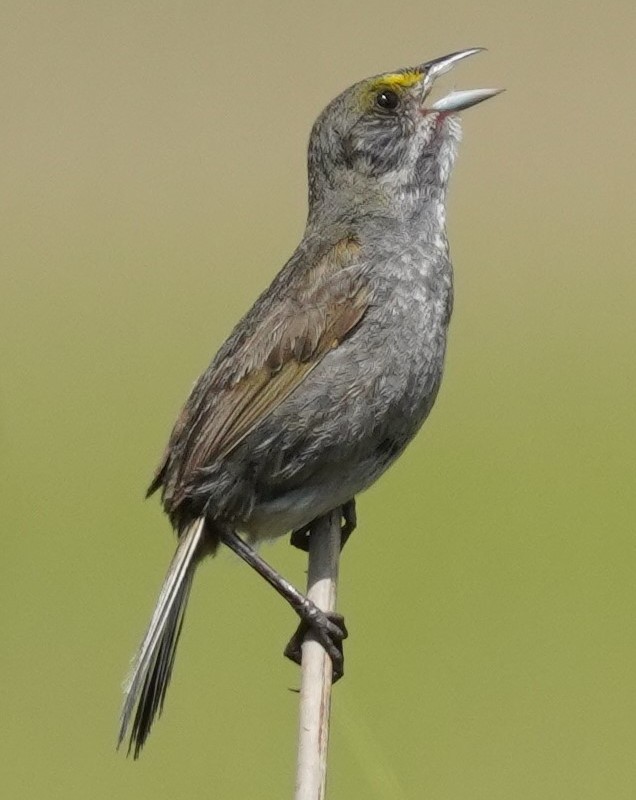
The Seaside Sparrow is one of the most tightly tied to a single habitat of any North American songbird. As its name promises, it lives in coastal salt marshes and almost nowhere else, picking its way through cordgrass and rushes within a stone's throw of tidal creeks and mudflats. It is a chunky, dark, rather drab sparrow that most birders meet not by sight but by ear, when a male flutters to the top of a grass stem and delivers a wheezy, buzzing song that carries across the marsh on a humid summer morning.
What makes this bird worth knowing is its specialization. Few songbirds have committed so fully to life in the salt marsh, an environment that floods twice a day and bakes in summer heat. The Seaside Sparrow drinks brackish water, eats marsh invertebrates, and times its whole life around the tides. That dependence also makes it a bellwether: when coastal marshes are drained, developed, or drowned by rising seas, this is one of the first birds to disappear. The story of the now-extinct Dusky Seaside Sparrow of Florida is a sobering reminder of how fragile a narrow specialist can be.
This is a stocky, large-billed sparrow with a short tail and an overall grayish, dingy look that helps separate it from the warmer, more patterned sparrows of upland habitats. In good light the key giveaway is a small but distinct yellow spot in front of the eye, set against an otherwise gray and olive face.
| Overall color | Dusky gray-olive above, paler below with blurry gray streaking on the breast and flanks; lacks the bright tones of most sparrows |
| Yellow lore | A small yellow patch between the eye and the bill (the lore) is the single best field mark |
| Bill | Long, heavy, and spike-like for a sparrow, used to probe mud and grass |
| Throat | Whitish throat bordered by dark malar (whisker) stripes, contrasting with the gray face |
| Tail | Short and pointed, often held cocked as the bird creeps through grass |
| Legs | Sturdy, pinkish-gray legs suited to clambering on stems and walking on mud |
Male vs. female
Males and females look essentially identical in the field, both showing the gray plumage, yellow lore, and heavy bill. There is no seasonal or breeding plumage change to speak of. The only reliable behavioral clue is that singing birds perched up on grass tips are almost always males defending territory; females stay lower and more hidden, especially when tending a nest.
Juveniles
Juvenile Seaside Sparrows are browner and buffier than adults, with crisper, more defined streaking across the breast and a less obvious or absent yellow lore. They can briefly recall a young Saltmarsh or Nelson's Sparrow, but their large bill, dingy ground color, and salt-marsh setting point the way. As they molt into their first winter, they take on the grayer, more uniform look of adults.
The song is famously unmusical and easy to learn once you have heard it. A typical phrase begins with one or two soft introductory notes followed by a flat, buzzy trill, often written as tup-tup-zheeeeee or cut-cut-zhreeee. Many listeners say it sounds more like a distant insect or a Red-winged Blackbird's wheeze than a true sparrow song, and it carries surprisingly well over open marsh.
Calls include a sharp, dry chip or tcheck given in alarm, and a thin, high flight note. Males sing from low perches atop cordgrass and rushes, and will sometimes perform a short fluttering song-flight, rising a few feet and floating down while singing during the height of the breeding season.
The Seaside Sparrow is a bird of the Atlantic and Gulf coasts of the United States. Breeding populations stretch from New England (Massachusetts and the southern New England coast) south along the Atlantic seaboard, around Florida, and west along the Gulf Coast to Texas. Throughout this range it is restricted to tidal salt and brackish marshes and essentially never strays inland.
Northern breeders are migratory, pulling out of New England and the mid-Atlantic in fall to winter in the marshes of the Southeast and Gulf Coast. Populations from roughly the Carolinas southward, and around the Gulf, are largely resident year-round. Several distinctive regional races exist; the Cape Sable race of southern Florida is endangered, and the Dusky Seaside Sparrow of the Florida east coast went extinct in 1987, a loss directly tied to habitat destruction.
Seaside Sparrows are largely insectivorous, especially in the breeding season, feeding on the abundant invertebrate life of the salt marsh: marsh-dwelling spiders, grasshoppers, beetles, flies, caterpillars, and tiny crabs and amphipods gleaned from the mud. The bird's heavy bill is well suited to probing the base of grass clumps and picking prey from wet substrate.
They forage low and methodically, walking on exposed mud at the edges of tidal creeks and creeping through the grass rather than flushing into the open. In colder months they take more seeds, particularly from cordgrass and other marsh plants, supplementing the smaller supply of winter invertebrates.
Nesting is built entirely around the rhythm of the tides. The female constructs a cup nest of grasses woven into cordgrass or rushes, placed just high enough above the marsh surface to escape ordinary high tides but low enough to stay hidden. Some nests are partly domed or have grass arched over them for concealment. The great hazard is flooding: an unusually high tide or storm surge can wash out eggs and young, and pairs often re-nest after a loss.
The female lays a clutch of typically three to four pale, heavily speckled eggs and does most or all of the incubation, which lasts close to two weeks. Young leave the nest in roughly ten to twelve days, often before they can fly well, scrambling through the grass while the adults continue to feed them. Where the season is long enough, pairs may raise two broods.
This is not a backyard or feeder bird in any practical sense. The Seaside Sparrow is a true salt-marsh obligate, and unless your property includes tidal coastal marsh you are very unlikely to draw one in. The best way to enjoy this species is to go to it and to support the conservation of the marshes it depends on.
- Visit tidal salt marshes along the Atlantic or Gulf coast at low to mid tide, when birds forage on exposed mud at creek edges.
- Go early on calm mornings in late spring and summer, when males sing from grass tips and are far easier to find.
- Learn the buzzy song first. You will detect ten birds by ear for every one you spot, so the insect-like tup-tup-zheee is your most useful tool.
- Watch the grass-stem perches. Scan the tops of cordgrass for a chunky, dark sparrow rather than expecting one to come to open ground.
- Support coastal marsh protection. Backing land trusts and restoration efforts that preserve and rebuild tidal marsh is the most meaningful way to help this species persist.
- Saltmarsh Sparrow: Shares the salt marsh but is smaller and warmer-toned, with a bright orange-buff face triangle, crisp dark streaking below, and a much smaller bill. No yellow lore on a gray face.
- Nelson's Sparrow: Brighter and more colorful, with an orange wash across the breast and face and a grayer nape; smaller-billed and often in slightly fresher, less brackish marsh.
- Savannah Sparrow: Can show a yellow lore too, but is browner, crisply streaked, slimmer-billed, and found in open fields and dune edges rather than deep in tidal cordgrass.
- Song Sparrow: Coastal Song Sparrows can overlap at marsh edges but are warmer brown with bold breast streaking that converges into a central spot, longer-tailed, and far more widespread in habitat.
Where is the best place to see a Seaside Sparrow?
In a tidal salt or brackish marsh along the U.S. Atlantic or Gulf coast, anywhere from New England to Texas. Look and listen at the edges of tidal creeks at low to mid tide, especially on calm summer mornings when males are singing from grass tops.
How do I tell a Seaside Sparrow from a Saltmarsh Sparrow?
The Seaside Sparrow is larger, grayer, and dingier overall with a noticeably heavier bill and just a small yellow spot in front of the eye. The Saltmarsh Sparrow is smaller and warmer, with a bright orange-buff face triangle and crisp dark streaking on the underparts.
What does a Seaside Sparrow sound like?
Its song is a soft introductory note or two followed by a flat, buzzy trill, often written as tup-tup-zheee. Many people think it sounds more like a distant insect or a wheezy Red-winged Blackbird than a typical sparrow.
Will Seaside Sparrows come to a bird feeder?
Almost never. They are salt-marsh specialists that feed on marsh invertebrates and seeds within tidal grasses, so they have little reason to visit yards or feeders. To see one you generally have to go to coastal marsh habitat.
Is the Seaside Sparrow endangered?
The species as a whole is considered of Least Concern and is locally common, but it depends entirely on salt marshes that are shrinking. Some regional races are imperiled, the Cape Sable race in Florida is endangered, and the Dusky Seaside Sparrow went extinct in 1987, so coastal marsh loss and sea-level rise remain serious threats.