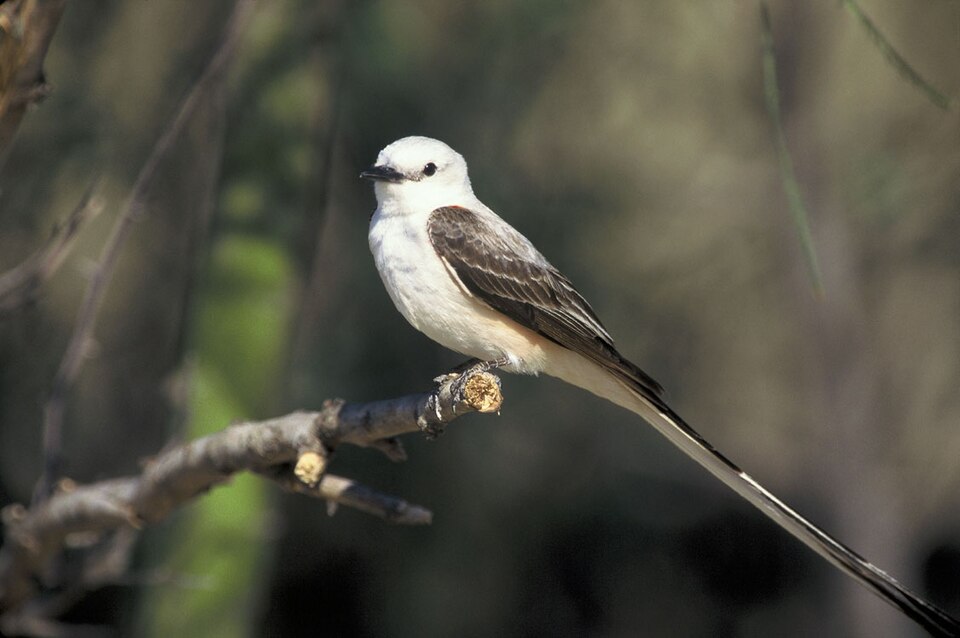
Few birds in North America are as instantly recognizable as the Scissor-tailed Flycatcher. With a tail nearly twice the length of its body, this pale, elegant flycatcher seems to trail two streamers behind it as it flutters up from a fence wire to snap an insect out of the air. Birders sometimes call it the "Texas bird-of-paradise," and it serves as the official state bird of Oklahoma, where it is a beloved sign of warm weather returning to the prairie.
It is a bird of open country: ranchland, pastures, roadsides, mesquite scrub, and the edges of small towns across the southern Great Plains. Despite the dramatic plumage, it is approachable and easy to watch, often perching conspicuously on power lines and barbed-wire fences where it surveys the surrounding grass for grasshoppers and other prey. Where it occurs, it is hard to overlook and a genuine delight to watch.
This is a slender, pale flycatcher whose silhouette gives it away long before color does. The body is roughly robin-sized, but the deeply forked, ribbon-like tail can more than double the bird's apparent length, especially in adult males. In flight the tail opens and closes like a pair of scissors, the field mark that gives the bird its name.
| Tail | Extremely long and deeply forked, black above with white outer edges; opens and closes like scissors in flight |
| Underparts | Pale whitish to soft gray on the head and breast, brightening to pale salmon-pink on the flanks and belly |
| Wing pits | Striking salmon-red to orange patches at the bend of the wing and underwing, often hidden at rest but flashing in flight |
| Head & back | Pearly pale gray, clean and unmarked, giving a soft, frosty appearance |
| Wings | Dusky gray-brown with paler feather edges, contrasting subtly with the pale body |
| Bill | Short, straight, black, broad-based, the classic flycatcher bill for catching insects on the wing |
Male vs. female
The sexes look similar but can often be told apart with a good view. Males have the longest tails, sometimes dramatically so, and tend to show brighter, more extensive salmon-pink on the flanks and richer red in the wing pits. Females are a touch duller overall with noticeably shorter tails, though still long by any normal standard. In the hand or with very close views the differences are clear, but a lone bird perched on a wire can be tricky to sex with confidence.
Juveniles
Juveniles are the give-away "short-tailed" scissor-tails of late summer. Young birds have noticeably stubbier tails that have not yet grown their full streamers, paler and less saturated pink on the sides, and a browner, more washed-out overall tone. They can briefly puzzle birders expecting the trademark long tail, but the pale body, dark wings, and overall shape still point the way. The full adult tail develops as the bird matures.
The Scissor-tailed Flycatcher is not a melodic singer; like its kingbird relatives, its voice is a series of sharp, bickering notes. Common calls include a dry, stuttering ka-quee and repeated harsh pik or kew notes, often run together into excited chatter when birds are agitated or interacting.
The most memorable performance is the male's "sky dance" flight display, given on the breeding grounds. He climbs steeply, then tumbles and zig-zags back down while delivering a rolling, cackling series of notes, a rollicking perk-perk-perk-perleep, with his tail streaming and wing patches flashing. It is one of the great spectacles of the spring prairie.
This is a bird of the south-central United States. Its breeding core runs through Texas and Oklahoma and spills into Kansas, Arkansas, Louisiana, southwestern Missouri, and southeastern New Mexico. It is a long-distance migrant, wintering primarily in southern Mexico and Central America, from southern Mexico through Panama, with some birds reaching Florida.
Scissor-tailed Flycatchers arrive on the breeding grounds in spring (roughly March into April) and depart in fall, often gathering in large, loose pre-migration roosts of dozens to hundreds of birds in late summer, a memorable sight on telephone wires. The species is also a famous wanderer, turning up well outside its normal range as a vagrant across much of the United States and into Canada, which makes it a prized find for birders far from Texas.
Scissor-tailed Flycatchers are insectivores that hunt by "hawking", perching on an exposed wire, fence post, or treetop, then sallying out to grab prey in mid-air or pouncing to the ground. Grasshoppers and crickets are dietary staples, along with beetles, dragonflies, bees, wasps, flies, and other large insects of open grassland.
They are agile and acrobatic on the wing, using that long tail as a rudder for sharp turns in pursuit. In late summer and on the wintering grounds they will also take small fruits and berries when insects are scarcer, but the bulk of their year is spent as a dedicated bug-catcher of open country.
Pairs nest in isolated trees and large shrubs scattered across open country, mesquite, oaks, and hackberries are favorites, and they readily use human structures such as utility poles, telephone-line crossarms, and outbuildings. The female builds a bulky cup of twigs, grasses, and plant down, often incorporating human-made materials like string, paper, and cloth, lined with softer fibers.
She typically lays a clutch of around 3 to 6 creamy eggs spotted with brown and lays them in late spring. The female does most or all of the incubation, while both parents feed the young. Scissor-tailed Flycatchers are famously aggressive nest defenders, fearlessly chasing and harassing hawks, crows, and other intruders many times their size, a trait shared with their kingbird cousins.
This is not a feeder bird, and you will not lure one in with seed or suet. It eats flying and ground insects, so attracting it is entirely about habitat and location, and you need to be within its southern-plains range for any real chance.
- If you live in or near its range (Texas, Oklahoma, and neighboring states), open habitat is the draw, large lawns, pastures, fields, and rural roadsides next to scattered trees.
- Provide perches. These birds hunt from exposed lookouts, so fence lines, utility wires, dead snags, and isolated tall trees give them the vantage points they want.
- Go easy on insecticides. A yard rich in grasshoppers, crickets, and other large insects is exactly what they are hunting for.
- Leave an isolated tree or large shrub standing in open ground; it may serve as a nest site, especially mesquite, oak, or hackberry.
- Watch the wires in summer. The easiest way to enjoy them is simply to scan roadside fences and power lines on a drive through their range from spring through early fall.
- Western Kingbird: Same open-country habitat and shape but with a short, square black tail (white-edged), gray head, and bright yellow belly, lacks the long streamers and pink flanks.
- Eastern Kingbird: Blackish above and white below with a distinctive white tail tip; a stockier, shorter-tailed relative with no pink and no forked streamers.
- Fork-tailed Flycatcher: A rare tropical vagrant with an even longer tail, but it has a black cap and clean white underparts with no salmon-pink, a true rarity rather than a regular sight.
What state bird is the Scissor-tailed Flycatcher?
It is the official state bird of Oklahoma, adopted in 1951. It is also a strong symbol of Texas, where it is one of the most familiar summer birds of open country.
How long is a Scissor-tailed Flycatcher's tail?
In adult males the forked tail streamers can make up more than half the bird's total length, with overall length reaching around 14-15 inches including the tail. The body itself is only about robin-sized; the rest is all tail.
Where do Scissor-tailed Flycatchers go in winter?
They are long-distance migrants that leave the U.S. in fall and winter mainly in southern Mexico and Central America, from southern Mexico south through Panama, with some birds wintering in Florida.
Will Scissor-tailed Flycatchers come to a bird feeder?
No. They are insect specialists that catch grasshoppers, beetles, and other bugs in the air or on the ground, so they ignore seed and suet feeders. To see them, look along rural fences and wires in open habitat within their range.
How can I tell a male from a female Scissor-tailed Flycatcher?
Males average the longest tails and show brighter, more extensive salmon-pink on the flanks and redder wing pits. Females are a bit duller with shorter (though still long) tails. Juveniles in late summer have noticeably short tails and washed-out color.