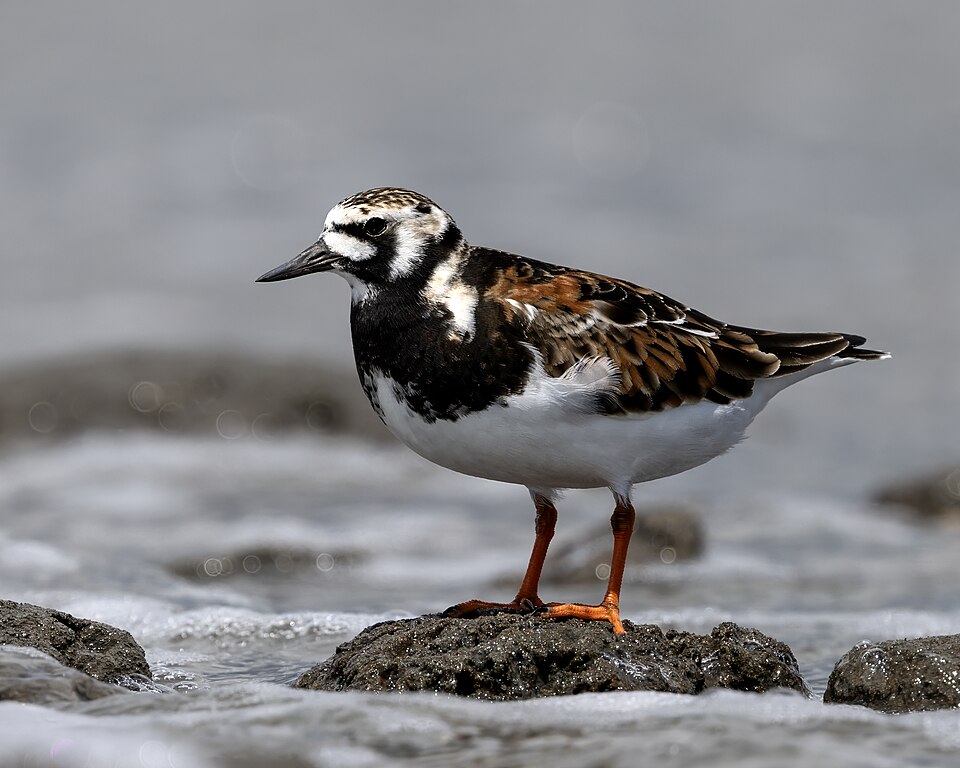
The Ruddy Turnstone is one of the most boldly patterned shorebirds in the world, and once you have seen a breeding adult in good light it is hard to forget. Stocky and short-legged, with a wedge-shaped black bill and a clown-like face mask, it earns its name honestly: it walks the tideline flipping over stones, shells, seaweed, and clumps of debris to snatch the small creatures hiding underneath. Few other shorebirds feed this way, and watching one work a rocky jetty or wrack line is a small lesson in problem-solving.
This is a true globe-trotter. Ruddy Turnstones breed on the high Arctic tundra of North America and Eurasia, then scatter to coastlines on nearly every continent, reaching the tip of South America, southern Africa, and Australia. On their wintering and migration grounds they are birds of rocky shores, mudflats, sandy beaches, breakwaters, and harbor pilings, often mixing with other shorebirds. Because they show up almost anywhere there is a coast, they are a favorite "first hard shorebird" for new birders learning to read a winter flock.
Look for a compact, chunky shorebird that sits low to the ground on short, bright orange legs. The body is rounded, the neck is short, and the bill is distinctive: black, slightly upturned, and tapered to a sharp wedge that the bird uses like a small crowbar. Even in dull non-breeding plumage, the orange legs and the dark, bib-like breast pattern set it apart from most other small to medium shorebirds.
| Breeding back | Bright calico of chestnut-rust, black, and white, giving a tortoiseshell or 'harlequin' look |
| Head & face | Black-and-white harlequin face mask; white head with bold black markings in breeding birds |
| Breast | Black bib that breaks into irregular blotches against a clean white belly |
| Legs | Short and bright orange to orange-red, obvious year-round |
| Bill | Short, black, slightly upturned and wedge-shaped, built for flipping debris |
| In flight | Striking white stripes on the back, wings, and tail create a bold harlequin pattern overhead |
Male vs. female
In breeding plumage the sexes are similar but separable with a good look. The male is more crisply marked: cleaner white on the head with sharper, more contrasting black face and crown markings and a brighter, more vivid rust on the back. The female is a bit duller and "muddier," with more brownish or smudged tones on the crown and face and slightly less brilliant chestnut. Outside the breeding season both sexes wear the same drab brown-and-white non-breeding plumage and cannot reliably be told apart in the field.
Juveniles
Juvenile and first-winter Ruddy Turnstones look like washed-out versions of non-breeding adults: dark grayish-brown above with neat pale fringes to the back and wing feathers that give a slightly scaly, scalloped appearance. The face and breast pattern is duller and browner rather than crisp black, and the legs are often a more muted orange. The basic shape, the wedge bill, and the dark breast band still make them recognizable as turnstones even when the bright adult colors are absent.
Ruddy Turnstones are vocal, and their calls are a good way to detect them in a busy flock. The most familiar sound is a low, hard, rattling chatter, a rapid tuk-a-tuk-tuk or kt-kt-kt-kt that has a dry, staccato, almost mechanical quality. When flushed they give sharper, metallic kewk or chik-ik notes.
On the breeding grounds males add a longer, rolling, churring song delivered in display, a guttural trilled rattle that carries across the open tundra. Away from the Arctic you are most likely to hear the conversational rattling calls birds give as they feed and jostle along the shore.
Ruddy Turnstones breed across the high Arctic, including the northern coasts and islands of Canada, Alaska, Greenland, and arctic Eurasia. They are long-distance migrants with one of the broadest non-breeding distributions of any shorebird, wintering along temperate and tropical coastlines on six continents, from both coasts of the United States south through Central and South America, and across Europe, Africa, Asia, and Australia.
In North America, spring and fall migration brings them to beaches, jetties, and mudflats along the Atlantic, Gulf, and Pacific coasts, with notable spring concentrations at stopovers such as Delaware Bay, where they feed heavily on horseshoe crab eggs. Many non-breeders linger along southern coasts through the summer, so it is possible to find turnstones in some areas in nearly any month.
The Ruddy Turnstone is an opportunistic generalist with one signature technique: it flips. Using that wedge-shaped bill, it overturns stones, shells, seaweed, and tideline debris to expose the invertebrates sheltering beneath, small crustaceans, amphipods, marine worms, insects, mollusks, and barnacles. It will also probe, pry into crevices on rocks and jetties, and dig small holes in sand or mud.
Its diet is remarkably flexible. During spring migration along the Atlantic coast, turnstones gorge on the eggs of spawning horseshoe crabs. They readily scavenge as well, picking at carrion, fish scraps, and human food waste around harbors and beaches, and they have even been recorded raiding the eggs of other birds. This adaptability is a big reason the species thrives on so many different coastlines.
Ruddy Turnstones nest on open Arctic tundra, often near the coast on gravel, rock, or low vegetation. The nest is a simple, shallow scrape on the ground, sometimes lined sparsely with leaves, lichen, or grass. The pair is monogamous, at least for the season, and both adults are strongly territorial, defending the nest aggressively against gulls, jaegers, and other predators.
The female typically lays four eggs, olive to buff with dark blotching that blends into the tundra. Both parents share incubation, which lasts about three weeks, and the downy chicks leave the nest soon after hatching to feed themselves under parental guard. The female often departs before the young fledge, leaving the male to tend the brood through the final stretch. There is a single brood per year, matched to the short Arctic summer.
The Ruddy Turnstone is not a backyard or feeder bird, so there is no seed mix or feeder setup that will bring one to your garden. It is a coastal specialist, and the way to "attract" it is simply to go where it lives and watch quietly. The good news is that they are widespread, approachable, and active feeders, which makes them one of the more rewarding shorebirds to seek out.
- Search the right habitat: rocky jetties, breakwaters, harbor pilings, and tideline wrack are prime, but they also use sandy beaches and mudflats.
- Time your visit to the tides, turnstones feed actively at the exposed wrack line, so a falling or low tide usually offers the best viewing.
- Visit during spring and fall migration, when numbers peak; in spring, horseshoe-crab spawning beaches can draw large flocks.
- Bring binoculars and watch for the telltale behavior, a chunky, orange-legged shorebird flipping over shells and seaweed is almost certainly this species.
- Move slowly and let the flock settle; turnstones are relatively tame and will often feed within close range if you do not crowd them.
- Black Turnstone: Pacific-coast relative; uniformly dark slaty-black above with no rust or calico tones, and dark legs rather than bright orange.
- Surfbird: Shares rocky Pacific shores and a stocky build, but is gray overall with yellow legs and a stubbier bill, and lacks the harlequin pattern.
- Dunlin: Also common on coasts but slimmer, with a long downcurved black bill, black legs, and a plain grayish (or black-bellied breeding) plumage, no flipping behavior.
- Sanderling: Pale beach shorebird that chases waves rather than flipping debris; black legs and bill and a much plainer, paler body.
Why is it called a turnstone?
The name comes directly from its signature feeding behavior. It uses its short, wedge-shaped bill to flip over stones, shells, and clumps of seaweed along the shore, then snaps up the small invertebrates hiding underneath. Very few shorebirds feed this way, which makes the behavior a reliable field mark on its own.
Where can I see a Ruddy Turnstone?
Look on coastlines almost anywhere outside the breeding season, rocky jetties, breakwaters, harbor pilings, sandy beaches, and mudflats. In North America they pass through both coasts and the Gulf during spring and fall migration, and many linger along southern shores through winter. They breed only on the high Arctic tundra.
How do I tell a Ruddy Turnstone from a Black Turnstone?
The two overlap mainly on the Pacific coast. The Ruddy Turnstone has bright orange legs and, in breeding plumage, a calico back of rust, black, and white. The Black Turnstone is uniformly dark slaty-black above with no rust and has dark, dusky legs rather than orange ones.
What does a Ruddy Turnstone eat?
It is an opportunistic generalist. The core diet is small invertebrates, crustaceans, marine worms, insects, mollusks, and barnacles, pried from beneath stones and debris. During spring migration they feast on horseshoe-crab eggs, and they will also scavenge carrion, fish scraps, and human food waste around harbors.
Are Ruddy Turnstones rare or endangered?
The species is listed as Least Concern globally and remains common across its huge range. However, several populations have shown long-term declines, linked partly to pressures at key migration stopovers, so they are a species conservationists keep a close eye on even though they are still widespread.