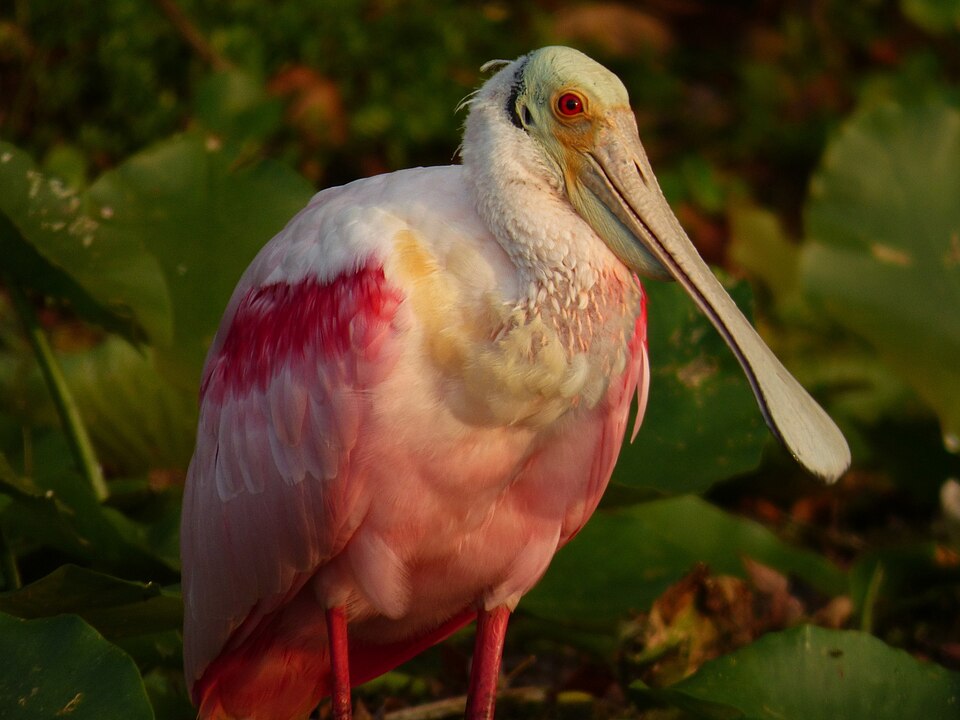
Few birds in North America stop a person in their tracks like the Roseate Spoonbill. Standing knee-deep in a coastal lagoon, this big wader looks almost impossible: a body washed in pink and rose, blood-red shoulder patches, an orange tail, a bare greenish head, and that famously flattened, spoon-shaped bill swinging side to side through the water. Birders new to the Gulf Coast often mistake a distant flock for flamingos, but spoonbills are stockier, shorter-legged, and carry that unmistakable spatulate bill. They are the only spoonbill found in the Americas.
Spoonbills belong to the ibis family (Threskiornithidae), not to the flamingos they superficially resemble. Their pink color, like a flamingo's, comes from carotenoid pigments in the crustaceans and small fish they eat, so the brightest birds are usually the best-fed adults. Once nearly wiped out in the United States by plume hunters who prized their feathers for ladies' hats and fans, the species has rebounded strongly along the Gulf and South Atlantic coasts. Today a summer trip to a Florida, Louisiana, or Texas wetland almost guarantees a look at one of the continent's most colorful birds.
The Roseate Spoonbill is a tall, heavy-bodied wading bird with a long neck, long pink-and-black legs, and an unmistakable bill that is broad and rounded at the tip like a kitchen spoon. In flight it holds its neck outstretched (unlike herons, which fold theirs) and shows pink wings with deeper rose at the bend. Even at a great distance, the combination of overall pink coloring and the flat-tipped bill rules out everything else in North America.
| Bill | Long, gray, flattened and spatulate (spoon-shaped) at the tip, the single most diagnostic feature |
| Plumage | Pale to deep pink body with bright carmine-red shoulders ('drip' patches) and an orange-buff tail in breeding adults |
| Head | Bare, greenish-gold skin on a featherless head in adults; no feathers on the face |
| Legs | Long, pinkish-red legs and feet, suited to wading in shallow water |
| Flight | Neck and legs extended, slow steady wingbeats, often in lines or loose Vs |
| Size | Large, roughly the size of a small heron, with a 4-foot-plus wingspan |
Male vs. female
Males and females look essentially alike in plumage, so you cannot reliably sex a spoonbill in the field by color. Males average slightly larger overall and tend to have a somewhat longer, heavier bill, but this is only obvious when a pair stands side by side. Both sexes develop the same vivid breeding colors and the bare head, and both share incubation and chick-feeding duties at the nest.
Juveniles
Young spoonbills are easy to age. Juveniles are a much paler, washed-out pink, sometimes almost whitish, and lack the brilliant red shoulder patches and orange tail of adults. Crucially, immature birds have a fully feathered, whitish head rather than the bare greenish skin of adults, and their bill is smoother and pinker before it develops the adult's grayish, ridged texture. It takes about three years for a spoonbill to acquire full adult coloring, so flocks often contain birds at several shades of pink.
The Roseate Spoonbill is a famously quiet bird, far less vocal than the herons and egrets it often shares a marsh with. Most of the time it feeds in near silence. When it does call, it produces low, guttural grunts and a soft, rattling huh-huh-huh or uh-uh-uh, often given at the nest or when birds jostle for feeding space.
At breeding colonies the sounds become more varied: rhythmic clucking, croaking, and a dry bill-clattering or clacking during courtship and nest exchanges. None of these carry far, and there is no true song. If you hear loud squawks from a wading flock, look first to the herons rather than the spoonbills.
In the United States, Roseate Spoonbills are birds of the southern coasts. Breeding strongholds run along the Gulf of Mexico from Florida west through coastal Louisiana and Texas, with smaller populations along the South Atlantic coast. The species ranges far south of the U.S. as well, breeding through Mexico, Central America, the Caribbean, and across much of South America to Argentina and Chile.
After the nesting season, many birds disperse widely, and post-breeding wanderers can turn up well north of the breeding range, strays reach inland states, the mid-Atlantic, and occasionally the upper Midwest in late summer. Florida and coastal Texas populations are largely resident year-round, while birds at the northern fringe of the range are more migratory or nomadic, shifting with water levels and food availability rather than following a strict calendar.
Spoonbills are tactile feeders, and watching one hunt is a treat. The bird wades through shallow water with its bill partly open and submerged, sweeping the spoon-shaped tip from side to side in steady arcs. Sensitive nerve endings inside the bill snap it shut the instant it touches prey, so the bird does not need to see what it catches, it can even feed effectively in muddy or murky water and after dark.
The diet is mostly small aquatic animals: minnows and other small fish, shrimp, crayfish, crabs, aquatic insects and their larvae, mollusks, and occasionally bits of plant material swept up with the rest. They favor shallow, brackish and freshwater wetlands, tidal flats, mangrove pools, and managed impoundments where small prey concentrate. Spoonbills often feed in loose groups and will follow falling tides or shrinking pools that trap fish in easy reach.
Roseate Spoonbills are colonial nesters, building their nests alongside herons, egrets, and ibises in mangroves, on coastal islands, or in shrubs and small trees standing over or near water. The male gathers most of the sticks and the female does most of the building, weaving a bulky platform with a shallow cup lined with finer twigs and leaves. Pairs are seasonally monogamous and perform bill-clattering and stick-passing displays during courtship.
The female typically lays 2 to 4 dull whitish eggs marked with brown spots. Both parents incubate for roughly three weeks, and both feed the chicks by regurgitation. Young spoonbills are clumsy and stay in or near the nest for several weeks, clambering through branches before they can fly at around six to eight weeks old. Colonies are sensitive to disturbance and to water management, so successful nesting depends heavily on stable wetland conditions during the breeding season.
The Roseate Spoonbill is not a backyard or feeder bird, and there is no realistic way to attract one to a typical yard, it needs shallow coastal wetlands full of small fish and crustaceans, not a seed feeder. Instead, the goal is to put yourself where they already are.
- Visit coastal wildlife refuges and wetland boardwalks along the Gulf Coast, Florida, Louisiana, and Texas offer the most reliable viewing.
- Time visits for spring and summer, when breeding adults are at their pinkest and gather at colonies and feeding flats.
- Look at shallow, brackish pools and tidal flats on a falling tide, when concentrated small fish draw spoonbills in to feed.
- Scan mixed wading-bird flocks carefully, spoonbills often feed alongside egrets, herons, and ibises, and the pink stands out once you spot it.
- Bring binoculars or a spotting scope and keep your distance from nesting colonies, which are easily disturbed.
- If you keep a coastal property near wetlands, protecting and not draining nearby shallow water does more for spoonbills than any feeder ever could.
- American Flamingo: Far taller and pinker with a long, downward-bent (not spoon-shaped) bill and an extremely long neck; rare in the U.S. and not easily confused once the bill is seen.
- Scarlet Ibis: Brilliant red, not pink, with a slender curved (decurved) bill rather than a flat spoon; not native to the U.S. but sometimes seen in collections or as escapees.
- White Ibis: Same family and habitats, but white with a curved reddish bill; juveniles are brownish but never pink and lack the spatulate bill.
- Great Blue Heron: Similar size and shares the marsh, but gray-blue with a dagger bill and folds its neck in flight; no pink anywhere.
Why are Roseate Spoonbills pink?
Their pink color comes from carotenoid pigments in the small crustaceans and aquatic animals they eat, much like flamingos. Birds with the richest diets show the deepest rose and red, while young or poorly fed birds are much paler.
Is a Roseate Spoonbill the same as a flamingo?
No. Spoonbills are members of the ibis family, while flamingos are in a completely separate group. Both are pink from their diet, but a spoonbill is stockier, shorter-necked, and has a flat, spoon-shaped bill instead of the flamingo's down-bent bill.
Where can I see a Roseate Spoonbill in the United States?
They are most reliable along the Gulf Coast, coastal Florida, Louisiana, and Texas, at wildlife refuges, shallow lagoons, and tidal flats. Post-breeding wanderers occasionally show up much farther north in late summer.
What does a Roseate Spoonbill eat and how does it feed?
It eats small fish, shrimp, crayfish, crabs, aquatic insects, and similar prey. It feeds by sweeping its open spoon-tipped bill side to side through shallow water; the bill snaps shut on contact, so the bird can feed by touch even in murky water.
How can I tell a young spoonbill from an adult?
Juveniles are pale, washed-out pink with a feathered whitish head and no red shoulder patches. Adults are deeper pink with bright carmine shoulders, an orange tail, and a bare greenish head. Full adult color takes about three years.
Are Roseate Spoonbills endangered?
They are listed as Least Concern globally and have recovered well since plume hunting nearly wiped them out in the early 1900s. They remain sensitive to wetland loss and disturbance at nesting colonies, so local protection still matters.