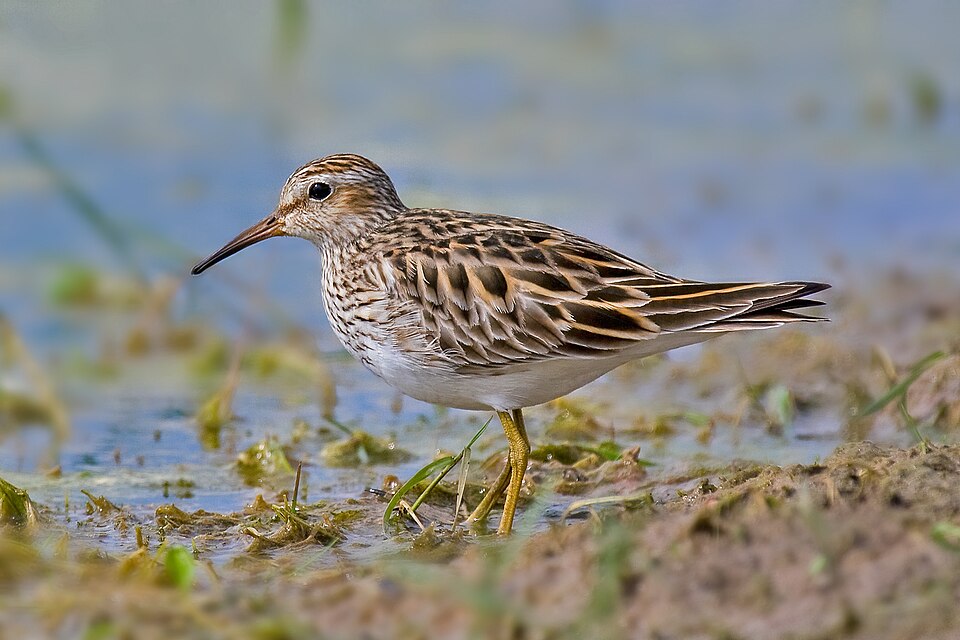
The Pectoral Sandpiper is one of North America's most familiar "grasspipers", a medium-sized shorebird that favors wet grassy meadows, flooded fields, and the muddy margins of marshes rather than open ocean beaches. Its name comes from the bold, sharply defined band of brown streaking across its chest that ends in a clean line against a white belly, as if someone drew a horizontal stroke and stopped. Once you learn that mark, this bird becomes one of the easier mid-sized sandpipers to name in the field.
It is also a champion long-distance traveler. Most Pectoral Sandpipers nest across the Arctic tundra of North America and Siberia, then funnel south through the interior of the continent to spend the northern winter on the wet grasslands and pampas of southern South America. That marathon, plus the male's strange inflatable-chest courtship display, makes this an unusually interesting bird hiding inside a plain brown package.
Look for a fairly chunky, medium-small sandpiper with a longish neck, a slightly down-curved bill of moderate length, and yellowish to greenish legs. It often stands upright in grass and walks deliberately, picking at the ground like a tiny plover-meets-snipe. The single best mark is the dense breast streaking that cuts off abruptly across the chest.
| Breast band | Dense brown streaking on the chest ending in a sharp, clean line against a white belly, the key field mark in all plumages. |
| Bill | Medium length, slightly decurved, dark with a paler dull-yellow or greenish base. |
| Legs | Dull yellow to yellow-green (not black), helping separate it from many small peeps. |
| Size | Noticeably larger than a Least or Semipalmated Sandpiper but smaller than a dowitcher; males are distinctly bigger than females. |
| Back pattern | Brown back with neat pale feather edges; juveniles show crisp white braces (lines) down the back. |
| Posture | Often stands erect in grass with a slightly potbellied, long-necked look; crouches and creeps when nervous. |
Male vs. female
Males and females share the same plumage pattern, so you cannot reliably sex them by color. The big clue is size: male Pectoral Sandpipers are conspicuously larger and heavier than females, often looking like a different species when the two stand side by side, and a large male can weigh roughly twice as much as a small female. In breeding males the chest band is part of an inflatable fat-and-air sac used in display, giving displaying birds a swollen, pendulous-breasted profile that females never show.
Juveniles
Juveniles are the freshest and brightest plumage you'll see in fall migration, and they make up most of the birds passing through in autumn. They show warm, rusty-edged back feathers arranged in two bright white "braces" or suspender-like lines down the back, a rusty cap, and a cleaner, more buff-toned breast band than worn adults. The crisp pale fringes give juveniles a scaly, neatly scalloped upperside that is genuinely handsome up close.
The flight and contact call is the most useful sound: a low, rich, reedy churk or prrt, often described as a dry, slightly trilled krrrt that sounds throatier and lower-pitched than the thin notes of small peeps. Birds flushed from wet grass typically give this call as they tower away.
On the breeding grounds, displaying males produce one of the strangest sounds in the shorebird world: a deep, resonant, hollow hooting, a series of muffled, booming oonh-oonh-oonh notes, created by inflating the air sac in the chest and forcing air through it as the male flies low over the tundra with puffed-out breast. It carries a long way across the flat Arctic and is unlike anything you'll hear from this bird during migration.
Pectoral Sandpipers breed across the high Arctic, from the tundra of northern and western Alaska and Arctic Canada westward across a broad swath of northern Siberia. They are long-distance migrants that move primarily through the interior of the Americas, the Great Plains, prairie pothole region, and Mississippi flyway see the heaviest passage, though they turn up coast to coast.
The bulk of the population winters in southern South America, especially the grasslands and wetlands of Argentina, Uruguay, Paraguay, and southern Brazil, with some reaching as far as Patagonia. They are also famous vagrants: small but regular numbers appear in western Europe each autumn, making this one of the most frequent American shorebirds to cross the Atlantic. In North America look for them in spring (roughly April–May) and during a long fall passage (July into October), with fresh juveniles dominating later.
Pectoral Sandpipers are visual, surface-and-shallow feeders. They walk steadily through wet grass, mud, and shallow flooded ground, picking and probing for small invertebrates rather than wading into deep water. The diet is dominated by insects and their larvae, especially flies and midges, beetles, and the larvae that thrive in wet soil, along with small crustaceans, worms, snails, and spiders. On the breeding grounds, swarms of Arctic flies and midges fuel both adults and the rapidly growing chicks.
During migration they exploit ephemeral habitats: rain-flooded farm fields, the grassy edges of sewage and treatment ponds, sod farms, wet pastures, and the drawdown margins of reservoirs. Their preference for short, wet vegetation over open mud is a big reason birders nickname them and their relatives "grasspipers."
Nesting takes place on the open Arctic tundra. The nest is a simple shallow scrape on the ground, often tucked beside a grass tussock or in low sedge, lined with bits of grass, leaves, and lichen. The female typically lays four eggs, buff to olive, heavily blotched with brown, that blend almost perfectly into the tundra.
This species has a notably uneven sex-role system. Males are polygynous: they compete for and display to multiple females using the inflatable-chest hooting flight, then take essentially no part in raising young. The female alone incubates the eggs and tends the precocial, downy chicks, which leave the nest soon after hatching and feed themselves while she broods and guards them. With the brief Arctic summer, the whole cycle is compressed into just a few intense weeks.
This is not a feeder or backyard bird, it won't visit seed, suet, or a typical yard. But it is very findable if you go where the water and grass meet, and a wet-enough property can genuinely draw it during migration.
- Scan flooded fields, wet pastures, and sod farms during spring and especially fall migration, these short-grass wet habitats are exactly what Pectorals seek out.
- Check the grassy margins of sewage lagoons, retention ponds, and reservoir drawdowns, where receding water exposes muddy, weedy edges full of insect larvae.
- If you manage land, maintaining a shallowly flooded grassy area in late summer can pull in migrant shorebirds, including Pectorals.
- Look closely at mixed shorebird flocks for a larger bird with a sharply cut-off streaked breast and yellowish legs standing upright in the grass.
- Time your searches to July through October for the long fall passage, when fresh, bright juveniles are most numerous and confiding.
- Least Sandpiper: Much smaller, with the same yellowish legs but a finer breast wash that lacks the bold, sharply cut-off band; size difference is obvious side by side.
- Sharp-tailed Sandpiper: A close Asian cousin and frequent confusion species; juveniles are richer buff-orange on the breast with a bright rusty cap and a bolder eyebrow, and lack the crisp band cutoff.
- Baird's Sandpiper: More elongated and long-winged with black legs and a buffy, finely streaked breast that fades gradually rather than ending in a hard line.
- Dunlin: Similar size but with black legs, a longer drooping bill, and (in breeding plumage) a black belly patch instead of a clean white belly below a streaked chest.
Why is it called a Pectoral Sandpiper?
The name refers to the pectoral (chest) region. Males have an inflatable air-and-fat sac in the breast that they puff out during their hooting courtship display, and all ages show a heavily streaked chest band, so the chest is both the bird's signature field mark and the origin of its name.
What's the easiest way to identify a Pectoral Sandpiper?
Look for the dense brown streaking across the chest that ends in a sharp, clean line against a white belly, combined with dull yellow-green legs and a medium, slightly decurved bill. A bird the size between a small peep and a dowitcher, standing upright in wet grass with that crisp breast band, is almost always a Pectoral.
Where and when can I see one?
Watch flooded fields, wet pastures, sod farms, and the grassy edges of ponds and reservoirs, mainly in the continent's interior. Spring passage runs roughly April to May, and there is a long fall passage from July into October when bright juveniles are most common.
Why are some Pectoral Sandpipers so much bigger than others?
Males are dramatically larger than females in this species, a difference among the most extreme of any sandpiper. So two Pectorals standing together that look like different sizes are usually just a male and a female, not two different species.
Will Pectoral Sandpipers come to my backyard or feeder?
No. They don't eat seed or visit feeders and avoid dry lawns. The way to attract them is habitat: shallow flooded grassy areas, wet field edges, and muddy pond margins during migration, where they hunt insects and other small invertebrates.