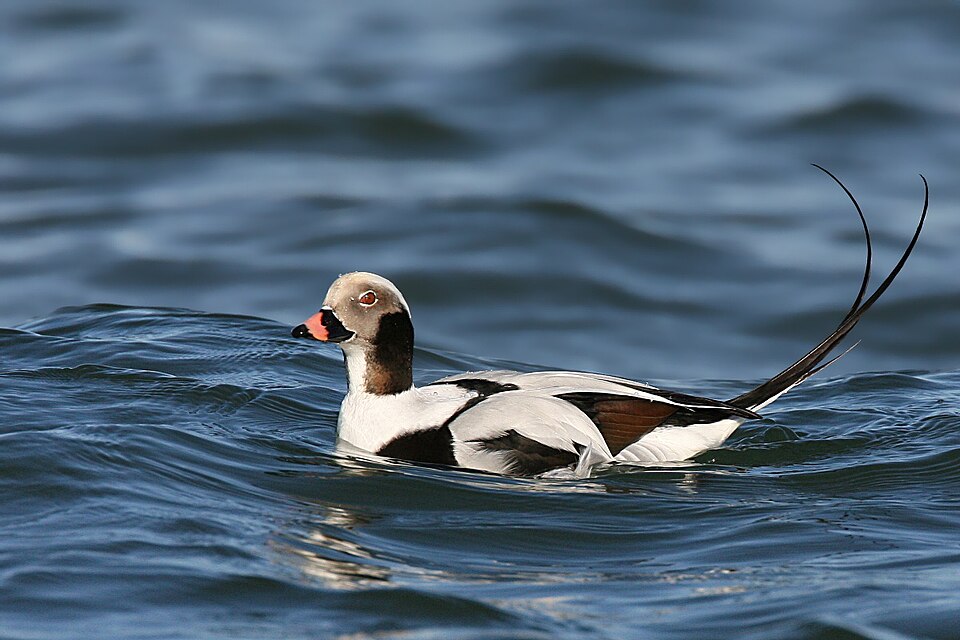
The Long-tailed Duck is one of the most striking and restless of the sea ducks, a small, compact diver that breeds across the high Arctic and spends winters bobbing on cold coastal waters and the Great Lakes. Once known by the now-retired name "Oldsquaw," it stands out for two reasons: the drake's slender, whip-like central tail feathers that trail behind him on the water, and his loud, yodeling call that carries across the waves like the sound of a distant gathering. Few ducks are as vocal or as constantly in motion.
What makes this species especially confusing for new birders is that it wears completely different plumages through the year, swapping between dark and white in patterns unlike any other North American duck. It is also a remarkable diver, plunging deeper than almost any other duck to feed on the bottom. For most of us it is a winter bird of the coast, big lakes, and open bays, and spotting a tight, fast-flying flock skimming low over gray water is one of the small rewards of cold-season birding.
Look for a small, short-bodied, round-headed duck that sits low in the water and dives constantly. The body is chunky and the bill is short and stubby. Males show the unmistakable long, thin tail streamers; on both sexes, watch for bold blocks of dark and white plumage that shift dramatically with the seasons, plus uniformly dark, plain wings in flight (no wing patch or speculum).
| Size & shape | Small, compact diving duck with a rounded head, short neck, and short stubby bill; sits low in the water. |
| Male tail | Two greatly elongated, needle-thin central tail feathers that trail behind on the water - unique among North American ducks. |
| Winter male | Mostly white head and body with a bold dark cheek patch, dark breast, and dark back; short pink-and-black bill. |
| Wings in flight | Plain, all-dark upperwings with no white patch or speculum on either sex - a key flight mark. |
| Female | Brownish above and white below with a pale face, dark crown, and a smudgy dark cheek spot; no long tail. |
| Flight style | Fast, low, tilting flocks that twist and roll, often flashing dark-and-white as they bank over the water. |
Male vs. female
Males and females look quite different, and both also change with the seasons, which is why this duck trips people up. The breeding (summer) male is mostly dark chocolate-brown to black with a white face patch around the eye and white flanks, plus the long tail plumes. By winter, the male flips to mostly white on the head, neck, and body, with a dark gray-brown cheek smudge, a dark breast band, and a dark back; his short bill is black with a pink band. Females never grow the long tail. A female is browner and plainer overall: dark above, white below, with a pale face, a dark cap, and a dusky cheek spot whose size and shape shift through the year. When in doubt, the plain dark wings and the constant diving help confirm the species in either sex.
Juveniles
Juveniles and first-winter birds resemble adult females: brown-backed, pale-bellied, with a muted face pattern and a soft dusky cheek mark. Young males are duller and more washed-out than adult winter drakes and lack the fully grown tail streamers, gaining their long central feathers and crisper black-and-white pattern as they mature into their first spring and beyond. Through fall and early winter, expect messy, intermediate-looking birds as they molt - a young drake may show patchy hints of the adult cheek patch and breast band before the pattern fully comes in.
The Long-tailed Duck is famously noisy, and its voice is part of what makes a winter flock memorable. Males give a loud, musical, yodeling call often written as ow-ow-owdle-ow or a-ahlee, ahlee-ah, a rolling three-note phrase that carries a long way over open water. From a big raft of birds the overlapping calls create a constant, almost cheerful clamor that some old-timers compared to distant bagpipes or a pack of hounds.
The old name "Oldsquaw" actually came from this chatter. Females are far quieter, giving lower, softer grunting and quacking notes. The yodeling is most intense in late winter and early spring as flocks pair up, so a calm coastal morning in February or March is a good time to hear them in full chorus.
Long-tailed Ducks breed across the high Arctic, on tundra ponds, marshy lake edges, and coastal islands throughout northern Canada, Alaska, Greenland, and across northern Eurasia. They are circumpolar, nesting nearly to the limit of land in the far north. After breeding they move south to spend the winter on cold marine waters.
In North America, winter brings them to both coasts - the Atlantic from the Canadian Maritimes south to the mid-Atlantic, and the Pacific from Alaska down the western seaboard - as well as in large numbers to the Great Lakes, where huge rafts gather offshore. They favor open bays, deep lake waters, and the edges of sea ice. They are scarce inland away from big water, so for most birders this is a coastal or Great Lakes specialty seen from late fall through early spring.
This is one of the deepest-diving of all ducks. Long-tailed Ducks routinely feed well below the surface and have been recorded diving far deeper than most other ducks, using their wings as well as their feet to "fly" underwater after food. They forage on the bottom and in the water column, often diving repeatedly in long, rhythmic sequences.
The diet is dominated by animal prey: small mollusks like clams and mussels, crustaceans such as amphipods and small crabs, marine worms, and small fish and fish eggs, plus aquatic insects on the tundra breeding grounds. On the wintering Great Lakes they take a heavy toll on small invertebrates and have benefited locally from introduced mussels. Because they feed by diving and not at the surface, they tend to disappear underwater for long stretches, which is itself a useful clue when scanning a distant flock.
Long-tailed Ducks nest on the open Arctic tundra, usually near water - the edge of a pond, a marshy lake, or a coastal islet. The female chooses the site and builds a simple ground nest, a shallow scrape tucked among low vegetation or rocks and lined with plant material and a generous layer of her own dark down for insulation against the cold.
She lays a clutch of roughly 6 to 8 olive to buff eggs and does all the incubation herself over about three and a half weeks. The ducklings are precocial, leaving the nest soon after hatching and feeding themselves under the female's watch. With the brief Arctic summer, the species raises a single brood per year, and birds head back to coastal waters as the young fledge and the tundra freezes.
This is not a backyard or feeder bird, so there is no way to lure one in with seed or a yard pond. It is a true sea duck that needs cold, open, often deep water, and you attract sightings by going to the right places at the right season rather than by setting anything out.
- Go to the coast or the Great Lakes from late fall through early spring - this is a cold-season bird that vanishes north to breed in summer.
- Scan open bays, harbor mouths, jetties, and deep lakeshores, especially where you can see far out over the water; they often raft well offshore.
- Bring a spotting scope - flocks frequently sit at a distance, and a scope turns distant dots into identifiable ducks.
- Listen as much as you look. The drakes' yodeling calls carry across the water and often reveal a flock before you spot it.
- Watch for the constant diving - if a small, low-sitting duck keeps disappearing underwater in long sequences, it is worth a closer look.
- Check Great Lakes piers and breakwaters in winter, where birds sometimes feed surprisingly close to shore.
- Northern Pintail: Also has long, pointed tail feathers, but it is a slim, long-necked dabbling duck of freshwater that tips up to feed rather than diving; the Long-tailed Duck is a compact, short-necked sea duck.
- Harlequin Duck: Another small, dark sea duck of cold water, but the male is slate-blue with bold white stripes and chestnut sides; it lacks long tail streamers and prefers rocky surf.
- Bufflehead: Small diving duck of similar size, but the male is glossy black-and-white with a big white head patch and no long tail, and it lacks the Long-tailed Duck's seasonal dark-and-white shifts.
- White-winged Scoter: Shares the same cold winter waters, but it is a much larger, bulkier, dark scoter with a white wing patch in flight - the opposite of the Long-tailed Duck's plain dark wings.
Why was the Long-tailed Duck called Oldsquaw?
That was its old North American name, drawn from the constant chattering, yodeling calls of a flock. The name was officially changed to Long-tailed Duck, which is both less offensive and a better description, since it matches the species' name used in much of the rest of the world and points to the drake's distinctive tail.
Do female Long-tailed Ducks have long tails?
No. Only the adult male grows the two greatly elongated central tail feathers that give the species its name. Females and young birds have a normal short tail, so you identify them by their compact shape, plain dark wings, pale face with a dark cheek smudge, and constant diving instead.
Where can I see a Long-tailed Duck?
In winter, look on cold coastal waters of both the Atlantic and Pacific and especially on the Great Lakes, where large rafts gather offshore. Check open bays, harbor mouths, jetties, and deep lakeshores from late fall through early spring. They breed in the high Arctic and are largely absent from the lower latitudes in summer.
How deep can a Long-tailed Duck dive?
Remarkably deep - it is among the deepest-diving of all ducks and has been recorded feeding far below the surface, deeper than most other diving ducks. It uses its wings underwater to chase mollusks, crustaceans, and small fish on or near the bottom, which is why it spends so much time submerged.
What does a Long-tailed Duck sound like?
The male gives a loud, musical, yodeling call often written as ow-ow-owdle-ow or a-ahlee, ahlee-ah. From a large flock the overlapping calls create a constant, far-carrying clamor that some people compare to distant bagpipes or baying hounds. Females are much quieter, giving low grunts and quacks.