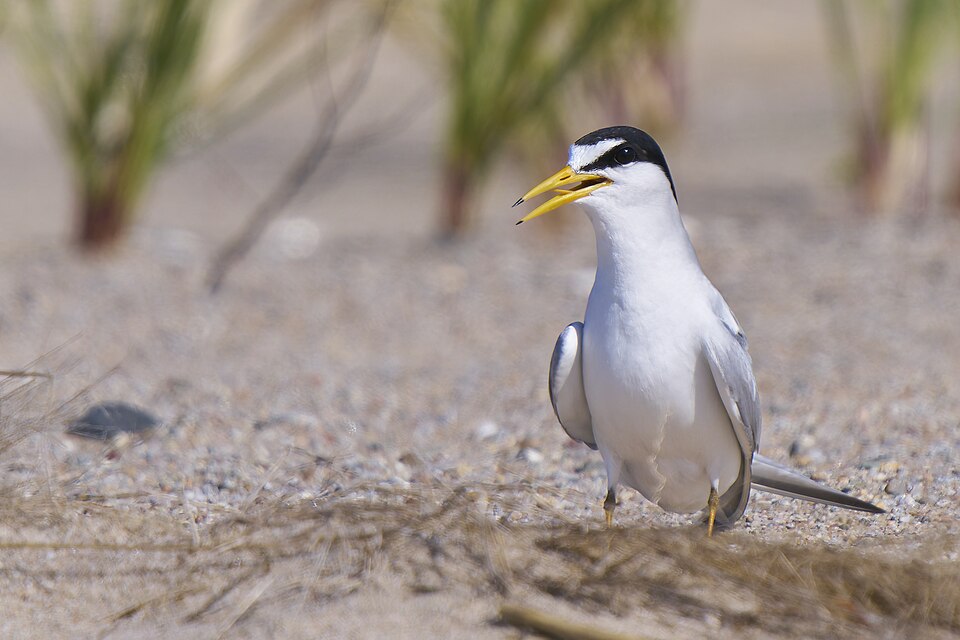
The Least Tern is the smallest tern in the Americas, barely larger than a big swallow and dwarfed by the gulls it often nests near. Despite its size, it is one of the most energetic birds you can watch over open water: it patrols just above the surface on quick, stiff wingbeats, hovers for a moment with its bill pointed straight down, then folds up and plunges with a tiny splash to snatch a minnow. In summer it brings life to a habitat most beachgoers overlook, the bare sand and gravel of barrier islands, river sandbars, and dredge-spoil flats.
This is a bird worth caring about. Several populations, including the interior and California subspecies, have been listed as threatened or endangered because the open, undisturbed nesting grounds they need are exactly the places people love to drive, walk dogs, and build. Where conservationists rope off colonies and keep predators in check, Least Terns can still thrive, and watching one dive into the surf is one of the small, bright pleasures of a summer day at the coast.
Think of a Least Tern as a tern in miniature: slender, sharp-winged, and buoyant, with a deeply forked tail and a fast, almost frantic flight that sets it apart from larger, more languid terns. At rest it looks pale gray above and white below, and the size alone, smaller than a Killdeer, is often the first clue.
| Size | Tiny for a tern, about 9 inches long with a roughly 20-inch wingspan; noticeably smaller than nearly every other tern in its range. |
| Bill | Yellow with a small black tip in breeding adults, the only North American tern with a yellow bill; legs are orange-yellow. |
| Head | Black cap with a distinctive white triangle on the forehead in summer, and a black line running from the bill through the eye. |
| Upperparts | Pale gray back and wings; the two outermost primaries form a sharp black wedge along the leading edge of the wingtip in flight. |
| Flight | Fast, shallow, flickering wingbeats and frequent hovering; looks hurried and twitchy compared with slower, deeper-beating larger terns. |
| Tail | White and deeply forked, though shorter and less streaming than the long tail of a Common or Forster's Tern. |
Male vs. female
Males and females look alike. Both sexes share the black cap, white forehead, yellow black-tipped bill, and gray-and-white body in breeding plumage, and they cannot be reliably told apart in the field by appearance. Behavior is the best clue during courtship: the male is usually the one carrying a small fish, presenting it to a prospective or established mate in the ritual "fish flight" and ground display that cements the pair bond.
Juveniles
Juveniles look scaly and dull compared with crisp summer adults. They are buff to grayish above with dark U-shaped or scalloped feather edges across the back and wings, a smudgy dark cap that does not reach the bill cleanly, and a dark bar on the inner forewing. The bill is dusky or dull yellowish rather than bright, and the legs are paler. By their first winter, young birds and adults alike show a white forehead extending farther back, a dark bill, and a reduced dark cap, looking much plainer than the breeding adult.
Least Terns are noisy, excitable birds, and a colony announces itself well before you see it. The most familiar sounds are a sharp, high kip and a rasping, scolding zree-eep or z-z-z-zreep given in alarm or as birds chase each other overhead. When a predator approaches the nesting ground, the whole colony erupts into a buzzy, grating chorus and dives at the intruder.
A common contact and courtship note is a quick, repeated kit-kit-kit or ki-deek, often delivered in flight. The overall impression is thin, sharp, and squeaky, fitting the bird's small size, and quite different from the deeper, harsher calls of larger terns.
Least Terns breed across three broad regions of the United States: along the Atlantic and Gulf coasts from Maine to Texas, inland along major river systems such as the Mississippi, Missouri, Arkansas, and Red rivers (the interior population), and along the Pacific coast of California and into Mexico (the California population). They favor open sand and gravel near water, whether ocean beach, river sandbar, salt flat, or even gravel rooftops in some urban areas.
They are long-distance migrants and are present in North America only during the warm months, roughly April or May through August or September. In fall they head south to winter along the coasts of Central America and northern South America. Because they are absent in winter and tied to specialized nesting habitat, most birders see them only as a summer specialty along beaches and big rivers.
Least Terns eat mostly small fish, supplemented by shrimp and other small aquatic invertebrates. They hunt in shallow coastal waters, estuaries, lagoons, and rivers, taking prey from at or just below the surface. Favored fish are slim, silvery species small enough to swallow whole, such as silversides, killifish, anchovies, and young of many shoreline fishes.
The hunting style is classic and fun to watch: the tern flies into the wind low over the water, hovers on rapidly beating wings while it fixes on a target, then plunge-dives headfirst with a small splash, usually staying near the surface rather than going deep. Caught fish are often carried crosswise in the bill, both to feed chicks and to present to mates during courtship.
Least Terns nest in loose colonies on open ground with little or no vegetation: bare sand, shell, or gravel on beaches, islands, river sandbars, dredge-spoil sites, and sometimes flat gravel rooftops. The nest is minimal, just a shallow scrape in the substrate, occasionally lined with a few bits of shell, pebbles, or debris. Both members of the pair share nesting duties.
A typical clutch is two to three eggs, pale and heavily spotted to blend almost perfectly with sand and gravel. Both parents incubate for roughly three weeks, and the downy, well-camouflaged chicks leave the scrape within a few days but stay nearby, fed small fish by both adults until they fledge at around three weeks and remain dependent for some time after. Colonies aggressively mob gulls, crows, and people that wander too close, but eggs and chicks remain extremely vulnerable to foot traffic, vehicles, dogs, and predators, which is why so many colonies are fenced and posted.
The Least Tern is not a backyard or feeder bird and cannot be attracted with food, water features, or nest boxes. It is a colony-nesting seabird tied to open sand and gravel beside water, and it eats live fish caught on the wing. The best way to "attract" and support them is to protect their nesting habitat and view colonies responsibly.
- Respect posted colonies. Stay well outside roped-off or signed beach and sandbar areas during the May-through-August nesting season; the eggs and chicks are nearly invisible against the sand and easy to step on.
- Keep dogs leashed (or off beaches entirely) near nesting areas, since loose dogs flush incubating adults and can destroy a colony in minutes.
- Drive only where vehicles are permitted and never on dry upper beach or sandbars where terns nest; tire tracks crush camouflaged nests.
- If terns dive and scold at you, you are too close to a nest, back away immediately so the adults can return to shade their eggs or chicks.
- Support local beach-nesting bird programs, volunteer steward groups, and habitat restoration, which do far more for Least Terns than anything in a backyard.
- Pack out trash and food scraps, which draw gulls, crows, raccoons, and foxes that prey on tern eggs and young.
- Common Tern: Much larger with a red-orange bill (usually black-tipped) and no white forehead patch in breeding plumage; lacks the Least Tern's tiny size and frantic, hovering flight.
- Forster's Tern: Bigger and paler with an orange black-tipped bill, frosty white primaries, and a long forked tail; in winter shows a bold black eye mask rather than a white forehead.
- Black Tern: Similar small size but dark sooty-gray body in breeding plumage and a black bill; feeds by dipping over marshes and fields rather than plunge-diving into open water.
- Sandwich Tern: Larger with a shaggy black crest and a long black bill tipped yellow; shares coastal habitat but is far bigger and flies with slower, deeper wingbeats.
How do I identify a Least Tern?
Look for the smallest tern around, about 9 inches long, with a yellow black-tipped bill, a white triangle on the forehead inside the black cap, pale gray wings with a sharp black wedge at the wingtip, and a fast, hovering flight low over the water. The yellow bill is the standout field mark, since no other North American tern has one.
What is the difference between a Least Tern and a Common Tern?
Size and bill color are the easiest clues. The Least Tern is much smaller (about 9 inches versus 13 to 14), has a yellow bill and a white forehead patch in summer, and flies with hurried, flickering wingbeats and frequent hovering. The Common Tern is noticeably larger with a red-orange bill, a full black cap with no white forehead, and slower, deeper wingbeats.
Where do Least Terns nest?
They nest in colonies on open, bare ground near water: sandy or gravelly beaches, barrier islands, river sandbars, salt flats, dredge-spoil sites, and sometimes flat gravel rooftops. The nest is just a shallow scrape in the sand holding two or three well-camouflaged, speckled eggs.
Are Least Terns endangered?
As a species they are listed as Least Concern globally, but several U.S. populations are protected. The interior (inland river) population and the California population have been listed as endangered or threatened because human disturbance, development, and altered river flows have destroyed much of their open nesting habitat. Many colonies are fenced and monitored to help them recover.
When and where can I see Least Terns?
They are summer visitors to North America, present from about April or May through August or September, then migrate to Central and South America for the winter. Look for them over shallow coastal waters and along major rivers, hunting by hovering and plunge-diving, especially near protected beach or sandbar nesting colonies.