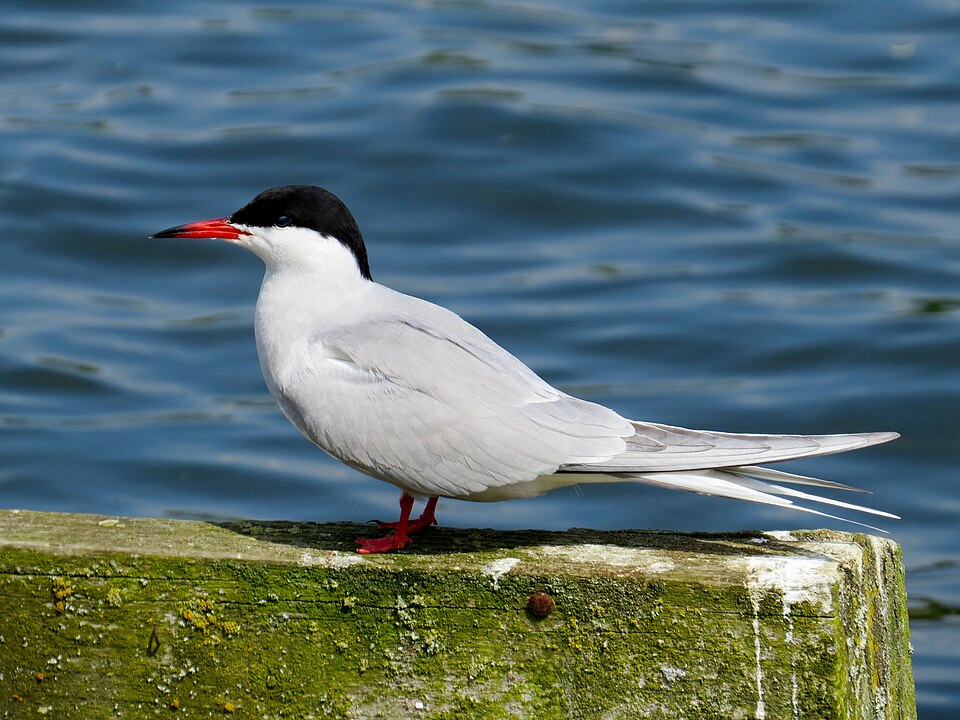
The Common Tern is the bird most people picture when they think "tern", a slim, silvery seabird with a black cap, a forked tail, and a buoyant, bouncing flight over the water. Slender and pale, with long narrow wings and a deeply notched tail, it earned the old nickname "sea swallow" for the way it knifes and twists through the air. You'll see it patrolling above waves and harbors, pausing to hover, then folding its wings and plunging headfirst after a fish with a small splash.
Despite its name, "common" doesn't mean confined to the sea. This is one of the most widespread terns in the Northern Hemisphere, nesting on both coasts of North America as well as inland on the Great Lakes, prairie marshes, and reservoirs. It is a fierce defender of its colonies, dive-bombing and screaming at any intruder, gull, fox, or human, that wanders too close to its eggs. For coastal birders, the return of Common Terns each spring is one of the surest signs that summer is on the way.
Look for a medium-sized, pale gray-and-white waterbird with long pointed wings, a deeply forked tail, and an obvious black cap pulled down over the eyes. In flight it is light and elastic, often hovering before a dive. On the ground it sits low on short red-orange legs. Size and shape sit neatly between the larger gulls and the smaller, daintier terns.
| Bill | Orange-red with a distinct black tip in breeding season; turns mostly dark by late summer and fall |
| Cap | Solid black crown and nape in summer; forehead becomes white as the cap recedes in winter and on immatures |
| Upperwing | Pale gray above with a dark gray wedge on the outer primaries that grows more obvious as feathers wear through summer |
| Tail | Deeply forked, white with gray outer edges; the tail streamers fall short of the wingtips on a perched bird |
| Underparts | White to very pale gray, giving a clean, frosty look; some birds show a faint gray wash on the belly |
| Legs | Short and red-orange, noticeably brighter than the dark legs of similar terns |
Male vs. female
Males and females look alike. There is no reliable plumage difference between the sexes in the field, both wear the same black cap, gray back, and red-orange bill in breeding season. Males average very slightly larger with a marginally longer bill, but the overlap is so great that you cannot sex an individual by sight. Behavior offers the only practical clue: during courtship the male is usually the one carrying a small fish to present to the female, and the female is typically the bird that crouches and begs.
Juveniles
Juveniles look scaly and washed-out compared with crisp adults. The back and wing coverts are marked with warm gingery-brown and buff edgings that fade to gray over the first weeks, the forehead is white, and the bill is dull pinkish-orange to dark with a black tip. The most telling mark is a dark bar across the leading edge of the upperwing (the "carpal bar") paired with a dark wedge on the secondaries, which together break up the wing into a patchy pattern. First-summer birds keep a white forehead and dark shoulder bar, so a tern that looks "messy" in early summer is usually a young one.
Common Terns are noisy, especially around their colonies, and the calls are a big part of identifying them. The signature sound is a harsh, drawn-out KEE-arrr that drops in pitch at the end, often described as grating or tearing, sharper and lower than the rolling calls of many gulls. When alarmed or mobbing an intruder they give a rapid, scolding kik-kik-kik or a short, clipped kip.
A distinctive flat keeur or kyar is given in flight, and the colony as a whole produces a constant, raspy clamor on a summer afternoon. The downslurred quality of the main call is a useful way to separate Common from Arctic Tern, whose voice tends to be higher and more whistled.
Common Terns breed widely across the Northern Hemisphere. In North America they nest along the Atlantic coast from the Canadian Maritimes south to the Carolinas, around the Great Lakes, and across interior wetlands and reservoirs of the northern plains and prairie provinces. Other populations breed across Europe and much of temperate Asia. They favor sandy or gravelly beaches, islands, dredge-spoil sites, and marsh edges where they can nest in loose colonies.
This is a true long-distance migrant. North American breeders winter along the coasts of Central and South America, some reaching as far as Argentina and Chile, while Old World birds head to coastal Africa and southern Asia. Spring migration brings them back to northern colonies from April into May; by August and September they are streaming south again, often gathering in large feeding and roosting flocks at river mouths and on beaches before departing.
Common Terns are specialist fish-eaters. They hunt by flying steadily into the wind a few yards above the surface, scanning down, then hovering briefly before plunge-diving headfirst to seize small fish just below the water. They take prey such as sand lance, herring, silversides, capelin, and other small schooling fish, switching to whatever is locally abundant. Unlike many gulls, they rarely settle on the water and do not scavenge much; they catch their food live and on the wing.
When fish are scarce they will also snatch small crustaceans, shrimp, and insects from the surface or even hawk flying insects in the air. Around colonies you'll see adults flying in with a single fish held crosswise in the bill, these are courtship gifts or meals for chicks. The local supply of small fish strongly shapes their breeding success, which is why these terns are watched closely as indicators of the health of coastal food webs.
Common Terns nest in colonies on the ground, choosing open beaches, sandy or gravel islands, salt marsh wrack, and human-made sites like dredge spoil and gravel rooftops. The nest itself is minimal, a shallow scrape in sand or gravel, sometimes lined with a few bits of shell, grass, or debris. Nesting in groups gives them safety in numbers, and the whole colony will rise to mob a predator together, a strategy effective enough that other birds sometimes nest nearby for protection.
The female typically lays two to three eggs, buff to olive and heavily blotched with dark spots that camouflage them against sand and pebbles. Both parents share incubation for roughly three weeks, and both feed the chicks. The young can leave the scrape and hide nearby within a few days but depend on their parents for food for weeks, even after fledging at around four weeks of age. Pairs usually raise a single brood per season, though they may re-lay if a clutch is lost early.
The Common Tern is not a backyard or feeder bird. It eats live fish caught by diving and nests on open beaches and islands, so it has no use for seed feeders, suet, or nest boxes. You won't lure one to a suburban yard. What you can do is support and enjoy them where they already live, at the coast, on big lakes, and around reservoirs.
- Visit them in their world: scan beaches, jetties, harbor breakwaters, and lake shorelines from late spring through early fall, when terns are most active.
- Give nesting colonies space. Respect posted beach closures and fenced nesting areas, terns abandon scrapes easily and a single disturbance can expose eggs and chicks to gulls and heat.
- Keep dogs leashed near beaches in summer; loose dogs are a major cause of colony failure for ground-nesting terns.
- Support local beach-nesting bird programs and land trusts that fence and steward tern colonies, these are often the difference between a successful and a failed season.
- Watch for the plunge-dive. A tern hovering and then dropping into the water is the easiest way to find one; bring binoculars and look over open water rather than at land.
- Reduce shoreline trash and fishing-line litter, which entangles terns and attracts the gulls and rats that raid their nests.
- Forster's Tern: Very similar in summer but has frosty silvery-white primaries (not a dark wedge), and in winter shows a bold black eye-patch instead of a full black cap reaching the nape.
- Arctic Tern: Shorter-legged with an all-red bill (no black tip), longer tail streamers that reach past the wingtips at rest, and translucent wings with only a thin dark trailing edge.
- Roseate Tern: Paler overall with a mostly black bill in early summer, very long white tail streamers, and a faint pink flush on the breast; its call is a soft 'chu-ick' rather than a harsh tearing note.
- Sandwich Tern: Larger and lankier with a slim black bill tipped yellow and a shaggy black crest; favors saltwater coasts and lacks the orange-red bill of the Common Tern.
What is the difference between a Common Tern and a seagull?
Terns are slimmer and more delicate than gulls, with narrow pointed wings, a deeply forked tail, and a thin pointed bill carried angled downward in flight. Gulls are bulkier, broader-winged, and have square or rounded tails and heavier bills. Terns also hunt by hovering and plunge-diving for live fish, while gulls more often scavenge, float on the water, and walk around on land.
How do you tell a Common Tern from a Forster's Tern?
In breeding plumage, look at the wingtips and bill: Common Tern shows a darker gray wedge on the outer wing and a slightly more orange-red bill, while Forster's has frostier, silvery primaries. The easiest separation is in fall and winter, Forster's wears a bold black mask through the eye, whereas Common keeps a darker cap that wraps around the back of the head.
Where do Common Terns go in winter?
They are long-distance migrants. North American breeders leave their northern colonies by fall and winter along the coasts of Central and South America, some traveling as far south as Argentina and Chile. They return north to breed from April into May.
Why do terns dive-bomb people on the beach?
They are defending their nests. Common Terns nest on the ground in colonies, and when a person, dog, or predator gets close to their eggs or chicks they will swoop, scream, and sometimes strike the intruder's head. It is not aggression for its own sake, it means you are too near a nest, and the best response is to back away calmly.
What do Common Terns eat?
Almost entirely small fish such as sand lance, herring, silversides, and capelin, which they catch by plunge-diving. When fish are scarce they also take shrimp, other small crustaceans, and insects snatched from the surface or caught in flight.