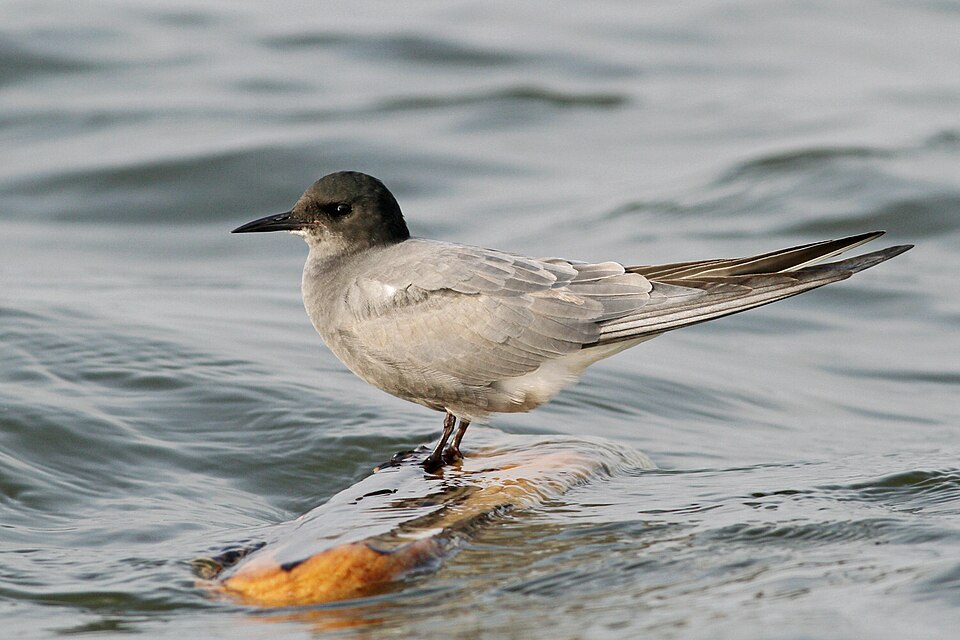
The Black Tern is one of the most distinctive terns in North America and Eurasia, and for good reason: in breeding plumage it is the only tern that looks genuinely dark. Where most terns are crisp studies in white and pale gray, a breeding Black Tern wears a sooty slate-black head and body set against ashy-gray wings, giving it an almost smoky, twilight look as it floats over a marsh. It belongs to a small group called the "marsh terns" (genus Chlidonias), which differ from the familiar sea-going terns in their inland habits, shorter and less deeply forked tails, and a habit of plucking food from the surface rather than plunge-diving headlong into the water.
This is a bird of freshwater wetlands rather than the open coast. It nests on inland marshes, prairie potholes, and the shallow, vegetated margins of lakes and sloughs, then undertakes a long migration to spend the non-breeding season at sea and along coastlines in the tropics. Black Tern populations have declined substantially across much of their range as marshes have been drained and water levels manipulated, which makes a buoyant flock dancing over a healthy wetland one of the more rewarding sights of a summer birding trip.
Black Terns are small, slim, and lightly built, noticeably smaller than the common terns most people picture. The key to identifying them is their combination of small size, dark coloration (in summer), proportionally broad-based wings, and a short, only slightly notched tail. Their flight is the real giveaway: light, erratic, and almost butterfly-like as they dip and swerve over water.
| Breeding plumage | Slate-black head, neck, breast, and belly; ashy-gray wings, back, and tail; white undertail coverts |
| Bill | Thin, straight, and black, shorter and finer than a Common Tern's |
| Non-breeding plumage | White underparts and forehead, gray crown and nape, with a distinctive dark smudge or 'ear spot' on each side of the breast |
| Tail | Short and only shallowly notched, not the long, deeply forked tail of sea terns |
| Flight style | Buoyant, erratic, dipping flight, picks food from the surface rather than plunge-diving |
| Size | Small for a tern, about 9-10 in long; smaller than Common or Forster's Tern |
Male vs. female
Male and female Black Terns look essentially alike and cannot be reliably separated in the field. Both sexes show the same dark breeding plumage and the same pale non-breeding pattern. Females may average very slightly paler or less uniformly black on the underparts, but this overlaps heavily with individual and seasonal variation, so it is not a dependable mark. For practical birding, treat the sexes as identical.
Juveniles
Juveniles resemble non-breeding adults but look scalier and browner above, with pale buff or brownish edges to the back and wing feathers giving a faintly scaled appearance. They share the adult's white underparts and the characteristic dark patch on the side of the breast, along with a dark cap and dark ear region. As they mature into their first winter and spring, they gradually lose the brown wash and may show a patchy, half-molted look, a blotchy mix of dark and white feathering, before acquiring full breeding plumage.
Black Terns are not musical, but they are vocal around the nesting marsh. The most frequent call is a sharp, slightly metallic kik or kreea, often repeated as the birds wheel overhead. When alarmed or mobbing an intruder near the colony, they give a more strident, scolding kik-kik-kik or a drawn-out screechy note.
Away from the breeding grounds these terns are usually quiet, and migrants passing over a lake often pass in near silence. The calls carry a thin, high quality that blends into the general chatter of a busy marsh, so they are easy to overlook unless a flock is actively disturbed.
In North America, Black Terns breed across the northern prairies and the upper Midwest, the Great Lakes region, the Prairie Provinces of Canada, and locally west into the Great Basin and east toward the Northeast. The species also breeds widely across Europe and Asia. They are long-distance migrants: North American breeders winter along the coasts of Central America and northern South America, largely at sea and along productive coastlines, while Eurasian birds winter mainly along the coasts of Africa.
For most birders in the U.S. and Canada, Black Terns are a bird of late spring through late summer, with a fairly compressed window. They appear on breeding marshes in May, nest through the summer, and many begin moving south by late July and August. Migrants can turn up on almost any large lake, reservoir, or coastline during passage, sometimes in loose flocks, before the species largely vacates the continent by fall.
Black Terns have a broader, more flexible diet than the fish-focused sea terns. During the breeding season they feed heavily on insects, dragonflies, damselflies, mayflies, midges, beetles, and other emergent or flying invertebrates, which they snatch from the air or pluck delicately from the water's surface and from emergent vegetation. They also take small fish, tadpoles, and other small aquatic animals.
Their feeding style is part of what makes them so recognizable. Rather than hovering and plunge-diving like a Common Tern, a Black Tern coasts low over the marsh on light, erratic wingbeats, dropping briefly to dip its bill at the surface or hawking insects on the wing like an oversized swallow. On their wintering grounds at sea they shift more toward small fish and marine invertebrates.
Black Terns are loosely colonial marsh nesters. They build flimsy, often soggy nests on floating mats of dead vegetation, on the matted bases of emergent plants like cattails and bulrushes, or on muskrat lodges and other low platforms surrounded by shallow water. The nest is a slight, sometimes barely-there accumulation of plant material, and it is vulnerable to wind, waves, and changing water levels, a major reason the species suffers in marshes with artificially manipulated water.
A typical clutch is two to three eggs, buff or olive and heavily marked with dark blotches that camouflage them well against the wet vegetation. Both parents incubate and both feed the chicks, which are downy and can leave the immediate nest area before they fledge. Pairs generally raise a single brood per season, and the colony as a whole will mob and harass passing harriers, gulls, and other predators.
The Black Tern is not a backyard or feeder bird, and there is no realistic way to attract one to a typical yard. It eats flying insects and small aquatic prey caught over open water, and it nests only on wet marshes, so the way to "attract" Black Terns is at the landscape scale, by protecting and restoring the wetlands they depend on. If you want to see them, the better strategy is knowing where and when to look.
- Look at the right habitat: large freshwater marshes, prairie potholes, and shallow, vegetated lake margins are where they nest and forage.
- Time your visit for late spring and summer (roughly May through August in North America), when breeders are present and most vocal.
- Watch large lakes and reservoirs during migration in spring and late summer, where loose flocks of foragers often pass through.
- Scan for the flight style, light, dipping, swallow-like flight low over water is often the first clue before you see the dark plumage.
- Support wetland conservation and stable water levels; this species declines sharply when marshes are drained or heavily managed.
- Bring binoculars and patience, they range widely over a marsh, so a fixed vantage point and a careful scan of distant birds pays off.
- Common Tern: Larger, with white underparts, a deeply forked tail, and an orange-red bill; plunge-dives for fish rather than dipping at the surface. Never shows the Black Tern's dark body.
- Forster's Tern: Pale and white-bodied year-round, larger, with a long forked tail; in winter shows a bold black eye-mask rather than the Black Tern's dark cap and breast smudge.
- White-winged Tern: A rare visitor and close relative; breeding birds have strikingly pale, whitish wings contrasting with a black body, plus a white tail and red legs, far more contrasty than the uniformly gray-winged Black Tern.
- Bonaparte's Gull: A small, buoyant gull sometimes confused in flight, but it is white-bodied, has a fuller body and broader wings, and lacks any dark breeding underparts.
Why is the Black Tern black when other terns are white?
Its dark slate-black breeding plumage is unusual among terns and is thought to help with camouflage and social signaling in the dense, shadowy marsh habitat where it nests. It only looks dark in summer, in non-breeding plumage it becomes mostly white below with a gray crown, much more like a typical tern.
Where can I see a Black Tern?
Look on large freshwater marshes, prairie potholes, and vegetated lake edges across the northern prairies, the Great Lakes, and Canada in late spring and summer. During migration they also turn up on big lakes and reservoirs almost anywhere along their flyway.
What does a Black Tern eat?
Mostly flying and aquatic insects such as dragonflies, mayflies, and midges during the breeding season, plus small fish and tadpoles. Unlike sea terns, it picks food from the water's surface and hawks insects in the air rather than plunge-diving.
Is the Black Tern endangered?
Globally it is listed as Least Concern, but it has declined significantly across much of North America and Europe, mainly due to wetland drainage and unstable water levels at nesting marshes. It is a species of conservation concern in many regions even though it is not formally endangered.
How do I tell a Black Tern from a Common Tern?
Size, color, and behavior. The Black Tern is smaller, has a dark body in summer, a short shallowly notched tail, a thin black bill, and a light dipping flight. The Common Tern is larger and white below, with a deeply forked tail, an orange-red bill, and a habit of plunge-diving for fish.