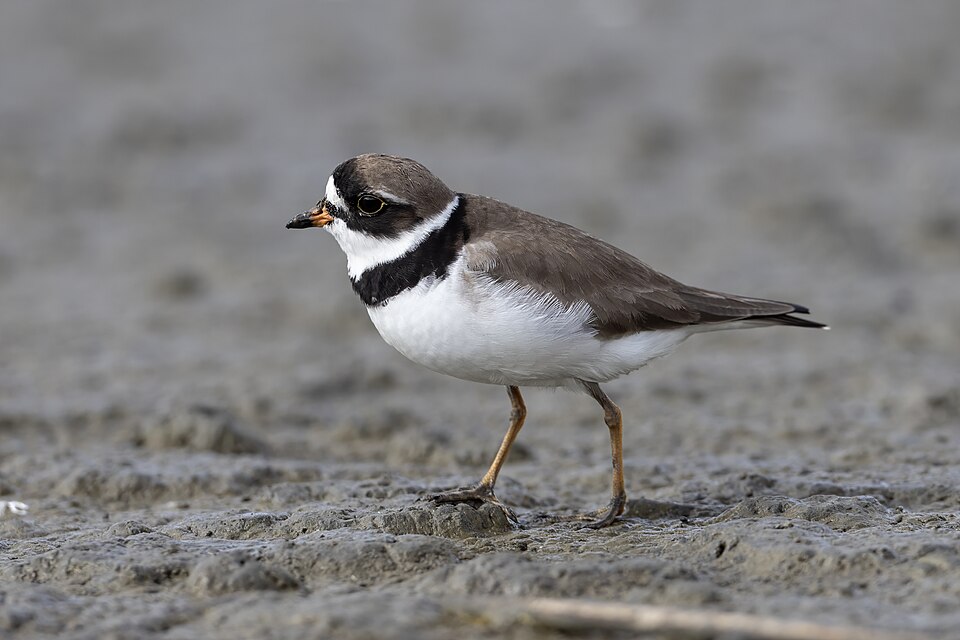
The Semipalmated Plover is the small, round-headed shorebird most beachgoers have walked right past without noticing. About the size of a sparrow with longer legs, it works open mudflats and sandy shores with a busy run-stop-peck rhythm, blending almost perfectly into wet sand and pebbles. Its plain brown back, clean white underparts, and single dark band across the chest make it look like a miniature, tidier version of the familiar Killdeer.
It earns its odd name from the partial webbing, "semipalmation", between its toes, a feature you'll almost never see in the field but which hints at a bird at home where land meets water. Common and widespread across North America during migration, it nests in the far north and winters along warm coasts, making it one of the continent's most reliable and approachable small plovers for anyone willing to scan a shoreline carefully.
Look for a compact, big-eyed plover with a rounded head, short bill, and an upright, slightly hunched posture. It's noticeably smaller and stubbier than a Killdeer and runs in short bursts, then freezes, a posture that often gives it away before the markings do.
| Breast band | A single dark (black in breeding males) collar across a white chest, never the double band of a Killdeer |
| Upperparts | Plain mud-brown back and crown, with no streaks or spots, blending into wet sand |
| Face | Dark mask through the eye and a dark forehead bar in breeding birds; white throat and collar around the neck |
| Bill | Short and stubby, orange at the base with a black tip in breeding season, all-dark in winter |
| Legs | Bright orange to yellow-orange, often the most eye-catching feature on a distant bird |
| Size & shape | Small and dumpy, about 7 inches, with a rounded head and short neck |
Male vs. female
The sexes look very similar and are often impossible to separate in the field. In breeding plumage, males tend to show the cleanest, blackest face mask, forehead bar, and breast band, while females usually average a bit duller, with browner tones replacing some of the black around the face and collar. By fall and winter both sexes wear muted brown markings, and the distinction disappears entirely. For practical birding, treat them as look-alikes.
Juveniles
Juveniles and non-breeding adults are softer and browner overall. The crisp black of breeding birds is replaced by warm brown on the breast band, mask, and forehead, and the breast band may even look incomplete or broken in the center. The bill is mostly dark with little or no orange, though the legs stay yellow-orange. Fresh juveniles often show neat pale fringes on the back feathers, giving the upperparts a faintly scaly, scalloped look in good light.
The signature sound is a clear, rising two-note whistle, often written as chu-WEE or too-LEE, with the second note sliding upward. It's a plaintive, friendly call that carries well across open flats and is one of the easiest ways to pick the species out among mixed shorebirds.
On the breeding grounds males give a more elaborate, repeated series during display flights, and birds use various soft chip and cheep notes when alarmed or jostling for space at a crowded mudflat. The rising chu-WEE remains the call to learn first.
Semipalmated Plovers breed across the Arctic and subarctic, from Alaska across northern Canada to Newfoundland, nesting on open tundra, gravel bars, and sandy clearings near water. They are long-distance migrants, passing through almost the entire United States in spring and fall, where they turn up on coastal beaches, inland mudflats, lake edges, flooded fields, and sewage ponds.
In winter they retreat to milder coasts, ranging from the southern U.S. down through Mexico, Central America, the Caribbean, and into South America. Peak numbers at most stopover sites come in May and again from late July through September, when adults and then juveniles move south.
This plover is a visual hunter that eats small invertebrates, marine worms, tiny crustaceans, insects and their larvae, small mollusks, and other soft-bodied prey it pulls from the surface of wet mud and sand. It feeds with the classic plover gait: a quick run, an abrupt stop, a tilt forward to snatch something, then off again. It doesn't probe deeply like a sandpiper; instead it spots movement and grabs prey at or just below the surface.
Like several plovers, it sometimes "foot-trembles," vibrating one foot against the wet substrate to startle hidden prey into moving, then quickly picking off whatever surfaces. Birds often spread out across a flat, each defending a small feeding patch from neighbors.
Nesting happens on the open ground of the northern breeding range. The nest is a simple shallow scrape in sand, gravel, or short tundra vegetation, sometimes lined with a few bits of shell, pebble, or plant material. The clutch is typically four eggs, buff or olive and heavily marked with dark spots and blotches that camouflage them beautifully against the surrounding stones.
Both the male and female share incubation, which lasts roughly three to four weeks. The chicks are precocial, downy, mobile, and able to leave the scrape and feed themselves within hours of hatching, while the parents stand guard and lead them to good feeding areas. Adults are famous for the "broken-wing" distraction display, dragging a wing along the ground to lure foxes, gulls, and other predators away from the young.
The Semipalmated Plover is not a backyard or feeder bird, it won't visit a seed feeder, suet, or birdbath, and it nests only in the remote Arctic. The way to enjoy it is to go where it feeds during migration rather than to bring it to you.
- Scan open mudflats, beaches, and lake edges during migration, peak windows are May and again late July through September
- Look at the wet zone where receding tide or shallow water meets exposed sand and mud; that's where they forage
- Learn the rising chu-WEE whistle, it often reveals birds you'd otherwise overlook among other shorebirds
- Bring a spotting scope or good binoculars; these birds are small, well camouflaged, and often distant
- Check mixed shorebird flocks, Semipalmated Plovers frequently mingle with sandpipers and other plovers at the same flats
- Visit sewage lagoons, flooded fields, and reservoir mudflats inland, not just the coast, where they're regular stopover guests
- Killdeer: Larger and slimmer with two black breast bands (not one), a long tail, and bright rufous rump shown in flight
- Piping Plover: Much paler, sandy-gray above rather than mud-brown, with a thinner, often-incomplete band and a more ghostly look on dry sand
- Snowy Plover: Paler still, with dark legs (not orange), a thin black bill, and only a small dark patch on each side of the neck instead of a full collar
- Wilson's Plover: Similar single band but distinctly larger, with a long, heavy all-black bill and dull pinkish-gray legs
What's the difference between a Semipalmated Plover and a Killdeer?
The easiest tell is the breast band: a Semipalmated Plover has a single dark collar, while a Killdeer has two black bands across its chest. The plover is also much smaller and stubbier, lacks the Killdeer's long tail, and doesn't flash a rufous rump in flight.
Why is it called 'semipalmated'?
The name refers to the partial webbing between its toes, 'semi' meaning half and 'palmate' meaning webbed. You almost never see it in the field, but it's a real anatomical feature that sets the species apart from some other small plovers.
Where and when can I see Semipalmated Plovers?
They migrate through nearly all of North America, so most birders see them on beaches, mudflats, lake edges, and flooded fields during spring (around May) and fall (late July through September). They breed only in the Arctic and winter along warm southern coasts.
Are Semipalmated Plovers endangered?
No. They are listed as Least Concern and remain common and widespread, unlike their rarer relative the Piping Plover, which is threatened. Their remote tundra breeding grounds keep them relatively buffered from many human pressures.
What do Semipalmated Plovers eat?
They eat small invertebrates such as marine worms, tiny crustaceans, insect larvae, and small mollusks, which they pick from the surface of wet sand and mud using a quick run-stop-grab feeding style rather than deep probing.