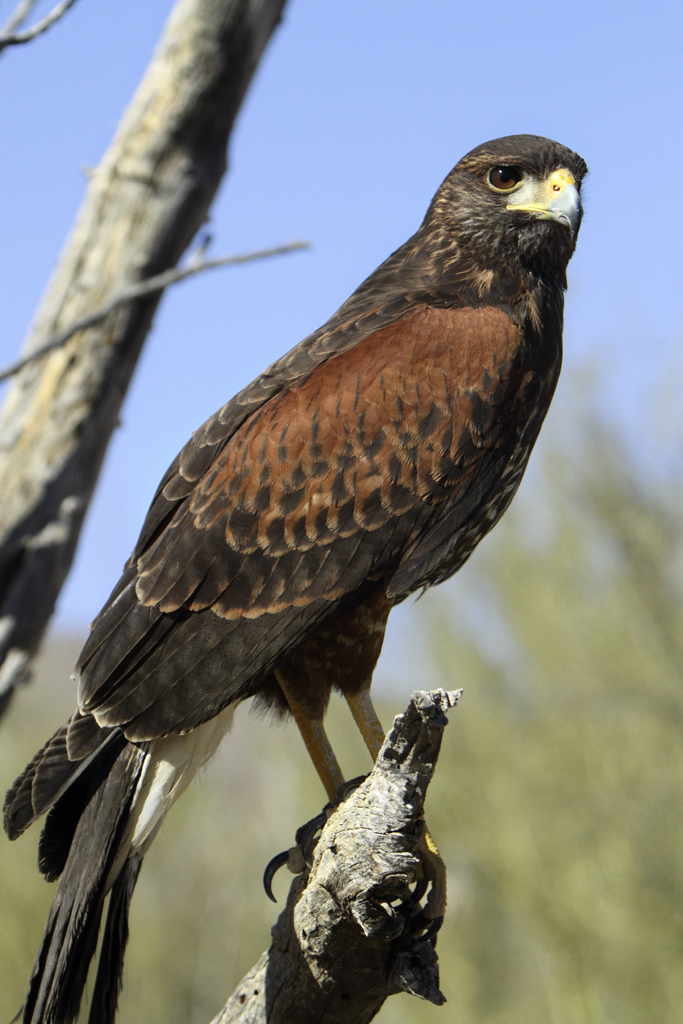
The Harris's Hawk is one of the most striking raptors of the American Southwest, a dark chocolate-brown bird splashed with rich chestnut shoulders and a flashy white-tipped tail. But its looks are only half the story. This is the most social hawk in the world, famous for living and hunting in cooperative family groups rather than the lone-wolf style we expect from birds of prey. Watching a band of them work a mesquite thicket together - some flushing prey, others waiting to ambush - feels more like watching a pack of wolves than a typical hawk.
Found in the deserts and brushlands of Arizona, New Mexico, Texas, and southward through Mexico into Central and South America, the Harris's Hawk thrives where saguaro cactus, mesquite, and yucca dot the landscape. Its intelligence and willingness to work with others have made it a favorite of falconers worldwide, but in the wild it remains a charismatic symbol of the Sonoran and Chihuahuan deserts. Birders traveling to the Southwest often put it near the top of their wish list, and for good reason.
A medium-large, long-legged, long-tailed hawk with broad wings and a relaxed, buoyant flight. Perched, it looks dark and upright; in the air, the combination of dark body, bright chestnut wing patches, and a bold white band at the base and tip of the tail is unmistakable within its range.
| Overall color | Dark sooty-brown body, almost blackish at a distance |
| Shoulders & thighs | Bright rufous-chestnut wing coverts ('shoulders') and reddish leggings |
| Tail | Black with a broad white base and a crisp white tip - very distinctive |
| Legs & cere | Long, bright yellow legs and yellow facial skin (cere) |
| In flight | Chestnut underwing coverts contrast with dark flight feathers; white tail bands flash |
| Size | Larger than a Red-shouldered Hawk, smaller and slimmer than a Red-tailed Hawk |
Male vs. female
Males and females look essentially identical in plumage - both wear the same dark brown body, chestnut shoulders, and white-banded tail. As with most birds of prey, the difference is size: females are noticeably larger and heavier than males, sometimes by a third or more. In a hunting group you can often pick out the dominant female by her bulk, but a lone bird can't be reliably sexed in the field by eye.
Juveniles
Young Harris's Hawks are messier-looking than adults. They show the same dark base color but are heavily streaked and mottled with buff and cream on the underparts and chest, and the chestnut shoulders are duller and more broken up. Their tails are more finely barred and lack the clean, bold white-and-black pattern of adults. The bright rufous tones and crisp tail bands develop over the first year or two as they molt into full adult plumage.
Harris's Hawks are not melodic. Their signature sound is a harsh, drawn-out, grating scream - a low irrrrr or jaaairr that has a raspy, almost mechanical quality, like air being forced through a reed. It carries well across open desert and is often given from a high perch or in flight.
Within family groups they also use shorter, sharper contact calls and clucking notes to coordinate movements while hunting. The cooperative lifestyle means they are generally more vocal and communicative with one another than most solitary hawks.
In the United States, Harris's Hawks are residents of the desert Southwest - central and southern Arizona, southern New Mexico, and southern and western Texas - with strongholds in the Sonoran and Chihuahuan deserts. From there the species ranges south throughout much of Mexico, Central America, and into South America as far as Chile and Argentina, occupying dry brushland, savanna, and semi-open country.
They are largely non-migratory. A pair or family group typically holds a year-round territory, so a bird seen in summer is likely the same one you'll find in winter. Vagrants occasionally turn up north of the normal range, but for most birders, seeing one means a trip to the Southwest.
Harris's Hawks are versatile, opportunistic predators. Their staple prey includes rabbits and hares, ground squirrels, packrats and other rodents, along with quail, doves, and other medium-sized birds; they'll also take lizards and large insects when the opportunity arises. In open desert, a cottontail or jackrabbit is a prized target.
What sets this hawk apart is how it hunts. Family groups of two to six birds often hunt cooperatively, a behavior almost unheard of among raptors. Several hawks will surround a brushy patch or cactus, with some birds flushing prey toward others lying in wait - a relay-and-ambush strategy that lets the group take animals too large or too wary for a single hawk. They also perch-hop and tail-chase, and individuals will sometimes stack up on a single perch, even standing on each other's backs, a quirk known as 'back-stacking.'
Pairs and family groups build bulky stick nests in the arms of a saguaro cactus, in mesquite or paloverde trees, on yuccas, or increasingly on power poles and other structures in suburban edges. The nest is lined with grass, bark, and softer plant material and is often reused and added to year after year.
Harris's Hawks are unusual in sometimes breeding cooperatively: a single nest may be attended by more than two adults, with extra 'helper' birds - frequently offspring from previous years - assisting in feeding and defending the young. The female does most of the incubating while the group provisions her. In the warm Southwest, pairs can raise two or even three broods in a single year when prey is abundant, which is exceptional for a hawk.
This is not a feeder bird, and you can't lure a Harris's Hawk with seed or suet - it's a predator of live prey. That said, if you live within its desert range, there are real ways to make your property hawk-friendly and improve your odds of hosting one.
- Live in or near its range - southern Arizona, New Mexico, or Texas - and preserve native mesquite, paloverde, and saguaro habitat rather than clearing it.
- Leave tall perches available: dead snags, large cacti, or even utility poles give hawks the high vantage points they hunt from.
- Maintain healthy populations of natural prey by tolerating cottontails, ground squirrels, and quail rather than poisoning rodents.
- Never use rodenticides - poisoned rodents kill the hawks that eat them, a major threat to raptors near homes.
- Provide a large, sturdy bird bath or shallow ground water source; desert raptors will visit water to drink and bathe.
- Keep small pets supervised - a Harris's Hawk is a capable hunter, and a hungry one won't distinguish a tiny dog or cat from natural prey.
- Red-tailed Hawk: Larger and bulkier with a pale, often white chest and a rusty (not white-banded) tail; lacks chestnut shoulders and is far less social.
- Red-shouldered Hawk: Smaller, with finely barred reddish underparts and a black-and-white banded tail; an eastern and West Coast woodland bird that rarely overlaps in desert habitat.
- Common Black Hawk: Uniformly blackish with very broad wings and a single bold white tail band; ties to streamsides rather than open desert and lacks the chestnut shoulders.
- Zone-tailed Hawk: All-dark like a Harris's at a glance but has multiple gray tail bands, mimics Turkey Vultures in flight with raised wings, and shows no rufous shoulders.
Why do Harris's Hawks hunt in groups?
Cooperative hunting lets a family group take larger or more elusive prey - like jackrabbits - than a single hawk could manage alone, and it improves success in the open, cover-poor desert where prey can dash for safety. By flushing and ambushing as a team, more birds eat more reliably.
Are Harris's Hawks dangerous to pets?
They can be a risk to very small dogs, cats, and other tiny pets, since a hungry hawk hunts live prey of that size. Attacks are uncommon, but if you live in their range it's wise to supervise small animals outdoors, especially at dawn and dusk.
Where can I see a Harris's Hawk in the wild?
Look in the desert Southwest - southern Arizona (around Tucson and Phoenix), southern New Mexico, and south and west Texas are reliable. They favor mesquite brushland and saguaro desert and often perch conspicuously on poles, cacti, and dead trees.
Why are Harris's Hawks so popular in falconry?
Their natural social intelligence makes them unusually trainable and tolerant of working with humans, and their pack-hunting instinct translates well to hunting alongside a falconer. They are now among the most widely used birds in falconry worldwide.
Do Harris's Hawks migrate?
No, they are largely year-round residents. A pair or family group typically defends the same territory through all seasons, so the bird you see in summer is usually the same one present in winter.