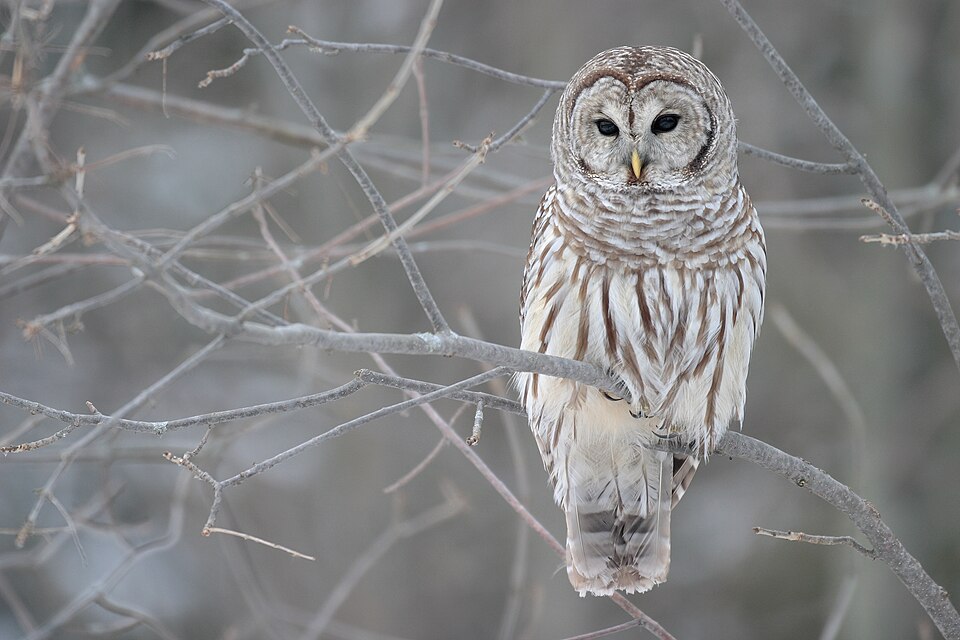
The Barred Owl is one of the most frequently heard owls in eastern North America, and increasingly across the West. Big, round-headed, and soft-edged, it has none of the fierce ear tufts of a Great Horned Owl. Instead it shows a smooth dome of a head and a pair of deep, dark, almost liquid eyes that set it apart from nearly every other North American owl. Most people meet this bird by ear long before they ever see it, thanks to its rhythmic, carrying hoot that sounds remarkably like a spoken phrase drifting out of the woods at dusk.
It is a bird of mature, moist forests, especially bottomland hardwoods, swampy woods, and wooded river corridors, but it has adapted well to leafy suburbs and large wooded parks. Once largely confined to the East, the Barred Owl has expanded steadily northwest through Canada and down into the Pacific Northwest over the past century, where it now overlaps with and outcompetes the rarer Spotted Owl. For most backyard birders, though, it is simply the friendly, approachable big owl of the neighborhood woodlot, often active well before full dark and surprisingly tolerant of a quiet observer standing below its perch.
This is a large, stocky, big-headed owl with a rounded silhouette and no ear tufts. Perched, it looks heavy and upright; in flight it appears broad-winged and moth-soft, gliding silently between trees. The single best fieldmark is the combination of dark brown eyes set in a pale, gray-brown facial disk, paired with the streaky, vertically barred markings that give the bird its name.
| Eyes | Dark brown to nearly black - the only common large North American owl with dark eyes rather than yellow |
| Head | Large, rounded, smooth-domed with no ear tufts; pale gray-brown facial disk with fine dark rings |
| Throat & upper breast | Horizontal barring across the upper chest - the 'bars' that name the bird |
| Belly | Bold vertical brown streaks on a whitish background below the barred chest |
| Overall color | Mottled brown and white, no bright tones; cryptic against tree bark |
| Size & shape | Crow-to-goose sized, stocky and broad-winged, smaller than a Great Horned Owl |
Male vs. female
Males and females look essentially identical in plumage, so you cannot reliably sex a Barred Owl by sight in the field. As with most owls, the female is somewhat larger and heavier than the male, but the difference is hard to judge unless the pair is perched side by side. Voice offers a better clue during the breeding season: the female's hoots tend to be slightly higher and more nasal, and in duetting pairs she often delivers the rising, drawn-out notes while the male's voice runs a touch deeper.
Juveniles
Young Barred Owls leave the nest before they can fly, clambering through branches as fuzzy, pale "branchers" covered in soft, buffy-white down with a darker facial pattern already forming. For weeks they look scruffy and shorter-tailed than adults, with downy tufts clinging to a body that is gradually filling in with proper feathers. By late summer juveniles resemble adults but may look a bit softer and paler; the dark eyes are present from an early age, which helps separate scruffy young Barred Owls from young Great Horned Owls.
The classic call is an unmistakable nine-note hooting phrase widely translated as "Who cooks for you? Who cooks for you-all?" The series rises and falls with a distinctive drop and drawl on the final note, carrying a long way through still evening woods. Pairs frequently duet, and these exchanges can erupt into a wild, almost unhinged chorus of cackles, gurgles, and caterwauling hoots that sound startlingly like monkeys or laughing people - one of the strangest and most delightful sounds in the eastern night.
Beyond the signature phrase, Barred Owls give single drawn-out hoo-aaah notes that slur downward, sharp barks, and a rising, catlike scream. They call year-round but are most vocal in late winter and early spring as pairs establish territory, and again in late summer when noisy young beg from the trees. Unlike many owls, this species will sometimes hoot during daylight, especially on overcast days.
The Barred Owl is a year-round, non-migratory resident across its range. Historically it occupied the eastern United States and southeastern Canada, from the Gulf Coast and Florida north through the Great Lakes and into the boreal edge, west to roughly the Great Plains. It favors mature deciduous and mixed forests, wooded swamps, and riverine woodlands, and has spread readily into well-treed suburbs.
Over the last century the species expanded dramatically across central and western Canada and down into the Pacific Northwest, reaching Washington, Oregon, and northern California. In that western range it now overlaps the threatened Northern Spotted Owl, which it outcompetes and sometimes hybridizes with - a major conservation concern that has prompted active management. Individual birds are largely sedentary and hold the same territory for years; young birds disperse to find their own ground but rarely travel far.
Barred Owls are opportunistic predators that hunt mainly from a perch, watching and listening, then dropping silently onto prey. Small mammals make up the bulk of the diet - voles, mice, shrews, squirrels, chipmunks, and young rabbits - but this is a notably flexible hunter. It readily takes birds, frogs, snakes, lizards, and large insects, and it is unusual among owls in its willingness to take aquatic prey such as crayfish, fish, and even small turtles, often hunting at the edge of woodland streams and swamps.
Most hunting happens from dusk into the night, but Barred Owls will hunt by day more often than many owls, particularly when feeding young or during cloudy weather. Like other owls, they swallow small prey whole and later cough up compact pellets of bone and fur, which accumulate beneath favored roosts and are a good clue to a bird's presence.
Barred Owls are cavity nesters that favor large natural hollows in mature trees, often in broken-topped snags or old hardwood cavities high above the ground. They will also take over abandoned stick nests built by hawks, crows, or squirrels, and they readily use large nest boxes where natural cavities are scarce. The species mates for life and pairs typically reuse a productive territory year after year.
The female lays her eggs in late winter or early spring and does almost all of the incubation, sitting tight for roughly a month while the male delivers food. Once hatched, the young are brooded and fed by both parents. They climb out of the cavity to nearby branches well before they can fly, fluttering and clambering as "branchers," and remain dependent on the adults for food for several months after fledging - which is why family groups can be so noisy in late summer.
The Barred Owl is not a feeder bird and won't come to seed or suet, but if you live near mature woods or a wooded wetland you have a real chance of hosting one. The most effective thing you can do is provide habitat: keep large trees, especially older hardwoods with cavities and standing dead snags, and protect any wooded buffer along a stream or wet area.
- Leave dead trees standing where safe - large snags and broken-topped trees provide the natural cavities Barred Owls prefer for nesting and roosting.
- Put up a large owl nest box (roughly an 8-inch entrance hole, mounted high on a mature tree) in or at the edge of wooded property; this species takes to boxes readily where cavities are scarce.
- Maintain a healthy rodent population naturally by avoiding rodenticides - poisoned rats and mice can kill the owls that eat them.
- Protect wooded edges near water, since Barred Owls hunt frogs, crayfish, and other prey along streams and swampy ground.
- Listen at dusk in late winter, when calling peaks; a quiet evening is your best chance to confirm a resident pair without disturbing them.
- Avoid using call playback to lure them in - it stresses territorial birds, and habituating owls to people can put them in danger near roads.
- Great Horned Owl: Larger and fiercer-looking with prominent ear tufts and bright yellow eyes; Barred Owl has a smooth round head and dark eyes.
- Spotted Owl: Similar dark-eyed, round-headed shape but underparts are spotted rather than barred-and-streaked; restricted to western old-growth forests where the two now overlap.
- Barn Owl: Pale, heart-shaped white face and golden-buff back; gives a harsh scream rather than a hooting phrase, and favors open country and barns over forest.
- Great Gray Owl: Much larger with a huge gray facial disk, yellow eyes, and a bold white 'bow tie' on the throat; a bird of northern and montane forests.
What does a Barred Owl sound like?
Its signature call is a rhythmic nine-note hoot that sounds like the phrase 'Who cooks for you? Who cooks for you-all?', with a drawn-out, downward-slurring final note. Pairs also duet in wild cackling, gurgling choruses that can sound eerily like laughing monkeys.
Are Barred Owls dangerous to people or pets?
They are not generally dangerous to people, though a nesting bird may dive at someone who gets too close to its young. Very small pets such as tiny kittens or small birds could theoretically be at risk, but Barred Owls mostly hunt mice, voles, frogs, and crayfish, so the danger to typical pets is low.
What is the difference between a Barred Owl and a Great Horned Owl?
The Great Horned Owl has two obvious feather 'horns' (ear tufts) and bright yellow eyes, and is bulkier and more powerful. The Barred Owl has a smooth, rounded, tuftless head and dark brown eyes, and a gentler expression. Their calls differ too - the Great Horned gives deep, even hoots while the Barred says 'who-cooks-for-you.'
Why do I hear Barred Owls calling during the day?
Barred Owls are more willing than most owls to be active and vocal in daylight, especially on overcast days, during the breeding season, and when feeding hungry young. Hearing one hoot in the afternoon is normal and does not mean anything is wrong.
Will a Barred Owl come to a bird feeder or nest box?
They will not visit seed or suet feeders since they eat live prey, but they will readily use a large nest box with about an 8-inch entrance hole mounted high on a mature tree, particularly in wooded areas that lack natural cavities.