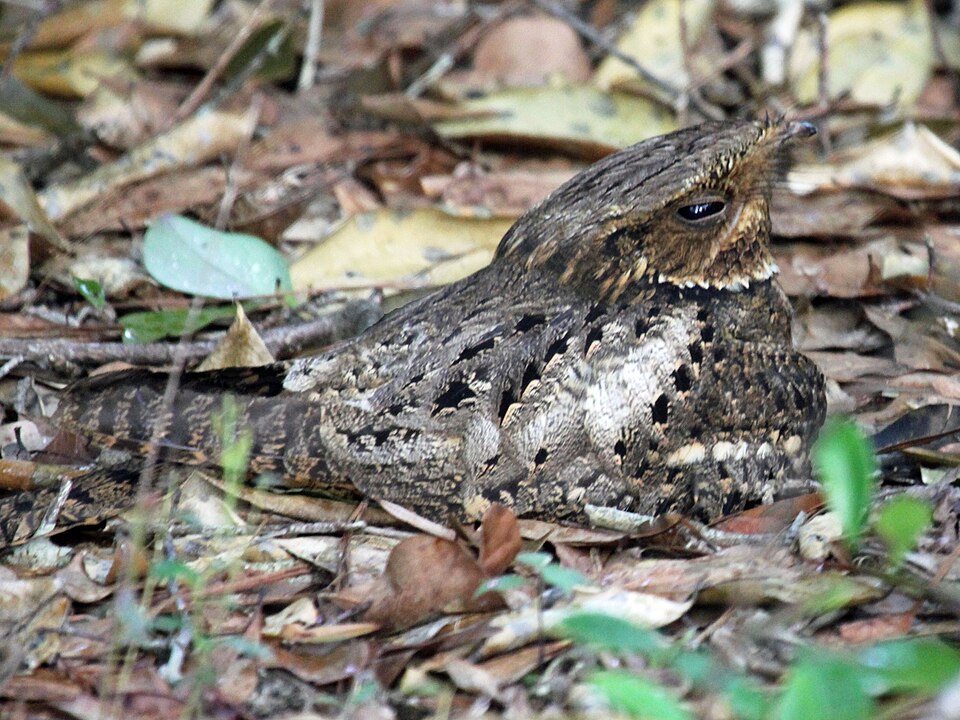
The Chuck-will's-widow is the largest nightjar in North America and the unmistakable summer voice of warm pine woods, oak hammocks, and sandy scrub across the American Southeast. Like its smaller cousin the Eastern Whip-poor-will, it is far easier to hear than to see. By day it rests motionless on the forest floor or lengthwise along a low branch, its mottled rusty-brown plumage blending so perfectly with dead leaves and bark that birders routinely walk within a few feet without noticing it. At dusk it lifts off on long, silent wings to hunt flying insects, and on warm nights its rolling, name-saying chant carries for a remarkable distance through the woods.
This is a bird most people know only as a sound drifting through an open window on a humid southern night. It belongs to the goatsucker family (Caprimulgidae), an old group of cryptic, big-mouthed, nocturnal hunters. Despite being widespread, Chuck-will's-widows have quietly declined over recent decades, likely tied to losses of insect prey and changes in fire-managed pine habitat. Learning its voice is the single best way to know it is around.
Chuck-will's-widow is a large, long-tailed, big-headed nightjar with a flat profile, tiny bill that opens into an enormous gape, and intricately patterned brown plumage. Size and overall warm, rusty tone are the first clues; in flight it looks bulky and broad-winged, more like a small hawk or large cuckoo than the slimmer whip-poor-will.
| Overall color | Warm rusty- and tawny-brown overall, finely mottled and barred with buff, black, and gray for perfect dead-leaf camouflage |
| Size & shape | Large and heavy-bodied with a big flat head, long rounded tail, and long broad wings; clearly bigger than a whip-poor-will |
| Throat | Buffy or pale tawny throat with a narrow whitish necklace at the lower border |
| Tail (male) | Inner webs of the outer three tail feathers are white-tipped, showing as buffy-white patches in flight at the tail corners |
| Bill & gape | Tiny bill but a huge mouth fringed with stiff rictal bristles, used to net flying insects |
| Eye | Large dark eye that shines orange-red in flashlight or headlight beams at night |
Male vs. female
The sexes look very similar and are hard to separate without a good view of the spread tail. The best mark is in the outer tail feathers: in the male, the inner webs of the outer three tail feathers are extensively tipped or paneled with white (showing buffy-white), flashing at the corners of the tail in flight or display. The female lacks these pale tail panels, showing a more uniformly brown, buff-barred tail. Both sexes share the same rusty, cryptic body plumage and pale throat necklace, so on a roosting bird seen from above the two are essentially identical.
Juveniles
Juveniles resemble adult females, with the same warm brown, leaf-litter camouflage but often looking a bit softer and more uniformly buffy, with less crisp barring. Like the female, young birds lack the bold pale tail panels of the adult male. Downy chicks are buffy and cryptic, hunkering motionless against the ground where their coloration makes them almost invisible until they move.
The song is the bird's calling card and the source of its name. Males deliver a rolling four-part chant usually written as chuck-will's-WID-ow, with a soft, almost throwaway introductory chuck followed by three clearer, accented notes. From a distance the opening chuck often drops out and you hear only the whistled will's-widow repeated over and over, sometimes for many minutes without pause. The cadence is slower, lower, and more burry than the sharp, snapping WHIP-poor-WILL of its relative.
Singing peaks at dusk and dawn and on warm, moonlit nights, especially in late spring when males are advertising territory. Away from song, both sexes give low growls and guttural clucking notes around the nest or when disturbed, but these are seldom heard.
Chuck-will's-widows breed across the southeastern United States, roughly from eastern Texas and Oklahoma east to the Atlantic coast and north into the mid-Atlantic, with the core of the range in the Coastal Plain, the Southeast's pine woods, and Florida. They favor open dry woodlands, pine-oak forests, sandy scrub, and the edges of fields and hammocks.
They are long-distance migrants. After breeding, they head south to winter in southern Florida, the Caribbean, Mexico, and Central America into northern South America. Spring arrival in the southern states is typically from March into April, and most have departed by September or October. Migrants move at night and are rarely detected except by the occasional flushed bird or a roadside individual caught in headlights.
This is an aerial insect hunter that feeds almost entirely at night, with peaks of activity at dusk and dawn. It catches large flying insects on the wing, including moths, beetles, winged ants, and flying termites, opening its huge bristle-fringed gape to scoop prey from the air. Birds often hunt from a low perch or the ground, sallying out after passing insects, and may forage over clearings, roads, and woodland edges where insects concentrate.
Remarkably for its size, the Chuck-will's-widow occasionally swallows small birds and even bats whole, a behavior documented from the stomach contents of individuals over the years. This makes it one of the few North American birds known to eat other vertebrate flyers, though insects remain the overwhelming bulk of its diet.
Chuck-will's-widows build no real nest. The female lays her eggs directly on the leaf litter of the forest floor, typically in dry, open woodland shaded by pines or oaks, often near the base of a shrub or among dead leaves that mirror the eggs' camouflage. The usual clutch is two eggs, creamy or pinkish-white with brown and gray marbling that blends into the ground.
Incubation and chick-rearing fall mainly to the female, who relies on her cryptic plumage to stay hidden; if a predator approaches, an adult may flush and perform a distraction display, flopping along the ground as if injured to lead the threat away. Pairs generally raise a single brood per year. The young are mobile soon after hatching and are tended on the ground until they can fly.
Chuck-will's-widow is not a feeder or birdhouse bird, so you will not attract it with seed, suet, or nest boxes. It is an insect-eating, ground-roosting nightjar of woodland habitat. That said, if you live within its southern range and near suitable woods, there are real ways to make your property more welcoming and to improve your odds of hearing one.
- Protect woodland habitat: Keep dry, open pine or oak woods, scrub, and brushy edges intact rather than clearing or mowing them into lawn.
- Go easy on insecticides: Pesticides reduce the moths, beetles, and other large flying insects this bird depends on. Reducing or eliminating spraying helps the whole nighttime insect web.
- Keep nights dark: Minimize bright outdoor lighting. Excess artificial light disrupts the moth populations nightjars hunt and the dark conditions they prefer.
- Leave the leaf litter: Undisturbed forest floor and natural ground cover provide camouflaged roosting and nesting spots.
- Listen at the right time: Step outside at dusk and dawn on warm, calm, moonlit nights from April through June, the peak singing season, and learn the rolling chuck-will's-widow chant.
- Eastern Whip-poor-will: Smaller and grayer, with a sharp, snapping WHIP-poor-WILL song versus Chuck's slower, burrier four-note chant; whip-poor-will males show more extensive pure-white in the outer tail.
- Common Nighthawk: Slimmer, longer pointed wings with a bold white wing patch, often seen flying high at dusk; gives a nasal peent rather than a name-saying chant, and is more active in early evening daylight.
- Chuck-will's-widow is sometimes confused with: Common Pauraque is a Texas/Mexico nightjar with bold white tail corners and a different rolling, churring whistle; range overlaps only in the lower Rio Grande area.
What does a Chuck-will's-widow sound like?
It sings a rolling, drowsy four-note chant that says its own name: a soft chuck followed by a clearer will's-WID-ow, repeated over and over at dusk, dawn, and on moonlit nights. From a distance the opening chuck often fades out and you hear only the whistled will's-widow. It is slower and burrier than the sharp WHIP-poor-WILL of the whip-poor-will.
How is a Chuck-will's-widow different from a Whip-poor-will?
Chuck-will's-widow is noticeably larger and warmer rusty-brown, with a four-note name-saying song, while the Eastern Whip-poor-will is smaller, grayer, and gives a sharper three-note WHIP-poor-WILL. Whip-poor-will males also show more bold white in the outer tail. Range overlaps in the Southeast, but Chuck favors warmer, drier pine and oak woods.
Where and when can I see a Chuck-will's-widow?
Look and listen in dry open pine, oak, and scrub woodlands across the southeastern U.S. from spring through summer, roughly March or April into September. They are nocturnal, so the best chance is hearing them sing at dusk and dawn; you may also spot one on a quiet road at night, its eyes glowing orange-red in headlights.
Do Chuck-will's-widows really eat birds and bats?
Yes, occasionally. While insects such as moths, beetles, and flying ants make up the vast majority of its diet, the Chuck-will's-widow is large enough to swallow small birds and even bats whole, and this has been documented from stomach contents. It is one of the few North American birds known to catch other small flying vertebrates.
Will a Chuck-will's-widow come to my yard or a nest box?
No. It is not a feeder or birdhouse bird. It eats flying insects caught on the wing and roosts and nests directly on the ground in woodland. You cannot lure it with seed or boxes, but if you live near suitable southern woods you can encourage it by protecting habitat, avoiding insecticides, and keeping outdoor lighting low so its insect prey thrives.