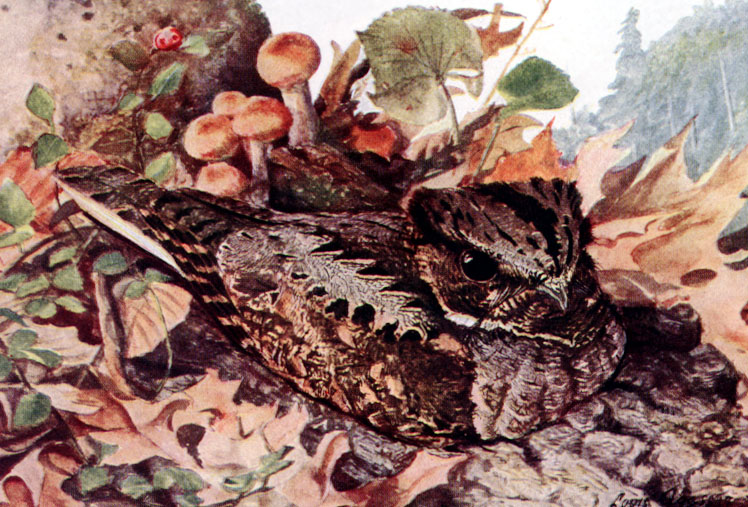
The Eastern Whip-poor-will is one of those birds you are far more likely to hear than to see. On warm spring and summer nights across the eastern United States and southern Canada, its endlessly repeated, whistled name rings out from the edges of open woodlands, and generations of country folk have fallen asleep to it. By day the bird all but vanishes, pressed flat against a leaf-littered forest floor or lengthwise along a horizontal branch, where its intricate brown, gray, and black plumage makes it look like nothing more than a chunk of bark or a pile of dead leaves.
It belongs to the nightjar family (Caprimulgidae), a group of cryptic, nocturnal insect-eaters with huge mouths, tiny bills, and soft, silent-flying feathers. The whip-poor-will hunts on the wing in the half-light of dusk, dawn, and moonlit nights, scooping moths and beetles out of the air. Once a familiar sound of rural America, it has declined sharply in recent decades as forests change and flying-insect numbers drop, which makes hearing one today feel like a real privilege rather than a given.
Shape and behavior tell you more than color with this bird. Look for a medium-sized, big-headed, large-eyed bird with a flat profile, very short legs, and long, rounded wings and tail. On the ground it crouches low and horizontal; in flight it looks broad-winged, buoyant, and moth-like, often flushing almost from underfoot and flitting a short distance before dropping back into cover.
| Overall color | Intricately mottled gray-brown, black, and buff, a 'dead leaf' pattern that breaks up its outline |
| Tail | Long and rounded; males show large white tips on the outer tail feathers, females buffy tips |
| Throat | A narrow pale band across the lower throat (white in males, buff in females) |
| Eyes | Large and dark; reflect bright orange-red in a flashlight or headlight beam at night |
| Bill & gape | Tiny bill but an enormous mouth fringed with stiff bristles (rictal bristles) for catching insects |
| Legs | Very short; the bird perches lengthwise on branches rather than crosswise |
Male vs. female
The sexes look nearly identical in pattern, and the differences are easiest to judge in flight or with a good look at a flushed bird. Males have bold white tips on the three outer tail feathers and a clean white band across the throat, both of which flash conspicuously during courtship and territorial flights. Females are slightly warmer and buffier overall, with buff or pale-tan tail corners instead of white and a buffier throat band. In the dark, of course, both sound exactly the same.
Juveniles
Newly hatched chicks are covered in pinkish-buff down and are remarkably mobile, able to shuffle away from the nest scrape within days. Juveniles quickly grow into a plumage much like the adult female's, heavily mottled and cryptic, with buffy rather than white tail markings, so young birds of the year can be very hard to distinguish from adult females in the field.
The song is the whole point of this bird. It is a clear, rhythmic, three-note whistle that really does sound like whip-poor-WILL, with the accent thrown onto the last note and a slight roll on the first. A bird will repeat it tirelessly, dozens, sometimes hundreds of times in a row, often speeding up and getting louder when excited. Counting the repetitions has long been a folk pastime; an enthusiastic male can rattle off the phrase many times a minute on a still night.
Up close you may also hear a soft, almost percussive chuck note that introduces each whistle, audible only when the bird is near. Away from song, whip-poor-wills give low growls and clucking notes around the nest and when alarmed. Singing peaks at dusk and dawn and on moonlit nights, when there is enough light for the birds to forage.
Eastern Whip-poor-wills breed across the eastern half of North America, from the Maritimes and southern Canada south through the eastern and central United States, favoring dry deciduous and mixed woodlands with open understory, forest edges, and clearings. There is also a separate population in the mountains of the desert Southwest and Mexico (sometimes the southwestern birds are treated as the closely related Mexican Whip-poor-will).
They are migratory. In fall the birds head south to spend the winter from the southeastern Gulf states through Mexico and into Central America. Spring migration brings them back north from roughly April into May, with the familiar nighttime chorus typically running from late spring through midsummer before tapering off as breeding winds down.
Whip-poor-wills are aerial insectivores that feed almost entirely on night-flying insects, with moths making up a large share of the diet, along with beetles, mosquitoes, flying ants, and other soft-bodied bugs. They hunt mostly at dusk, dawn, and during the brighter parts of moonlit nights, sallying out from a low perch or the ground to snap prey out of the air with their gaping, bristle-edged mouths before returning to a perch.
Because they rely on moonlight to see their prey, their breeding and feeding activity is tied to the lunar cycle, many birders notice that singing and foraging ramp up around the full moon. This dependence on flying insects also makes them sensitive to broad declines in insect populations.
There is essentially no nest. The female lays her eggs directly on the leaf litter of the forest floor, usually in dappled shade beneath shrubs or saplings, with no scrape, lining, or structure to give the site away. The eggs are creamy white with gray and brown marbling that blends perfectly into the surrounding leaves.
A typical clutch is two eggs. Both parents tend the young, and incubation and brooding fall mainly to the cryptically colored adults, who sit so tightly that they may not flush until you nearly step on them. Pairs often time hatching to the waxing moon so that the demanding nestling period coincides with the brightest nights for catching insects. If a nest is discovered or disturbed, the adults may perform distraction displays, flopping along the ground as if injured to lure the intruder away.
This is not a feeder bird, and there is no seed or suet that will bring one to your yard. Whip-poor-wills eat only flying insects and need fairly specific habitat, so attracting them is about land and light rather than food. If you live near or own appropriate woodland, you can make your property friendlier to them.
- Provide or protect open, dry woodland with a clear understory and nearby clearings, they avoid dense, cluttered forest and treeless open fields alike
- Reduce outdoor lighting at night; excessive artificial light disrupts their moonlight-dependent foraging and can deter them
- Skip insecticides and tolerate moths and beetles, a healthy population of night-flying insects is their entire food supply
- Leave leaf litter and natural ground cover intact, since they nest right on the forest floor and need that camouflage
- Maintain a mix of edges, small openings, and second-growth rather than clearing everything or letting it grow into closed canopy
- If you already hear them, simply avoid disturbing nesting areas in late spring and early summer
- Chuck-will's-widow: Larger and warmer brown; its song is a buzzier four-note phrase, and its range centers on the Southeast
- Eastern Whip-poor-will's western counterpart, the Mexican Whip-poor-will: Nearly identical in appearance; separated mainly by a lower, burrier voice and its southwestern mountain range
- Common Nighthawk: Slimmer with pointed wings marked by a white wing-bar; flies high with an erratic, batty flight and gives a nasal 'peent' rather than a whistled name
- Common Poorwill: Smaller and stubbier-tailed; a western bird whose soft two-note 'poor-will' is quite different from the three-note whip-poor-will
Why do whip-poor-wills call all night long?
Singing males are advertising their territory and trying to attract or keep a mate. They call most intensely at dusk and dawn and on moonlit nights, when there is enough light to both forage and defend territory, which is why a single bird can repeat its name for what feels like hours.
Are whip-poor-wills rare now?
They have declined substantially across much of their range over recent decades and are considered Near Threatened. Habitat loss and changes in forest structure, plus broad declines in the flying insects they eat, are thought to be the main drivers. Many people who grew up hearing them no longer do.
What is the difference between a whip-poor-will and a nighthawk?
Both are nightjars, but a Common Nighthawk has slim, pointed wings with a white wing-bar, flies high and erratically over open areas, and gives a nasal 'peent.' A whip-poor-will has rounded wings, stays low in woodland, is rarely seen, and whistles its own name.
Can I attract whip-poor-wills to my backyard?
Not with a feeder, they eat only flying insects. The best you can do is provide the right habitat: open woodland with clear understory, minimal night lighting, no pesticides, and undisturbed leaf litter for nesting. Food and birdbaths will not bring them in.
Where do whip-poor-wills go during the day?
They roost on the ground in leaf litter or lengthwise along a low horizontal branch, relying on their dead-leaf camouflage to stay hidden. They sit motionless and will often let you walk right past, flushing only at the last moment if you nearly step on them.