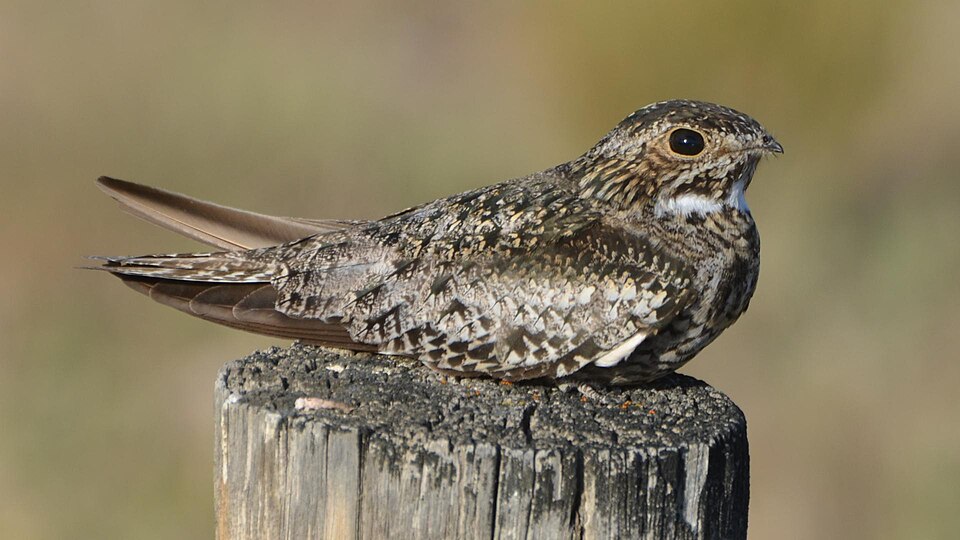
The Common Nighthawk is one of those birds you are far more likely to hear and watch overhead than to ever see up close. On warm summer evenings across much of North America, it patrols the half-dark sky with long, pointed wings and an erratic, bat-like flight, snapping up moths and beetles on the wing. Despite the name, it is not a hawk at all, and it is most active at dusk and dawn rather than the dead of night. It belongs to the nightjar family, a group of cryptically camouflaged, big-mouthed aerial insectivores.
What makes this bird such a treat for backyard and city birders is that it thrives in open country and over towns alike, often nesting on flat gravel rooftops in the middle of urban neighborhoods. Watch the sky over a ballfield's lights or a parking lot at twilight in June and you may catch its bounding flight and hear its distinctive nasal call. Sadly, like many aerial insect-eaters, Common Nighthawk numbers have fallen significantly over recent decades, making every summer encounter worth savoring.
In flight the Common Nighthawk is unmistakable once you know it: a slim, long-winged bird with a buoyant, irregular wingbeat and a flashy white bar near each wingtip. On the ground or perched it nearly vanishes, its mottled gray, brown, black, and buff plumage blending perfectly with bark, gravel, or a fence rail where it sits lengthwise.
| Wing bar | Bold white bar across the outer primaries, near the bend of each long, pointed wing - the single best flight mark |
| Wing shape | Long, narrow, sharply pointed wings that look slightly angled or crooked in flight |
| Plumage | Intricately mottled gray-brown, black, and buff above; barred underparts - superb camouflage at rest |
| Tail | Slightly notched tail; males show a white band near the tip |
| Throat | White throat patch (buffier in females), visible on perched birds |
| Flight style | Erratic, bounding, bat-like flight with deep, irregular wingbeats while foraging |
Male vs. female
The sexes look broadly similar but can be told apart with a good look. Males have a crisp white throat patch and a distinct white band across the tail near the tip, in addition to the white wing bars shared by both sexes. Females lack the white tail band, and their throat patch is smaller and washed buff or tan rather than clean white. In the air, the white tail band and brighter throat of a displaying male are often the easiest clues.
Juveniles
Juvenile Common Nighthawks resemble adult females but are paler and grayer overall, with even more delicate, frosty mottling that makes them blend into pale gravel and sand. They lack a bold white throat patch, showing only a faint buffy area, and have no white tail band. Freshly fledged young can look quite ghostly and washed-out compared with the richer-toned adults.
The signature sound is a sharp, buzzy, nasal peent (sometimes written beernt or peeyah), given repeatedly as the bird forages high overhead. It is a far-carrying, slightly electric-sounding note that, once learned, becomes a reliable summer-evening signal of nighthawks aloft.
The most thrilling sound, though, is not a vocalization at all. During courtship and territorial display, the male climbs high, then dives steeply toward the ground; at the bottom of the dive he flexes his wings and the air rushing through his primary feathers produces a deep, hollow vooom or booming whir - often called "booming" or "winnowing." Pairing the nasal peent overhead with an occasional booming dive is a classic dusk experience in nighthawk country.
The Common Nighthawk is a long-distance migrant that breeds across nearly all of North America, from central Canada south through the United States and into Mexico and Central America, in open and semi-open habitats - prairies, clearings, beaches, deserts, and the gravel rooftops of cities and towns.
It is one of the latest spring migrants to arrive, typically showing up in much of the U.S. in May, and one of the first to leave, with large, loose flocks streaming south in August and September. Its winter range lies in South America, as far as Argentina, making its annual round trip one of the longer migrations of any North American landbird. Spectacular evening migration flights - dozens to hundreds of birds drifting and feeding overhead - are a late-summer highlight in many regions.
Common Nighthawks are pure aerial insectivores, catching virtually all of their food on the wing. They feed heavily on flying insects such as moths, beetles, flying ants, true bugs, mayflies, and mosquitoes, scooping them from the air with a surprisingly enormous gape - the small bill opens into a wide, net-like mouth ideal for engulfing prey in flight.
They forage most actively at dusk and dawn, and readily exploit concentrations of insects around streetlights, stadium lights, and over water. A single nighthawk can consume large numbers of insects in an evening, making the species a genuine asset for natural pest control wherever it hunts.
Common Nighthawks build no real nest at all. The female simply lays her eggs directly on bare ground - open gravel, sand, rock, a forest clearing, a burned-over patch - or, famously, on flat gravel-covered rooftops in towns and cities. The eggs are heavily speckled and blend almost invisibly into the substrate.
A typical clutch is two eggs, with usually one brood per year. The female does most of the incubating, relying on her exceptional camouflage to sit tight and unseen. The downy chicks are well camouflaged too and are tended by the adults until they can fly. The shift toward smooth, membrane-covered "rubber" roofs in modern construction has reduced rooftop nesting sites, contributing to local declines.
The Common Nighthawk is not a feeder bird and will never visit a seed tray or suet cage - it eats only flying insects caught in mid-air. You can't bait it in, but you can absolutely make your skies more inviting and improve your odds of watching one.
- Protect insect populations: avoid broad-spectrum pesticides and mosquito foggers - a healthy supply of moths and beetles is what draws nighthawks overhead.
- Watch at the right time: scan open sky at dusk and dawn on warm evenings from late spring through late summer, especially over fields, water, and parking lots.
- Use the lights: nighthawks gather to feed on insects swarming around streetlights, ballpark lights, and lit parking areas - great places to spot their bounding flight.
- Welcome rooftop nesters: if you manage a building, retaining or adding gravel patches on flat roofs gives urban nighthawks a place to nest.
- Listen for the peent: learn the nasal call and you'll detect birds passing overhead long before you spot them.
- Watch for migration: in August and September, evening skies can fill with loose flocks of southbound nighthawks feeding as they go.
- Lesser Nighthawk: Very similar but a southwestern species; the white wing bar sits closer to the wingtip, flight is lower and more fluttery, and the voice is a soft toad-like trill rather than a nasal peent.
- Common Poorwill: A smaller, rounder-winged nightjar of the arid West; lacks the white wing bars, flies low to the ground, and gives a soft poor-will call rather than foraging high overhead.
- Eastern Whip-poor-will: A woodland nightjar with rounded wings and no white wing bar; heard far more than seen, sings its name whip-poor-will from the forest, and does not forage in open sky.
- Chuck-will's-widow: A larger, warmer brown southeastern nightjar of woodlands; rounded wings, no white wing bar, and a distinctive chuck-will's-widow song instead of the nighthawk's peent.
Is a nighthawk actually a hawk?
No. Despite the name, the Common Nighthawk is not a bird of prey and is unrelated to true hawks. It is a member of the nightjar family - a group of camouflaged, insect-eating birds with tiny bills but huge mouths. The 'hawk' in the name refers to its hawking flight as it chases insects through the air.
What is that buzzy peent sound in the sky at dusk?
That nasal, electric peent (sometimes written beernt) is almost certainly a Common Nighthawk foraging overhead. They call repeatedly as they patrol the evening sky for flying insects, so once you learn the sound you'll notice them on warm summer nights all over town.
What makes the booming or whooshing sound nighthawks produce?
During courtship and territorial display, a male nighthawk dives steeply and then pulls up sharply, flexing his wings so air rushes through his stiff primary feathers. This produces a deep, hollow vooom - it's a mechanical sound made by feathers, not a call from the bird's voice.
Do nighthawks really nest on rooftops?
Yes. Common Nighthawks make no nest and lay their eggs on bare ground or, very commonly, on flat gravel-covered rooftops in cities and towns. The eggs and chicks are beautifully camouflaged against the gravel. The move to smooth modern roofing has reduced these urban nest sites.
Why are Common Nighthawks becoming harder to find?
Like many aerial insectivores, nighthawks have declined significantly in recent decades. Likely causes include widespread insect declines from pesticide use, loss of gravel rooftop nesting sites, and habitat changes. They are still widespread but worth appreciating whenever you encounter one.