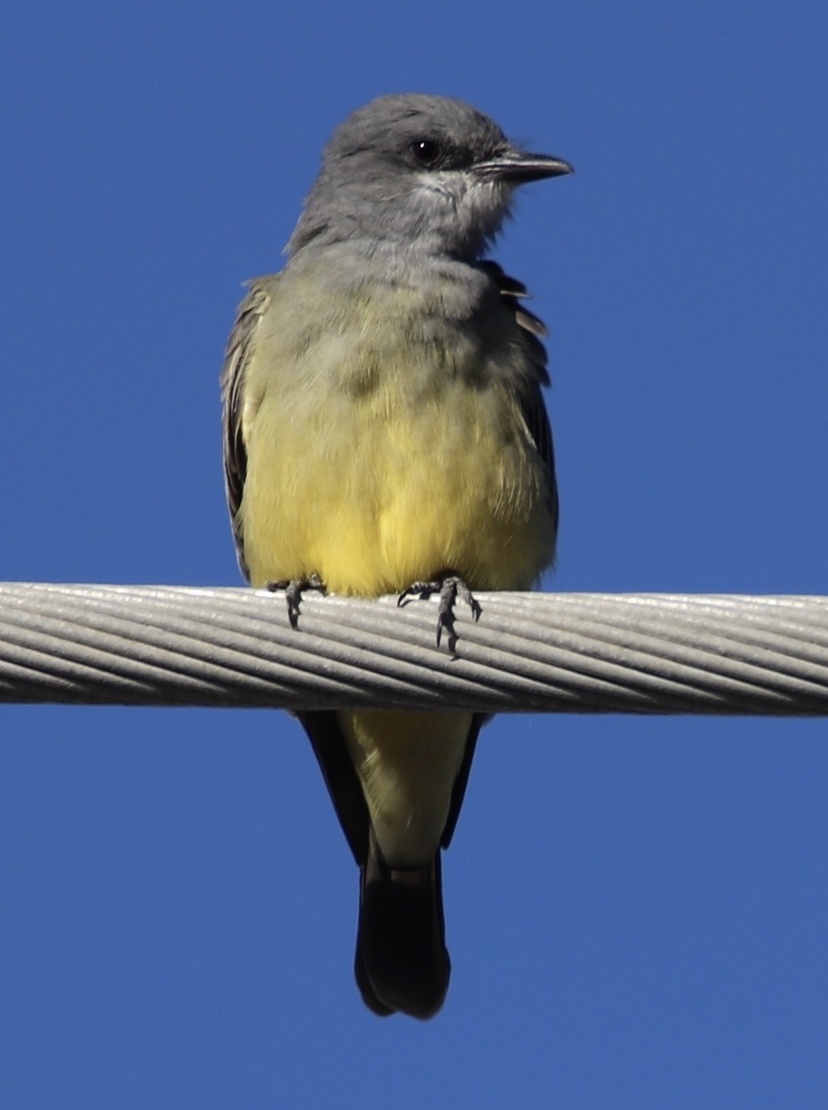
Cassin's Kingbird is a stocky, gray-and-yellow tyrant flycatcher of the open woodlands, foothills, and oak-juniper country of the American Southwest and Mexico. It shares much of its range with the better-known Western Kingbird, and the two are forever being mixed up, but Cassin's tends to favor higher, hillier, more wooded ground, and it announces itself with one of the most distinctive voices of any Western bird. Where the Western Kingbird is a bird of fence posts along the flats, Cassin's is more often a bird of the slopes, the canyon mouths, and the scattered tall trees above town.
Named for the 19th-century American ornithologist John Cassin, this is a confident, vocal, perch-and-pounce hunter. It sits upright on an exposed branch or wire, scans for flying insects, and sallies out to snap them from the air before returning to its lookout. Once you learn its insistent, burry call, you'll start hearing Cassin's Kingbirds in places you walked past for years, they are far easier to identify by ear than by eye.
A medium-large, big-headed flycatcher with a thick bill, broad shoulders, and a square-tipped tail. At rest it looks chunky and upright. The overall impression is a gray bird with a darker hood and a yellow belly, but the key marks are in the contrast of the head and chest and in the tail pattern.
| Head & chest | Dark slate-gray hood blending into a dusky gray breast, so the gray and the yellow belly meet with a soft, smudgy boundary rather than a clean line |
| Throat | Bright white chin and throat patch that stands out sharply against the dark gray face, often the first thing that catches your eye |
| Belly | Lemon to olive-yellow, a bit deeper and duller than the Western Kingbird's |
| Tail | Dark brownish tail with a pale grayish-white tip but NO white outer edges (unlike Western Kingbird) |
| Bill | Stout, broad-based, all black |
| Concealed crown | A small orange-red crown patch, usually hidden and only flashed in excitement or display |
Male vs. female
Males and females look alike in the field, both show the same gray hood, white throat, and yellow belly. Both sexes carry the concealed orange-red crown patch, which is rarely visible on either. Males average very slightly larger and are the more persistent singers, especially at dawn, but you cannot reliably sex an individual bird by sight.
Juveniles
Juvenile and first-year Cassin's Kingbirds resemble adults but are softer and browner overall, with paler, more washed-out yellow underparts and buffy or cinnamon edges to the wing feathers that create faint wingbars. Young birds lack the concealed crown patch, and their gray hood is less crisply defined. By their first fall they look much like adults.
The voice is the giveaway. Cassin's Kingbird's signature call is a loud, low, burry chi-BEER or ki-DEER, emphatic, slightly nasal, and far richer and lower-pitched than the high, bickering chatter of a Western Kingbird. Birders often write it as a single explosive note with a downward kick at the end.
At dawn, especially in breeding season, males give a long, excited rolling song, a stuttering series that builds and tumbles, often rendered as come-here, come-here, COME-HERE repeated insistently. They also give sharp, dry kip notes and a fast, agitated chatter when defending territory or mobbing a hawk. Once learned, the burry chi-beer separates this bird from every other kingbird instantly.
Cassin's Kingbird breeds from the interior West, California, Arizona, New Mexico, southern Colorado, and western Texas, south through the mountains and foothills of Mexico to Guatemala. It favors oak and pine-oak woodland edges, juniper savanna, riparian corridors, ranch country with scattered tall trees, and the wooded fringes of towns, generally at higher elevations than the Western Kingbird.
Most northern breeders are migratory, withdrawing in fall to spend the winter in Mexico and Central America, though some birds linger year-round in southern California, southern Arizona, and along the coast of Mexico. Spring migrants return to the Southwest from March into May. Vagrants turn up well outside the normal range, so birders along the coasts and in the East sometimes find a surprise Cassin's in late fall.
Like other kingbirds, Cassin's is primarily an aerial insect hunter. It perches upright on an exposed branch, wire, or treetop, watches for passing prey, and sallies out to seize flying insects, bees, wasps, beetles, grasshoppers, dragonflies, flies, and winged ants, often with an audible snap of the bill before returning to the same perch. It will also drop to the ground for crawling insects and hover-glean from foliage.
In late summer and on the wintering grounds it readily adds fruit and berries to its diet, taking elderberries, hackberries, and other small wild fruits. This seasonal switch to fruit helps fuel migration and carry the birds through periods when flying insects are scarce.
Cassin's Kingbirds nest fairly high in a tree, frequently in an oak, sycamore, cottonwood, or pine, and often well out toward the end of a horizontal limb. The nest is a bulky, somewhat untidy open cup of twigs, grass, weed stems, and rootlets, lined with finer plant fibers, plant down, and sometimes feathers. The female does most of the building.
A typical clutch is 3 to 4 eggs, creamy or pale buff and boldly blotched with brown and lavender. The female incubates for roughly two and a half weeks, and both parents feed the nestlings, which fledge a couple of weeks after hatching. Pairs are fiercely territorial and will boldly chase off hawks, ravens, and other intruders many times their size, true to the "kingbird" name.
Cassin's Kingbird is not a feeder bird, it eats flying insects and fruit, not seed, so it won't visit a seed feeder or suet cage. But if you live within its Western range, you can make your property appealing to one as a hunting and nesting territory.
- Keep tall, isolated perch trees and snags, kingbirds need open, exposed lookouts to hunt from, so avoid clearing every dead branch.
- Garden with insects in mind: avoid broad-spectrum insecticides, which wipe out the flying bugs that are this bird's entire diet.
- Plant native fruiting shrubs and trees such as elderberry and hackberry to provide late-summer and migration food.
- Leave open, semi-wooded edges rather than dense closed canopy, Cassin's likes the boundary between trees and open ground.
- Provide water; a clean birdbath or small pond can draw kingbirds and the insects they feed on.
- If you're in oak or pine-oak foothill country, simply protect mature trees, a tall horizontal limb is prime nesting real estate.
- Western Kingbird: Paler gray head and chest with a cleaner contrast between gray breast and bright yellow belly, and crucially shows white outer tail feathers; voice is high, sharp, and bickering rather than a low burry chi-beer.
- Tropical Kingbird: Larger bill, notched brown tail, more extensive and brighter yellow extending higher onto the chest, and an olive-tinged back; gives a rapid twittering trill very different from Cassin's.
- Couch's Kingbird: Very similar to Tropical Kingbird; both differ from Cassin's by the heavier bill, notched tail, and yellow reaching higher up the breast. Best separated by voice.
- Eastern Kingbird: Black-and-white, not gray-and-yellow, clean white underparts and a bold white band across the tail tip make it unmistakable next to Cassin's.
How do I tell a Cassin's Kingbird from a Western Kingbird?
Look at the tail and the chest. The Western Kingbird shows white outer tail feathers and a clean break between its pale gray chest and bright yellow belly. Cassin's has no white tail edges (just a pale tip), a darker gray hood, and a bright white throat that contrasts with the dark face. Best of all, listen: Cassin's gives a low, burry chi-beer, while the Western chatters in high, sharp notes.
What does a Cassin's Kingbird sound like?
Its signature call is a loud, low, slightly nasal chi-BEER or ki-DEER with a downward kick. At dawn males give an excited rolling come-here, come-here, COME-HERE song. The burry, lower-pitched quality instantly separates it from the higher, bickering Western Kingbird.
Where do Cassin's Kingbirds live?
They breed across the interior Southwest, Arizona, New Mexico, Colorado, west Texas, and California, and south through the Mexican highlands. They prefer oak and pine-oak woodland, juniper savanna, foothills, and ranch country with scattered tall trees, usually at higher elevations than the Western Kingbird. Most withdraw to Mexico and Central America for winter.
Will a Cassin's Kingbird come to my bird feeder?
No. Kingbirds eat flying insects and wild fruit, not seed or suet, so they won't use a feeder. You can still attract them by keeping tall perch trees, avoiding insecticides, planting native fruiting shrubs like elderberry, and offering water.
Why is it called a 'kingbird'?
Kingbirds earn the name for their fearless, aggressive defense of their territory. A Cassin's Kingbird will boldly attack and chase hawks, ravens, and crows far larger than itself, harassing them until they leave the area. The hidden orange-red crown patch, flashed during displays, adds to the regal nickname.