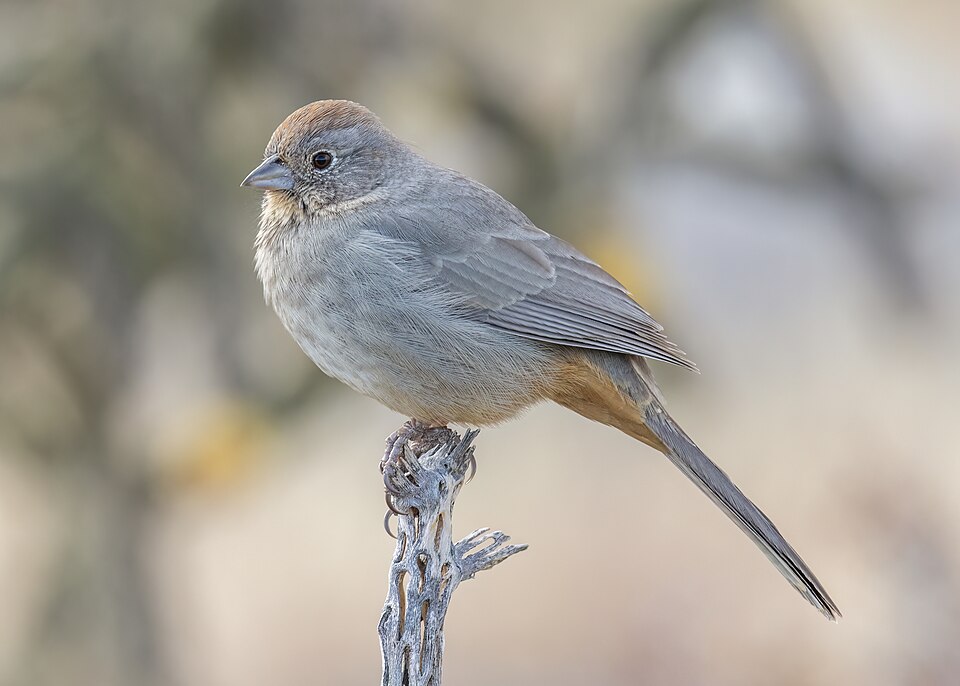
The Canyon Towhee is one of those birds that rewards a second look. At first glance it is an unremarkable, dust-colored ground bird shuffling along a rocky slope or a backyard patio in the desert Southwest. Spend a few minutes with one, though, and it becomes a character: it scratches noisily in the leaf litter, perches boldly on a low boulder to sing, and often lets people approach surprisingly close. For folks living across Arizona, New Mexico, west Texas, and into the Mexican Plateau, it is a familiar year-round neighbor.
Once lumped together with the California Towhee as a single species called the "Brown Towhee," the Canyon Towhee was recognized as its own species in the 1980s based on differences in voice, plumage, and genetics. It belongs to the genus Melozone, a group of New World ground sparrows. True to that family, it spends most of its life on or near the ground in arid, rocky country dotted with shrubs, cactus, and scattered trees, rarely straying far from cover.
This is a large, long-tailed, full-bodied sparrow with a rounded head and a fairly stout, conical bill. On the ground it looks chunky and a bit hunched; in flight the long tail is obvious as it flits low between bushes. The overall impression is plain grayish-brown, and the trick to identification is noticing the subtle details rather than any bold pattern.
| Overall color | Dull grayish-brown above and on the breast, slightly paler below, with no streaking |
| Crown | Warm rusty or reddish-brown cap, often raised into a slight peak |
| Throat | Pale buffy throat ringed by a necklace of fine dark spots, usually with one larger central breast spot |
| Undertail | Rich cinnamon-buff (rufous) feathers under the tail, visible when it lifts or droops the tail |
| Face | Plain face with a buffy eyering and a faint moustache; no bold eyeline or crisp markings |
| Bill & legs | Stout pale conical bill and sturdy pinkish legs built for ground-scratching |
Male vs. female
Males and females look essentially identical, and you cannot reliably tell them apart in the field by plumage. Both sexes share the rusty cap, buffy throat, spotted necklace, and cinnamon undertail. Males average very slightly larger and do most of the singing, so a bird perched up and belting out a song is statistically more likely to be a male, but this is a behavioral clue rather than a visible difference. During the breeding season a paired bird carrying nest material or food can be either sex, since both contribute to raising young.
Juveniles
Juvenile Canyon Towhees look much like washed-out adults but with one helpful difference: their underparts and breast show fine dark streaking, and the throat necklace is less defined. The rusty crown is duller or barely developed, and the plumage overall has a softer, fluffier, looser look. As they molt into their first winter, the streaking fades, the warm cap fills in, and they become hard to separate from adults. Begging juveniles in late spring and summer often trail a parent across open ground, fluttering their wings and giving thin, high calls.
The Canyon Towhee's song is a fairly simple, accelerating series of sharp, metallic notes, often described as chip-chip-chip-chili-chili-chili that speeds up and runs together into a rattling trill toward the end. It is not musical so much as insistent and a little mechanical, frequently delivered from an exposed perch on a rock, fence post, or low branch in the morning.
Calls are just as useful for finding this bird. The most distinctive is a sharp, nasal chit or chedup note, and mated pairs give an excited, squealing duet of run-together notes when they reunite or get agitated. You will also hear a metallic tink as birds keep contact while feeding on the ground. Learning that nasal call note is often the quickest way to detect one in dense desert scrub.
The Canyon Towhee is a year-round resident across the arid interior of the Southwest. In the United States its range covers most of Arizona and New Mexico, the southeastern corner of Colorado, the western and Trans-Pecos parts of Texas, and a sliver of southwestern Oklahoma. From there it continues south across much of the Mexican Plateau. It favors foothills, canyon bottoms, rocky slopes, desert washes, and brushy arroyos, typically in pinyon-juniper, oak scrub, mesquite, and cactus country, often at middle elevations.
This is a non-migratory bird. Individuals are highly sedentary, holding the same territories throughout the year and often for life. You will not see seasonal waves of Canyon Towhees passing through; instead, the same pair tends to stay put on a familiar patch of hillside or neighborhood, which makes them dependable birds to get to know.
Canyon Towhees are ground foragers, and their signature move is the two-footed backward scratch-hop, kicking aside leaves, gravel, and debris to expose food underneath. Their diet shifts with the seasons: seeds of grasses, weeds, and desert plants make up the bulk of it for much of the year, supplemented heavily by insects and other small invertebrates during the warmer breeding months when protein is needed for growing chicks. They also take berries, small fruits, and the occasional bit of waste grain.
They are opportunistic and comfortable around people. In towns and ranch yards they pick at spilled birdseed under feeders, glean insects from the bases of shrubs, and have even been known to forage around outdoor dining areas and the grilles of parked cars for trapped insects. Most feeding happens low and in the open near protective cover, with birds dashing back into a bush at the first sign of a hawk overhead.
Pairs are monogamous and typically defend the same territory year-round. The female builds a bulky, somewhat loose cup nest of twigs, grasses, and weed stems, lined with finer grass, rootlets, and animal hair. Nests are usually placed low, a few feet off the ground, tucked into a dense shrub, a cholla or prickly-pear cactus, a small tree, or a tangle of vines where the thorns and foliage provide protection from predators.
The female lays a small clutch of pale bluish or whitish eggs marked with dark scrawls and spots, and she does the incubating while the male helps feed her and, later, the nestlings. After the young fledge, the parents continue to tend them for some time. In the warmer, wetter parts of the range a pair may raise two or even three broods in a single season, timing later nests to coincide with the insect flush that follows summer monsoon rains.
Yes, Canyon Towhees will visit yards within their range, though they behave differently from a typical feeder bird. They prefer to feed on the ground and stick close to cover rather than perching on hanging tube feeders, so a yard set up with their habits in mind will have far better luck.
- Scatter millet, cracked corn, and mixed seed directly on the ground or on a low platform feeder, since these birds rarely use hanging feeders.
- Provide a low or ground-level birdbath with shallow water; desert birds are strongly drawn to a reliable drinking and bathing spot.
- Keep dense native shrubs, brush piles, and cactus near feeding areas so birds always have escape cover within a quick dash.
- Let part of the yard stay natural and a bit messy, with leaf litter and bare ground they can scratch through for seeds and insects.
- Plant native desert grasses and seed-bearing plants to supply natural food and attract the insects they feed to their young.
- Be patient and let them feel safe; a resident pair that decides your yard is part of its territory will often return reliably day after day.
- California Towhee: Nearly identical in shape but warmer and more uniform brown, lacking the rusty cap, breast spot, and necklace; ranges do not overlap, as California Towhee is restricted to the West Coast.
- Abert's Towhee: Shares Southwest desert habitat but is plainer and warmer brown with an obvious black face mask around the bill and no rusty cap or breast spot.
- Green-tailed Towhee: Smaller, with a bright rufous crown, clean white throat, gray face, and greenish wings and tail; much more boldly patterned and a migratory bird rather than a resident.
- Rufous-crowned Sparrow: Also has a rusty crown and lives in similar rocky country but is much smaller, with a bold black whisker stripe and white eyering, lacking the towhee's bulk and long tail.
What is the difference between a Canyon Towhee and a California Towhee?
They were once considered the same species but are now split. Canyon Towhees have a distinct rusty cap, a buffy throat ringed by a dark spotted necklace, and a noticeable central breast spot, and they live in the interior Southwest. California Towhees are warmer and more uniform brown, lack the rusty cap and breast spot, and are found only along the West Coast. Their ranges do not overlap, so location alone usually settles the ID.
Are Canyon Towhees rare?
No. Within their range across Arizona, New Mexico, west Texas, and the Mexican Plateau they are common, year-round residents and are listed as Least Concern. They are easy to overlook because they are plain and stay low to the ground, but in suitable rocky, brushy desert habitat they are widespread and familiar.
Why does a Canyon Towhee keep visiting my patio or car?
These birds are bold ground foragers and very tolerant of people. They are drawn to spilled seed, insects, and even bugs caught on the grilles of parked cars. A resident pair will often incorporate a yard or patio into its permanent territory and return to the same spots day after day looking for food.
Do Canyon Towhees come to bird feeders?
They will, but on their own terms. Rather than using hanging tube feeders, they prefer to feed on the ground or on a low platform. Scatter millet, cracked corn, or mixed seed beneath your feeders and keep dense shrubs nearby for cover, and you will greatly improve your chances of attracting them.
What does a Canyon Towhee sound like?
Its song is a simple, accelerating series of sharp metallic chip notes that speed into a rattling trill, often given from a low exposed perch. Its most distinctive call is a sharp, nasal chedup or chit note, and pairs greet each other with an excited squealing duet. That nasal call note is often the easiest way to detect one in thick scrub.
Where do Canyon Towhees build their nests?
The female builds a bulky cup of twigs and grass lined with fine material, placed low in a dense shrub, cactus, or small tree where thorns and foliage offer protection. She incubates the eggs while the male helps feed her and the young, and in wetter years a pair may raise two or three broods, often timed to summer monsoon rains.