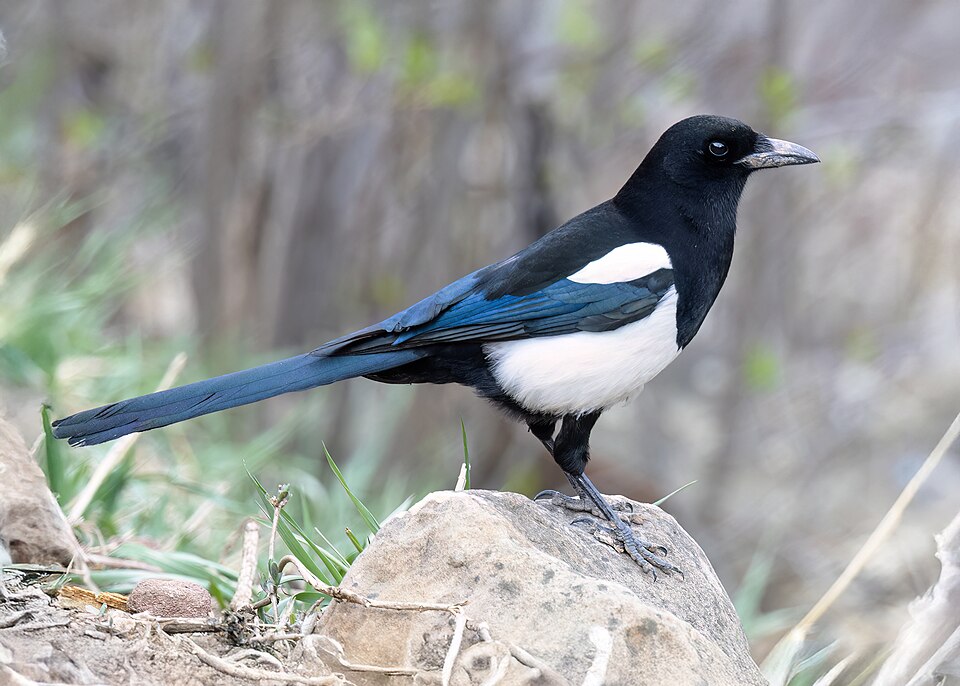
Few birds in western North America are as impossible to overlook as the Black-billed Magpie. Big, boldly pied in black and white, and dragging a tail nearly as long as its body, it patrols open country with a swaggering, confident presence. In good light the black plumage isn't really black at all, the wings and tail glow with iridescent green, blue, and purple, giving this rangeland bird a surprisingly jewel-like shimmer. Once you learn its harsh, scolding chatter, you'll hear it across pastures, ranchyards, sagebrush flats, and river bottoms throughout the interior West.
Like all members of the crow and jay family, the magpie is whip-smart, sociable, and endlessly opportunistic. It caches food, mobs predators, follows large mammals to glean ticks and scraps, and builds one of the most remarkable nests of any North American songbird, a bulky, roofed dome of sticks that can take weeks to assemble. Long persecuted as a pest, the Black-billed Magpie has held its ground and remains a familiar, characterful fixture of the open landscapes from the northern Rockies to the Great Plains.
This is one of the easiest birds to identify in its range, there's simply nothing else shaped like it. Look for a large, slender, jay-relative with a strikingly long, tapered tail, a heavy black bill, and a crisp black-and-white pattern that flashes in flight.
| Overall pattern | Bold black-and-white: black head, breast, and back; white belly and shoulders (scapulars) |
| Tail | Extremely long and graduated, often half the bird's total length, with green-bronze iridescence |
| Wings | Large white patches in the primaries flash brightly in flight; coverts shine blue-green |
| Bill | Stout, all-black, slightly curved at the tip |
| Gloss | Black areas show iridescent green, blue, and purple sheen in good light |
| Flight | Direct, somewhat labored flaps with the long tail streaming behind |
Male vs. female
Males and females look essentially identical in plumage, both wear the same black-and-white pattern with iridescent highlights, so you can't reliably sex them by color. Males average slightly larger and longer-tailed, but the overlap is too great to call an individual in the field. The most practical clue comes during the breeding season, when females do all the incubating and may be seen sitting low in the domed nest while the male stands guard or brings food nearby.
Juveniles
Freshly fledged magpies wear the same black-and-white pattern as adults but look noticeably scruffier and duller. Their tails are conspicuously short at first, lacking the elegant streamer of adults, and grow in over the following weeks. Juveniles show less iridescence, softer-edged feathers, and often have a fleshy gape at the corners of the mouth and a more uniformly dark, slightly browner cast. Begging youngsters are noisy and frequently seen trailing adults through late summer.
The Black-billed Magpie is far more of a talker than a singer. Its most familiar sound is a loud, harsh, rising chatter, a rapid shek-shek-shek-shek or rattling mag? mag? mag?, often delivered in a scolding series when the bird is excited or mobbing a predator. It also gives a nasal, querulous maag or aag-aag that rises in pitch like a question.
Beyond these everyday calls, magpies produce a startling range of squeaks, whistles, gurgles, and soft warbles, especially in quiet social settings. Like other corvids they are excellent mimics and will sometimes work odd whistled or mechanical sounds into their repertoire. There is no true musical song; communication is all about that grating, conversational chatter that carries far across open ground.
The Black-billed Magpie is a bird of interior western North America. Its range stretches from south-central Alaska and western Canada down through the northern Rockies, the Great Basin, and the Great Plains, common across states like Montana, Wyoming, Idaho, Colorado, Utah, Oregon, and the Dakotas, and reaching the eastern edges of the plains. It favors open and semi-open country: rangeland, foothills, sagebrush, agricultural edges, riparian thickets, and ranch and town outskirts.
It is essentially non-migratory, holding territory year-round, though birds may wander locally and shift to lower elevations or richer feeding areas in winter, often gathering in loose flocks. Note that the very similar bird of central California is now recognized as a separate species, the Yellow-billed Magpie, whose range does not overlap.
Magpies are true omnivores and supremely opportunistic. Their diet shifts with the seasons and with whatever is easiest to get: insects and other invertebrates (grasshoppers, beetles, caterpillars, grubs), carrion, small vertebrates, eggs and nestlings of other birds, grain, fruit, and human scraps. They are well known for following large grazing mammals, cattle, bison, elk, deer, to pick ticks and biting flies directly off their backs and to snap up insects flushed from the grass.
Much of their foraging happens on the ground, where they walk and hop with the tail held clear, flipping over dung and debris to find prey. Like other corvids, they cache surplus food in shallow ground holes or crevices and remember the locations, returning later when pickings are slim. This flexibility is a big reason magpies thrive alongside ranching and farming.
The nest is the magpie's signature creation: a large, bulky, roughly spherical structure of sticks with a domed roof and one or two side entrances, built in a thorny shrub, dense tree, or tall bush. Inside the stick framework the birds construct a sturdy mud-and-rootlet cup lined with finer grass and hair. Both members of a pair work on it, and the whole project can take many weeks; old nests are often reused or recycled by other species afterward.
The female lays a clutch of around six or seven greenish, heavily speckled eggs and incubates them alone for roughly 16 to 18 days while the male feeds her. The young remain in the nest for several weeks before fledging. Pairs typically raise a single brood per year. Magpies often nest in loose, semi-colonial clusters where habitat is good, and the conspicuous old domed nests are a familiar sight in bare winter trees across the West.
The Black-billed Magpie is not a classic feeder bird, but in its range it readily takes advantage of yards, especially in rural and semi-rural settings near open country. It's more likely to patrol your property for scraps and insects than to perch daintily at a seed feeder, and not everyone welcomes such a bold, noisy guest. If you'd like to see more of them, here's what helps.
- Offer protein-rich foods on a platform feeder or the ground, suet, peanuts, mealworms, cracked corn, and table scraps appeal far more than small seeds.
- Keep open lawn or pasture nearby; magpies forage on the ground and avoid cramped, heavily wooded yards.
- Provide a large, sturdy water source, a ground-level birdbath or shallow basin, since these big birds won't use small hanging baths.
- Leave dense, thorny shrubs or small trees standing to give them sheltered nesting and roosting cover.
- Accept that they may mob feeders and raid other nests; if you keep smaller songbirds, place vulnerable nest boxes away from magpie hangouts.
- Avoid rodenticides and pesticides, magpies eat carrion and insects and are vulnerable to secondary poisoning.
- Yellow-billed Magpie: Nearly identical in shape and pattern but has a bright yellow bill and a patch of bare yellow skin around the eye; restricted to central California with no range overlap.
- Common Raven: All-black, no white, and lacks the long graduated tail; far bulkier with a wedge-shaped tail and deep croaking calls.
- American Crow: Entirely black with a short, square tail; no white in the plumage and a harsh cawing rather than the magpie's rattling chatter.
- Lewis's Woodpecker: Shares western open habitats and a pied look at a glance, but is a woodpecker with a pinkish belly, gray collar, and undulating flight, no long tail.
Where do Black-billed Magpies live?
They live across interior western North America, from south-central Alaska and western Canada south through the northern Rockies, Great Basin, and Great Plains. Look for them in open and semi-open country, rangeland, sagebrush, foothills, riparian thickets, and the edges of farms and towns. They are absent from the East and most of the Pacific Coast.
Are Black-billed Magpies the same as the magpies in Europe?
They're very close relatives but not the same species. The European bird is the Eurasian Magpie (Pica pica). The North American Black-billed Magpie (Pica hudsonia) was long lumped with it and looks almost identical, but is now treated as a separate species based on differences in voice, behavior, and genetics.
What does a Black-billed Magpie sound like?
Its signature sound is a loud, harsh, rattling chatter, a rapid shek-shek-shek-shek, along with a rising, nasal, questioning maag. They are not songbirds in the musical sense; expect grating, conversational scolding that carries far across open ground, plus a wide range of squeaks and whistles.
Why do magpies build such huge covered nests?
The bulky domed nest, with its stick roof and mud cup inside, helps protect eggs and nestlings from weather and from predators and other corvids. Both members of a pair build it over several weeks, and the durable old nests are often reused later by hawks, owls, and other birds.
Are Black-billed Magpies good or bad for the environment?
They're a natural and beneficial part of western ecosystems. Magpies clean up carrion, eat large numbers of insect pests like grasshoppers, and pick ticks off livestock and wild grazers. They do raid the nests of smaller songbirds, but this is normal predator behavior and rarely a threat to healthy bird populations.