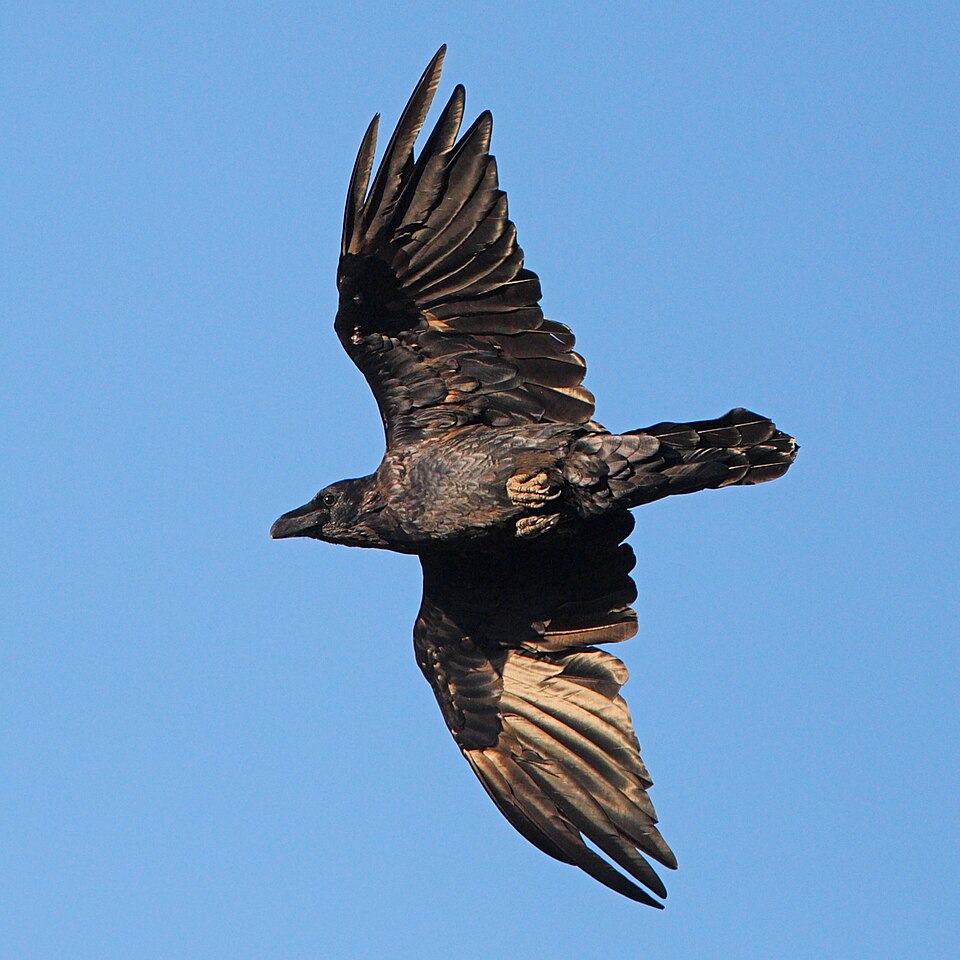
The Common Raven is an all-black bird the size of a hawk, and it carries itself like one. Where a crow looks tidy and businesslike, a raven looks shaggy, heavy-billed, and a little ragged at the throat. It is the largest member of the crow family and, by most measures, the largest songbird on Earth. Ravens have lived alongside people for thousands of years, turning up in mythology, folklore, and poetry across the Northern Hemisphere, and they earn the attention: few wild birds are as inventive, playful, or downright clever.
You will find ravens almost everywhere except the wettest tropics, from arctic tundra and high mountains to deserts, coastlines, and increasingly the edges of towns and cities. They are masters of the open sky, soaring and tumbling on long, finger-tipped wings, and they communicate with a remarkable vocabulary of croaks, knocks, and bell-like notes. Once persecuted and pushed back into wilderness, the Common Raven has rebounded strongly and is now expanding into suburbs and farmland across much of its range.
Size and shape are your best tools for a raven. Look for a big, broad-winged, long-tailed bird with a heavy, almost dagger-like bill and a noticeably shaggy throat. In flight the wedge- or diamond-shaped tail is the clincher, and ravens spend far more time soaring than crows do.
| Overall color | Entirely glossy black, including legs and bill; can show purple, blue, or oily green sheen in good light |
| Bill | Massive, deep, and slightly curved with a hooked tip; bristly feathers cover the base |
| Throat | Shaggy, loose 'hackle' feathers form a distinct ragged beard, especially when calling |
| Tail in flight | Long and wedge- or diamond-shaped, not the fan-shaped square tail of a crow |
| Wings | Long and narrow with splayed 'fingers' at the tips; raven frequently soars and glides |
| Size | Hawk-sized and bulky, much larger than any crow; flap is slow and deep |
Male vs. female
Males and females look alike, both glossy black with the same heavy bill and shaggy throat, so you cannot reliably sex a raven by plumage in the field. Males average slightly larger and heavier-billed than females, but the overlap is wide and the difference is usually only obvious when a pair is seen side by side. Behavior offers better clues during breeding season, when the male is often the more demonstrative partner in display flights and courtship.
Juveniles
Young ravens are a duller, sootier black than adults and lack the strong glossy sheen, often looking slightly brownish, especially as the feathers wear. The clearest tell is the mouth: juveniles have a pinkish or reddish gape and, for their first months, the inside of the mouth and the bristly throat feathers are less developed. Their eyes are grayish-blue at first, darkening to the adult's dark brown. By their first full year they are largely indistinguishable from adults in the field.
The classic raven sound is a deep, hollow, resonant croak, often written as kraaa or prruk-prruk-prruk, far lower and more drawn out than a crow's sharp caw. If a black bird sounds like it is gargling gravel from the bottom of a well, it is a raven. They commonly give a rolling cr-r-ruck in flight that carries a long way across open country.
Ravens have one of the richest vocal repertoires of any bird. Beyond the croak they produce knocking and clucking notes, a clear bell-like or water-droplet tok, nasal whines, and an array of mimicked and improvised sounds. Mated pairs and family groups keep up quiet conversational mutterings, and captive ravens can even imitate human words.
The Common Raven has one of the largest ranges of any bird, spanning nearly the entire Northern Hemisphere. In North America it is found from the high Arctic south through Canada, the western mountains and deserts, the Appalachians, and into Mexico and Central America. It is equally widespread across Europe, North Africa, and Asia. Historically scarce in the eastern and midwestern United States after centuries of persecution, it has been steadily reclaiming that ground.
Ravens are largely non-migratory and hold territories year-round, especially established breeding pairs. Young, non-breeding birds wander more widely and may gather in loose flocks, and birds in the far north may shift southward when winter conditions turn severe. For the most part, though, a raven you see in summer is a raven you can expect in the same area in winter.
Ravens are true omnivores and opportunists, eating almost anything they can find, catch, or steal. Carrion is a staple, and they are often the first birds at a roadkill or a carcass, using their powerful bills to tear into food other birds cannot open. They also take small mammals, eggs and nestlings, reptiles, amphibians, insects, grains, fruit, and human refuse from dumpsters and landfills.
Their feeding behavior shows off their intelligence. Ravens cache surplus food and remember where they hid it, follow predators like wolves to share in kills, and have been observed working in pairs to distract and rob other animals. They will drop hard food from a height to crack it and readily learn to exploit campgrounds, picnic areas, and roadsides where people leave scraps behind.
Ravens form long-term pair bonds and often mate for life, defending a large territory year after year. The nest is a bulky platform of sticks lined with softer material such as animal fur, bark strips, moss, and grass. Pairs favor high, sheltered sites: cliff ledges, tall trees, and increasingly human structures like power-line towers, bridges, and buildings. Both members of the pair help build, though the female does most of the lining.
The female lays a clutch of greenish, dark-blotched eggs and does nearly all of the incubation while the male brings her food. Young hatch helpless and stay in the nest for several weeks, fed by both parents, and family groups may stay loosely together for a time after the young fledge. Ravens typically raise a single brood per year.
The Common Raven is not a backyard feeder bird in the way a chickadee or finch is, and you should not expect it at a seed feeder or suet cage. It is a wide-ranging, wary, large-territory bird that you attract more by habitat and circumstance than by a feeding station. That said, you can improve your odds of seeing and even befriending the ravens in your area.
- Offer occasional protein-rich scraps like unsalted meat trimmings, peanuts in the shell, or eggs in an open, ground-level spot away from the house if ravens already patrol your area.
- Keep a reliable open water source such as a large, sturdy birdbath or ground basin; ravens drink and bathe readily.
- Preserve tall trees, snags, and open sightlines, since ravens prefer to perch high and survey before committing to a spot.
- Be patient and consistent, putting out food at the same time and place; ravens recognize individual people and routines, and may grow tolerant over weeks.
- Skip songbird-style feeders, which ravens cannot use well and which only draws bullying; an open platform or bare ground works far better.
- American Crow: Much smaller with a fan-shaped square tail, a slimmer bill, a smooth throat, and a higher sharp 'caw'; rarely soars for long.
- Fish Crow: Even smaller than the American Crow and best told by its nasal, two-note 'uh-uh' call; far smaller and tidier than a raven.
- Chihuahuan Raven: A smaller southwestern raven with a higher, crisper croak; white feather bases on the neck show when ruffled by wind.
What is the difference between a raven and a crow?
Ravens are much larger, with a heavier bill, a shaggy throat, and a long wedge-shaped tail, while crows are smaller and sleeker with a square fan-shaped tail. Ravens croak deeply; crows give a sharp caw. Ravens also soar and glide far more than crows, which mostly flap.
How big is a Common Raven?
A Common Raven is roughly 22 to 27 inches long with a wingspan of about 45 to 51 inches, making it close to hawk-sized and far larger than any crow. It is the largest member of the crow family and one of the largest songbirds in the world.
Are ravens really as intelligent as people say?
Yes. Ravens are among the smartest birds studied, capable of solving puzzles, planning ahead, using simple tools, caching and remembering food, and even recognizing individual human faces. Their problem-solving abilities rival those of some primates.
Do ravens come to backyard feeders?
Not typically. Ravens are large, wary, wide-ranging birds that do not use songbird feeders. You are more likely to attract them with open ground-level scraps, peanuts, or water if they already patrol your area, rather than with a standard seed or suet feeder.
What sound does a raven make?
The signature call is a deep, hollow, croaking 'kraaa' or rolling 'prruk-prruk', much lower than a crow's caw. Ravens also make knocking notes, clear bell-like 'tok' sounds, whines, and a wide range of other vocalizations, and they can mimic sounds including human speech.