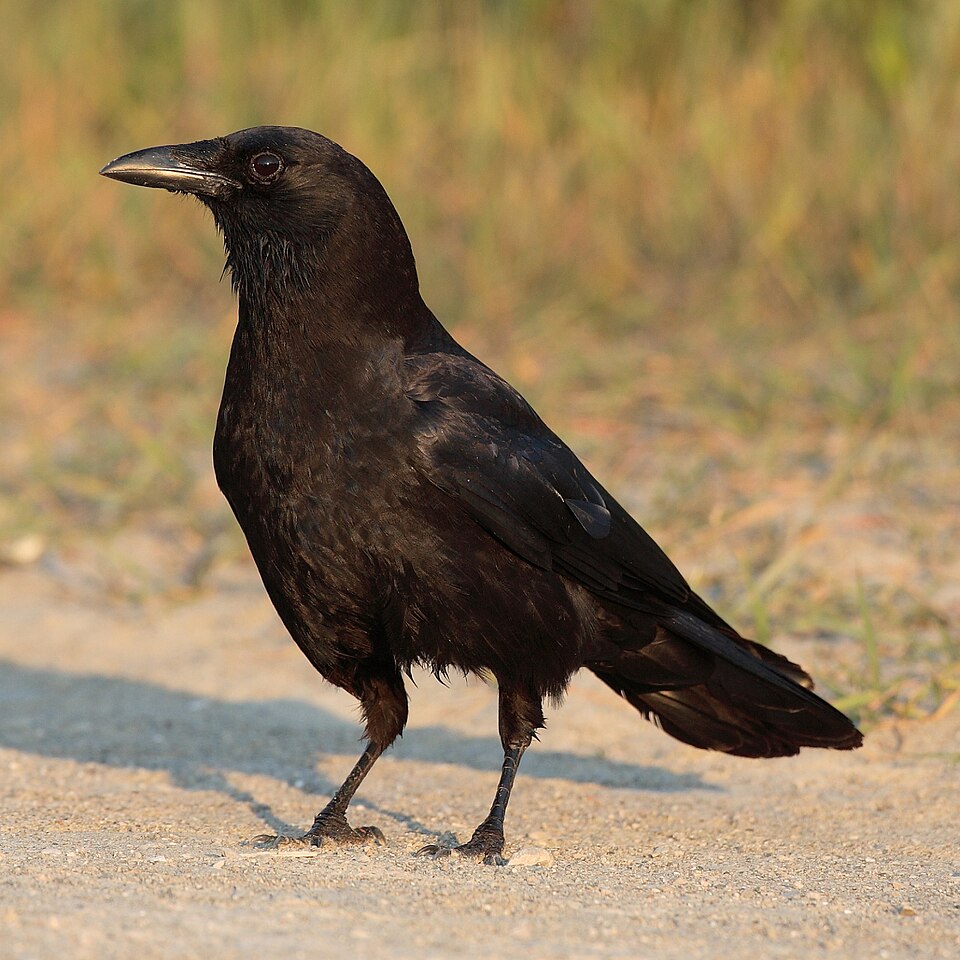
The American Crow is one of the most familiar birds on the continent, a glossy black bird that struts across lawns, parking lots, athletic fields, and farm stubble with obvious confidence. Loud, sociable, and genuinely smart, crows are easy to overlook precisely because they are everywhere, yet a few minutes of watching reveals one of the most interesting birds you can find without leaving your driveway. They cache food, recognize individual human faces, mob hawks and owls as a group, and pass information between generations within their family flocks.
Crows thrive in the patchwork landscapes people create, mixing open ground for foraging with scattered trees for roosting and nesting. They live in extended families: young from previous years often stay on to help their parents raise the next brood, which is unusual among birds. In winter, local family groups merge into communal roosts that can number in the thousands or, in a few famous cities, the hundreds of thousands. Whether you find them charming or maddening, crows are a permanent and impossible-to-ignore part of the North American backyard.
This is a large, entirely black bird with a heavy straight bill, a fan-shaped tail, and a steady, even wingbeat. Size and overall blackness usually identify it at a glance, but separating it from the larger Common Raven and the smaller Fish Crow is the real ID challenge.
| Color | Entirely glossy black including bill, legs, and eyes; plumage can show a faint purple or blue sheen in good light |
| Bill | Stout, straight, and heavy but not exaggerated; black throughout |
| Tail | Short and squared-off or rounded, fanning slightly in flight (not wedge-shaped like a raven) |
| Size | Large songbird, noticeably bigger than a Blue Jay but clearly smaller and slimmer-headed than a Common Raven |
| Flight | Steady, rowing wingbeats with little gliding or soaring; crows flap almost constantly |
| Voice | The classic clear caw-caw-caw, the single best clue separating it from the nasal Fish Crow |
Male vs. female
Males and females look identical in the field. Both sexes are uniformly black with no plumage differences, no seasonal change, and no reliable size difference visible at normal birding distances (males average very slightly larger, but you cannot judge this by eye). Pairs are best told apart by behavior at the nest rather than appearance.
Juveniles
Juvenile crows are also all black but look subtly scruffier than adults. Freshly fledged young have a duller, browner-tinged plumage that lacks the clean gloss of an adult, soft-looking loose feathers, and at very close range a pinkish or grayish lining inside the mouth and pale, bluish eyes that darken with age. Begging juveniles give a distinctive nasal, whining caw and often follow adults around with quivering wings, which is a good summer clue that you are watching a family group.
The American Crow's signature sound is its loud, clear caw, usually repeated in a short series: caw-caw-caw. The tone is full and open, almost a shout, and carries a long way. Crows have a surprisingly large vocabulary beyond this, including soft rattles, clicks, coos, and an oddly musical assortment of mutters they give among family members at close range.
The most useful field point is the contrast with the Fish Crow, whose call is shorter, lower, and distinctly nasal, often a two-note uh-uh or a flat caw that sounds like a crow with a head cold. If a crow answers you with a clear, ringing caw, it is almost certainly an American Crow; if it sounds congested and nasal, look closer.
American Crows are found across nearly all of the United States and southern Canada, from coast to coast, and are present year-round through most of that range. They occupy almost every habitat people use: suburbs, city parks, farmland, woodland edges, river corridors, beaches, and landfills.
Birds breeding in the far north and the northern Great Plains are migratory, pulling south in fall to escape deep snow and frozen ground, while crows across most of the Lower 48 are permanent residents that simply shift to communal winter roosts. These roosts form in late fall and break up in early spring as pairs disperse back to nesting territories. The species is largely absent from the harsh desert interior of the Southwest and from the highest mountains.
The American Crow is a true omnivore and opportunist, which is a big reason it does so well around people. Its diet includes insects and other invertebrates, earthworms, grains and waste corn, fruits and berries, small reptiles and amphibians, the eggs and nestlings of other birds, carrion, garbage, roadkill, and just about any edible scrap it can scavenge. Much of its feeding happens on the ground as it walks and probes open lawns, fields, and shorelines.
Crows are notable problem-solvers at the table. They drop hard-shelled food like walnuts and clams onto pavement to crack them, dunk dry food in water to soften it, and cache surplus food in the ground or in tree crevices to retrieve later, remembering many hiding spots. Family members often forage together, and the species is famous for following plows, mowers, and people who feed them.
American Crows build bulky stick nests, usually placed high in a tree, often in a crotch or against the trunk where the structure is well hidden by foliage. The outer shell is coarse sticks and twigs, lined with softer material such as bark strips, grass, moss, fur, and feathers. The female does most of the incubating while the male and any helpers bring her food.
A typical clutch is 3 to 7 pale blue-green eggs blotched with brown and gray, incubated for roughly 18 days, with young leaving the nest about a month after hatching. Crows are cooperative breeders: offspring from earlier years frequently remain with their parents and help defend the territory and feed the new nestlings. Most pairs raise a single brood per year, occasionally renesting if the first attempt fails.
Crows are not classic feeder birds, but they are easy to draw into a yard if you welcome them. They will not perch on a tube feeder or eat from a small hanging tray the way finches do; instead they want open ground and substantial food they can grab and carry off. Many people enjoy a backyard crow family, while others consider them a nuisance, so attract them deliberately.
- Offer food on the ground or a low open platform rather than hanging feeders; crows feed by walking and want room to land and look around.
- Put out unsalted peanuts in the shell, cracked corn, or scraps of bread, eggs, and meat; crows are bold about taking larger items they can carry off.
- Provide open water in a wide, sturdy bath or shallow dish on the ground; crows drink, bathe, and even dunk dry food to soften it.
- Be patient and consistent at the same time each day — crows learn routines and individual faces, and a fed family may visit for years.
- Keep in mind crows will also raid songbird nests and dominate a yard, so expect them to displace smaller feeder birds when present in numbers.
- Common Raven: Much larger with a heavier bill, shaggy throat feathers, a wedge-shaped tail, and frequent soaring; gives a deep croaking gronk rather than a clear caw.
- Fish Crow: Nearly identical in appearance and only safely separated by voice: a short, nasal, congested-sounding uh-uh instead of the American Crow's clear caw.
- Chihuahuan Raven: A raven of the arid Southwest, larger than a crow with a wedge tail and croaking calls; white feather bases at the neck show when wind ruffles the plumage.
- Common Grackle: Smaller and slimmer with a long keel-shaped tail, a pale yellow eye, and an iridescent purple-and-bronze sheen rather than uniform matte black.
What is the difference between a crow and a raven?
Ravens are noticeably larger with a heavier bill, shaggy throat feathers, and a wedge-shaped tail, and they soar on flat wings while crows flap steadily. The easiest tell is voice: ravens give a deep, hoarse croak while crows give a clear, ringing caw.
How long do American Crows live?
In the wild many crows live 7 to 8 years, but some banded birds have reached their late teens or beyond. In captivity crows can live much longer, occasionally past 20 years.
Are crows really as smart as people say?
Yes. American Crows use and even shape simple tools in some populations, solve multi-step puzzles, cache and recover food, and famously recognize and remember individual human faces, sharing that information with their flock.
Why do so many crows gather in one place at night?
In fall and winter, local family groups merge into large communal roosts for safety and warmth, sometimes numbering in the thousands. Roosting together gives more eyes to watch for predators and may help birds share information about food.
Why do crows chase or dive at hawks and owls?
This behavior is called mobbing. Crows harass predators in noisy groups to drive them out of the area and to teach younger birds which animals are dangerous, since hawks and owls hunt crows and their young.