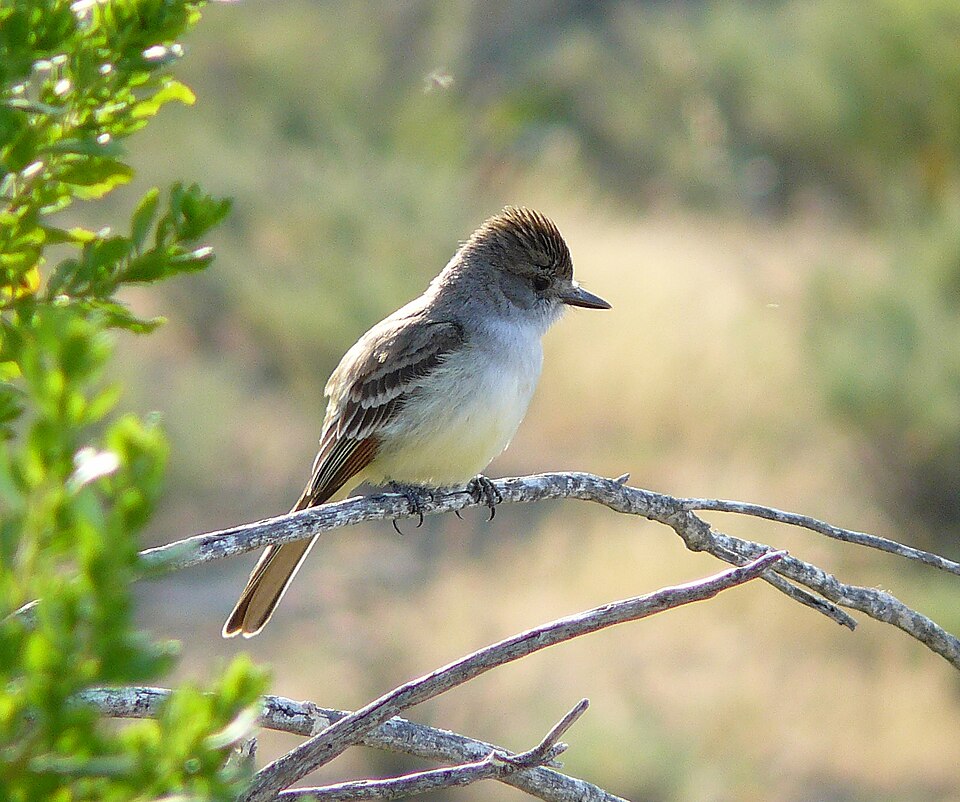
The Ash-throated Flycatcher is a slim, soft-colored member of the Myiarchus flycatchers, a group of medium-sized birds with bushy crests, long tails, and a habit of perching upright while they scan for prey. As its name suggests, this one is understated: a pale gray throat and breast, a wash of lemon on the belly, and a flash of warm cinnamon in the wings and tail that catches the light when it flies. Where its showier cousin the Great Crested Flycatcher fills eastern woodlands, the Ash-throated takes over the dry country of the American West, thriving in places too hot and brushy for many other birds.
This is a bird of deserts, oak scrub, mesquite, pinyon-juniper, and chaparral, and it is remarkably good at living without standing water, getting much of its moisture from insects and fruit. It nests in cavities, readily accepting old woodpecker holes, natural hollows, fence posts, drainpipes, and nest boxes, which makes it one of the more approachable desert birds for people who put up boxes. For many Western backyard birders, the dry rolling ka-brick call drifting out of a mesquite is the surest sign that summer has arrived.
Look for a medium-sized, slender flycatcher with an upright posture, a slightly bushy crest that gives the head a peaked or squared-off look, and a long tail it often pumps or flicks. The overall impression is pale and washed-out compared to other crested flycatchers, with the warm rufous in the wings and tail being the most reliable splash of color.
| Throat & breast | Pale ash-gray, fading to a soft, pale lemon-yellow on the belly and undertail |
| Head | Grayish-brown with a slightly bushy, peaked crest; large dark eye |
| Tail | Rufous-edged; outer feathers show cinnamon but the tail tip is typically dark, a key separator from similar species |
| Wings | Brown with two pale wing bars and bright rufous edges to the flight feathers |
| Bill | Fairly long, straight, all-dark, and broad at the base |
| Size & shape | Slim and long-tailed, about robin-sized but more elongated; perches upright and bolt-still between sallies |
Male vs. female
Males and females look essentially identical in the field. There is no difference in plumage color or pattern, and the slight size difference (males average marginally larger) is not something you can judge on a single bird. During the breeding season the female is the one that builds the nest and incubates, so behavior near a nest cavity is a better clue to sex than appearance ever will be.
Juveniles
Juveniles look much like adults but are even softer and more uniform in tone, with the rufous in the wings and especially the tail often brighter and more extensive than on adults. Fresh young birds in late summer can show cleaner, more rufous-edged wing feathers and a slightly buffier wash overall. They are most easily confused with worn adults, so rely on range and the dark tail tip rather than trying to age every bird precisely.
The Ash-throated Flycatcher is not a loud or musical bird, but its voice is distinctive once you learn it. The most familiar call is a rolling, burry ka-brick or ka-wheer, sometimes written as prit-wheer, with a rough, almost hiccupping quality. You will also hear a sharp, single pip or prrt note given as a contact call.
At dawn, especially early in the breeding season, males give a repeated rolling song that strings these notes together into a soft, churring series. Compared with the Great Crested Flycatcher's loud, rising wheeep, the Ash-throated's voice is drier, lower, and far less assertive, which fits a bird that spends much of its day quietly working the brush.
This is a long-distance migrant of western North America. It breeds across the arid and semi-arid West, from Washington and the interior Pacific states south through the Great Basin, the Southwest deserts, Texas, and well into Mexico, favoring deserts, oak and juniper woodlands, mesquite bosques, and dry brushy slopes.
In fall most birds withdraw to wintering grounds from western Mexico south to Central America, with a smaller number lingering along the southern edge of the U.S. range. The Ash-throated is also a famous vagrant: nearly every autumn and winter, individuals turn up far to the east, including along the Atlantic Coast, making it a bird Eastern birders watch for among late-season strays.
Insects and other arthropods make up the bulk of the diet. Ash-throated Flycatchers hunt by sitting upright on an exposed perch, scanning, then sallying out to snatch prey from foliage, branches, the ground, or occasionally the air. Unlike some flycatchers, they take a large share of their food by gleaning from surfaces rather than catching everything on the wing, snapping up grasshoppers, beetles, caterpillars, wasps, spiders, and even small lizards.
They also eat fruit, particularly in late summer, fall, and winter, including the berries of desert shrubs, mistletoe, and cactus fruit. This flexibility, plus their ability to get water from food, lets them thrive in habitats where surface water is scarce for much of the year.
The Ash-throated Flycatcher is a cavity nester that does not excavate its own hole. Instead it relies on old woodpecker holes, natural cavities in trees, cacti, and rotting limbs, and a wide variety of human-made spaces, including nest boxes, fence-post hollows, pipes, mailboxes, and other odd nooks. The female builds a bulky nest of grass, weed stems, hair, and fur, and many nests famously include shed snakeskin or, in modern times, strips of plastic that mimic it.
A typical clutch is four to five eggs, creamy with brown and lavender streaks and blotches. The female does the incubating, and both parents feed the young. Pairs usually raise one brood per season, occasionally two in the south, and they can be quite tolerant of nest boxes placed in suitable dry, open country.
Ash-throated Flycatchers are insect and fruit eaters, so they will not come to seed feeders, but they are very much a backyard bird in the right Western settings, and you can absolutely invite them in if you live within their range.
- Put up a nest box sized for them (similar to a bluebird box but with a slightly larger entrance, around 1.5 inches) on a post or tree edge in open, dry, brushy habitat.
- Keep your yard insect-friendly by avoiding pesticides; a healthy supply of grasshoppers, beetles, and caterpillars is the real draw.
- Plant or preserve native fruiting shrubs and trees such as desert hackberry, elderberry, and other berry producers for late-summer and fall feeding.
- Leave dead limbs and snags standing where safe; natural cavities and exposed hunting perches are exactly what this bird looks for.
- Offer a shallow water source or mister near cover; even desert birds appreciate clean water in hot weather.
- Maintain some open ground and edge habitat rather than dense lawn, giving them room to sally after ground-dwelling prey.
- Great Crested Flycatcher: Larger and much brighter, with a vivid lemon-yellow belly, gray throat, and reddish tail; ranges in the East with little overlap, and has a louder, rising wheeep call.
- Brown-crested Flycatcher: Bigger and bulkier with a heavier bill and brighter yellow belly; overlaps in the Southwest, so listen for its sharper, whistled calls and look for the larger, broader-based bill.
- Dusky-capped Flycatcher: Smaller and darker-headed with brighter yellow underparts and little or no rufous in the tail; gives a mournful, drawn-out whistled peeur unlike the Ash-throated's burry ka-brick.
- Western Kingbird: Similar dry-country range but stockier, with a gray head, bright yellow belly, and a black tail with white outer edges; perches more conspicuously and is far noisier and more aggressive.
What does an Ash-throated Flycatcher look like?
It is a slim, pale flycatcher with a bushy crest, ash-gray throat and breast, a soft lemon-yellow belly, and warm rufous edges in the wings and tail. The tail tip is dark, which helps separate it from brighter relatives. Males and females look alike.
What sound does an Ash-throated Flycatcher make?
Its signature call is a rolling, burry ka-brick or ka-wheer, plus a sharp pip note. At dawn males give a soft churring series. It is much quieter and drier-sounding than the loud, rising whistle of the Great Crested Flycatcher.
Will an Ash-throated Flycatcher use a nest box?
Yes. It is a cavity nester that readily accepts nest boxes, especially boxes similar to a bluebird box with an entrance around 1.5 inches, placed in open, dry, brushy Western habitat. It also uses old woodpecker holes, fence posts, and pipes.
What do Ash-throated Flycatchers eat?
Mostly insects and other arthropods such as grasshoppers, beetles, caterpillars, wasps, and spiders, plus occasional small lizards. They also eat fruit and berries, especially in late summer and winter, and get much of their water from food.
Where and when can I see an Ash-throated Flycatcher?
They breed across the arid western U.S. and Mexico in deserts, oak scrub, and pinyon-juniper from spring into summer, then migrate to Mexico and Central America for winter. Each fall a few wander far east as vagrants, even reaching the Atlantic Coast.