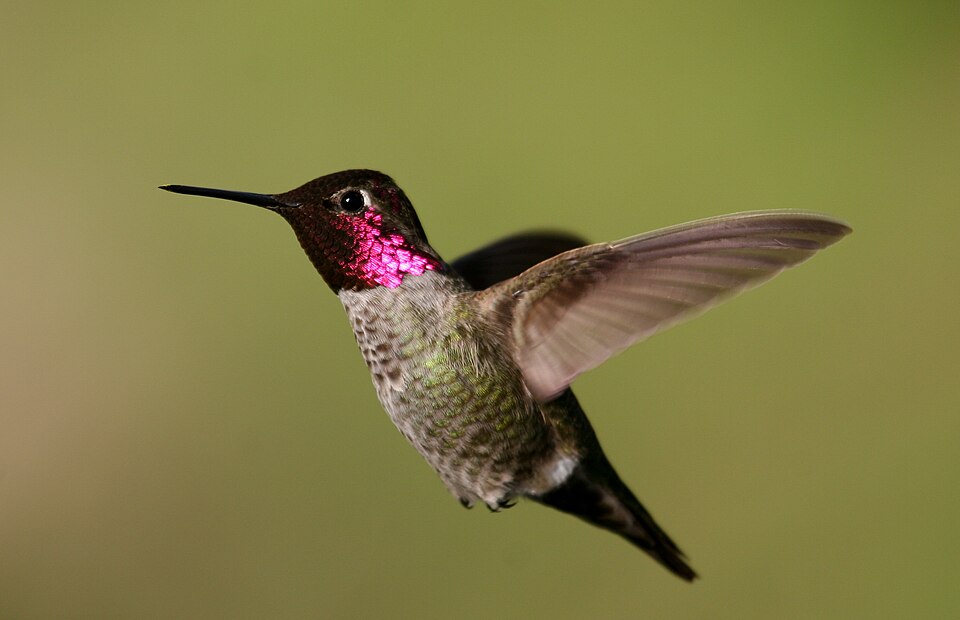
Anna's Hummingbird is the signature hummingbird of the Pacific Coast, a stocky, medium-sized jewel that stays put through the winter where most other North American hummingbirds vanish south. In a region from southern British Columbia down through California, this is very often the hummingbird at the feeder in December, hovering in cold drizzle while its breath shows in the morning chill. The adult male's head and throat blaze with iridescent rose-pink that can look almost magenta or coppery depending on the angle of the light, and when the light is wrong it simply looks black.
This is a bird that has thrived alongside people. Once largely tied to the chaparral and coastal scrub of California, Anna's Hummingbird has expanded its range dramatically over the past century, riding the spread of garden flowers, ornamental eucalyptus, and backyard nectar feeders. Today it is one of the most reliable and approachable hummingbirds in North America, and its loud, scratchy song and dramatic diving display make it easy to notice even before you spot the bird itself.
Anna's is a compact, fairly chunky hummingbird with a relatively short, straight black bill and a broad, full-looking body compared to the more slender Selasphorus hummingbirds. Look for a grayish, dingy underside and bronzy-green back; the real giveaway is the iridescent head, which on the male wraps from the crown all the way down over the throat.
| Size & shape | Stocky and broad-bodied for a hummingbird, with a short, straight, all-dark bill and a fairly short tail |
| Male head | Iridescent rose-pink to magenta covering both the crown and the gorget (throat); looks dull black in poor light |
| Female throat | Grayish with a small central patch of red-pink iridescent feathers, unlike most female hummingbirds |
| Underparts | Dingy grayish-white, often washed with green along the sides; not clean white |
| Back & crown | Bronzy-green, giving a metallic sheen in good light |
| Tail | Dark and relatively short, lacking the rufous (orange) tones of Rufous and Allen's hummingbirds |
Male vs. female
The sexes are quite different. The adult male is unmistakable when the light catches him: the entire head, including the crown, throat, and the flared corners of the gorget, glows rose-pink to magenta, while the body is grayish-green. The female lacks the full hood. She shows a grayish throat usually marked with a small, irregular central spot of red or pink iridescent feathers, a feature that sets her apart from most other female hummingbirds, which have plain or finely speckled throats. Females are also a bit larger and have white-tipped outer tail feathers.
Juveniles
Juveniles look much like adult females, with dingy grayish underparts and a green back, but they are even plainer at first, often lacking any throat color. Young males gradually acquire scattered iridescent rose feathers on the throat and crown through their first year, so you may see a "messy"-looking bird with a few bright pink feathers among the gray, an in-between plumage that can confuse new birders. By their first spring, young males are well on their way to the full rose hood.
Unusual among North American hummingbirds, the male Anna's actually sings, a long, scratchy, buzzy jumble delivered from an exposed perch. It is not melodic; think of a thin, grating series of squeaky and raspy notes that rises and falls, often described as a dry buzzing warble that goes on for many seconds. Once you learn it, this song is one of the most distinctive backyard sounds along the West Coast.
The most dramatic sound, though, is not vocal at all. During his courtship dive, the male climbs high into the air and then plummets straight down toward a female (or a person, or even a cat), pulling up at the bottom with an explosive, sharp squeak or peek produced by air rushing through his spread tail feathers. Both sexes also give sharp, hard chip notes and rattling chase calls when defending feeders or flowers.
Anna's Hummingbird is a Pacific Coast specialty, found year-round from southwestern British Columbia and Washington south through Oregon, California, and into northern Baja California, and eastward into Arizona. Unlike most hummingbirds in the United States and Canada, it is largely non-migratory and is a familiar winter resident across much of its range, especially in coastal lowlands, gardens, parks, and chaparral.
Its range has expanded markedly over the last hundred years. Helped along by the spread of exotic flowering plants, ornamental eucalyptus, and year-round nectar feeders, the species has pushed north into the Pacific Northwest and inland into the Southwest, places it was scarce or absent from in the early 1900s. Some birds make short seasonal or altitudinal movements, shifting to higher elevations or to areas with better flowering after the breeding season, but there is no long-distance migration to speak of.
Like all hummingbirds, Anna's runs largely on nectar, feeding from a wide variety of tubular flowers including currants, manzanita, gooseberry, eucalyptus, and many garden ornamentals, and readily visiting sugar-water feeders. It has a long, extensible tongue that laps nectar at high speed, and it will fiercely defend a rich nectar source, chasing off other hummingbirds and even larger birds.
Nectar alone does not provide enough protein, so insects and spiders are an essential part of the diet, particularly for breeding females and growing chicks. Anna's hawk tiny insects out of the air with quick sallies, glean them from foliage and spiderwebs, and even pluck trapped bugs from sap wells. This insect-hunting helps explain how the species can survive cold West Coast winters when few flowers are blooming.
Anna's Hummingbird is an early nester, often beginning in midwinter, with breeding in some areas underway as early as December and January, far ahead of most other birds. The female alone builds the tiny cup nest, about the size of a golf ball cut in half, out of plant down and soft fibers bound together with spider silk and camouflaged on the outside with lichen, bits of bark, and other debris. The stretchy silk lets the nest expand as the chicks grow.
She lays two white, jellybean-sized eggs and incubates them on her own for roughly two and a half weeks; the male plays no role in nesting beyond his dramatic courtship displays. The female feeds the nestlings a slurry of nectar and insects, and the young fledge about three weeks after hatching. In her favored climate, a female may raise two or even three broods in a single year.
Anna's is one of the easiest hummingbirds to attract, and because it sticks around all winter, a well-kept feeder can bring it to your window year-round across the West Coast.
- Hang a nectar feeder filled with a 1 part white sugar to 4 parts water solution; never use honey, red dye, or artificial sweeteners.
- Keep feeders clean: change the sugar water every few days in warm weather (more often in heat) to prevent mold and fermentation.
- In cold areas, keep feeders going through winter since Anna's does not migrate; bring feeders in overnight during hard freezes or use a feeder heater so the nectar does not turn to ice.
- Plant native and tubular flowers such as currant, manzanita, salvia, penstemon, and fuchsia for a natural nectar source and to draw the tiny insects hummingbirds also need.
- Provide a fine mister or dripper; hummingbirds love to fly through fine spray to bathe.
- Avoid pesticides in the yard so that small insects and spiders, a key protein source, remain available.
- Rufous Hummingbird: Male is bright orange-rufous overall with an orange-red throat, not rose-pink; females and immatures show rufous on the flanks and tail that Anna's lacks.
- Allen's Hummingbird: Very similar to Rufous, with a green back and rufous sides and tail; the orange tones separate it from the grayish-green Anna's.
- Costa's Hummingbird: Male has a purple crown and a gorget that flares out into long side points; smaller and paler, favoring desert habitats rather than coastal gardens.
- Black-chinned Hummingbird: Slimmer with a thin bill; male's throat is black with a narrow violet base band, never the full rose hood of Anna's.
Do Anna's Hummingbirds migrate or stay year-round?
Anna's Hummingbird is largely non-migratory and is one of the few hummingbirds that stays through the winter along the Pacific Coast. Some birds make short local or altitudinal movements after breeding, but you can expect to see them at West Coast feeders in every month of the year.
Why is the male's head sometimes pink and sometimes black?
The rose-pink color is structural iridescence, not pigment. The feathers reflect light only at certain angles, so the same male can flash brilliant magenta one moment and look flat black the next as he turns his head relative to you and the sun.
Should I keep my hummingbird feeder out in winter for Anna's?
Yes. Because Anna's does not migrate, a winter feeder can be a real help during cold snaps when flowers are scarce. In freezing weather, bring the feeder in overnight and put it back out at dawn, or use a heated feeder so the nectar does not freeze.
What is the loud squeak I hear when a hummingbird dives?
That sharp squeak comes from the male's courtship dive. He climbs high, drops in a steep plunge, and at the bottom spreads his tail so air rushing through the feathers produces an explosive popping squeak. It is a display sound, not a true call.
How can I tell a female Anna's from other female hummingbirds?
Look at the throat. Female Anna's usually show a small central patch of red or rose iridescent feathers on an otherwise grayish throat, which most other female hummingbirds lack. They are also stocky with dingy grayish underparts and a green back, without the rufous tones of Rufous or Allen's.