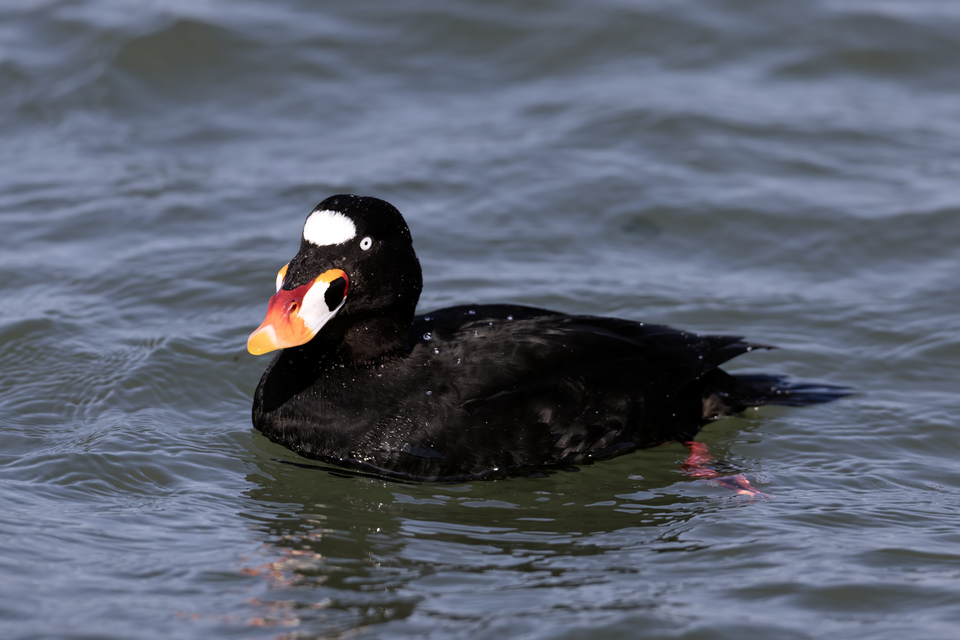
The Surf Scoter is a chunky, charismatic sea duck that earns its name by feeding right where the waves break, diving through the churning surf to pluck mussels and clams off rocky bottoms. It is a bird of saltwater for most of the year, riding the swells off North America's Atlantic and Pacific coasts in rafts that can number in the thousands. Among the three North American scoters, it is the only one found nowhere else in the world, breeding on remote boreal lakes in Canada and Alaska before heading to the sea for winter.
For coastal birders, the adult male is unmistakable and even a little comical, with a sloping orange, white, and black bill that has earned the species the affectionate nickname "skunk-headed coot" or "old skunkhead." Females and young birds are plainer brown, but the bird's heavy build, sloping forehead, and habit of diving headlong into breaking waves make scoters a memorable sight on any winter beach or jetty.
The Surf Scoter is a large, heavy-bodied diving duck with a thick neck, a steeply sloping forehead, and a distinctive triangular, wedge-shaped bill that gives the head a heavy, front-loaded look. On the water it sits low and chunky; in flight it shows broad, dark wings with no white wing patch, helping separate it from the White-winged Scoter.
| Male bill | Bold orange, white, and red, with a large black spot near the base and a swollen feathered knob on top |
| Male plumage | Glossy black overall with two crisp white patches: one on the forehead, one on the nape |
| Female | Sooty brown with two pale whitish patches on the side of the face and a dark crown |
| Head shape | Steep, sloping forehead and a heavy wedge-shaped bill create a distinctive flat-faced profile |
| Wings | All-dark in flight with no white wing patch (unlike White-winged Scoter) |
| Feet | Reddish-orange legs and feet, often glimpsed as the bird dives |
Male vs. female
Males and females look quite different. The adult drake is jet black with two bright white patches, one on the forehead and one on the back of the neck, and a swollen, multicolored bill of orange, white, red, and black that is impossible to mistake. The female is a more subdued sooty brown, lacking the white head patches, but she shows two pale smudges on each side of the face, one behind the bill and one on the ear area, against a darker cap. Her bill is darker and less swollen than the male's. Young males molting toward adult plumage often show a patchy, in-between look with developing white patches and brightening bill color.
Juveniles
Juvenile and first-winter Surf Scoters resemble adult females but are paler and grayer below, often with a whitish belly. Like females, they show the two pale face patches, but these tend to be more sharply defined and whiter on young birds. The bill is dull and dark, lacking the bright colors and swollen knob of the adult male, and young males only gradually acquire their gaudy bill and white head patches over their first year or two.
Surf Scoters are mostly silent birds, especially in winter, which is part of why their courting sounds can be so striking when you do hear them. Males give a low, liquid, gurgling or bubbling note, sometimes described as a soft puk-puk or a clear popping sound, and during courtship displays small groups of drakes produce these low calls together. Females give a harsher, crowlike crraaa or grating croak.
One of the most distinctive sounds scoters make is mechanical rather than vocal: a clear, whistling hum produced by the wings in flight. A passing flock can be heard as a rushing, whistling whir of wingbeats well before the birds themselves come into clear view.
The Surf Scoter breeds across the boreal forest and tundra-edge lakes of northern Canada and Alaska, favoring remote shallow lakes and ponds far from the coast. It is found only in North America and breeds nowhere else, making it a true continental specialty.
In late fall, scoters move to salt water, wintering along both the Pacific coast from Alaska south to Baja California and the Atlantic coast from Atlantic Canada south to Florida, with smaller numbers on the Gulf of Mexico and the Great Lakes during migration. Migration is largely coastal, and in spring and fall you can sometimes see long, low strings of scoters flying steadily just offshore. They are scarce inland except as migrants pausing on large lakes and reservoirs.
Surf Scoters are specialists on shellfish. In winter their diet is dominated by mollusks, especially mussels, clams, and other bivalves, along with crustaceans, marine snails, and other invertebrates pried from rocks and the seafloor. They are powerful divers, plunging through breaking surf and diving in coastal shallows, often in synchronized groups, to reach prey on the bottom. Shellfish are typically swallowed whole and crushed in the bird's muscular gizzard.
On the breeding grounds the diet shifts toward freshwater fare, including aquatic insect larvae such as caddisflies and midges, small crustaceans, and some plant material. Scoters concentrate where shellfish are abundant, which is why you so often find them clustered around mussel beds, jetties, and rocky points along the winter coast.
Surf Scoters nest on the ground near remote boreal and subarctic lakes, often well hidden under low shrubs, in dense vegetation, or among rocks not far from water. The nest is a shallow scrape lined with plant material and soft down. The female builds the nest and handles all incubation; the male typically departs the breeding area before the eggs hatch, leaving the female to raise the brood alone.
The clutch usually numbers five to nine creamy or pale buff eggs, with a single brood per year. The ducklings are precocial, leaving the nest soon after hatching and feeding themselves on aquatic insects while the female leads and guards them. Broods sometimes mix on breeding lakes, and the young are able to fly several weeks after hatching.
The Surf Scoter is not a backyard or feeder bird in any sense, so there is nothing to put out that would draw one in. It is a marine diving duck that spends its winters on open salt water and its summers on remote northern lakes, and it simply will not appear at a typical yard. The good news is that it is one of the easier sea ducks to go and find if you know where to look.
- Go to the coast in winter. Scan ocean bays, jetties, breakwaters, and rocky points from late fall through early spring, when scoters gather along both coasts.
- Look where the waves break. True to their name, Surf Scoters favor the turbulent water just offshore and over mussel beds and rocky bottoms.
- Bring a spotting scope. Birds often sit in rafts well offshore; a scope makes it far easier to pick out the male's painted bill and white head patches.
- Check large lakes during migration. Inland birders can catch passing scoters resting on big reservoirs and the Great Lakes in spring and fall.
- Scan mixed flocks carefully. Surf Scoters often mingle with White-winged and Black Scoters, so compare bill shape and wing pattern within a raft.
- White-winged Scoter: Larger, shows a bold white wing patch (often hidden when swimming but obvious in flight), and the male has a small white comma below the eye rather than white head patches.
- Black Scoter: Male is all-black with a bright yellow-orange knob at the base of the bill and no white head patches; female has a pale cheek contrasting with a dark cap, giving a two-toned head.
- Common Scoter: The Old World counterpart of the Black Scoter; very similar all-dark males with a yellow bill ridge, found in Europe and Asia rather than North America.
- Long-tailed Duck: Another sea duck of winter coasts, but much smaller and boldly patterned in black and white, with a short bill and, on males, long pointed tail feathers.
Why is it called a Surf Scoter?
The name comes from its habit of feeding right in the surf zone, diving through breaking waves close to shore to reach mussels and clams on rocky bottoms. You will often see them appear and disappear among the crashing swells just off the beach.
How do I tell a Surf Scoter from a White-winged Scoter?
The quickest clue is the wing: White-winged Scoters show a white wing patch, especially in flight or when flapping, while Surf Scoters have all-dark wings. The male Surf Scoter also has white patches on the forehead and nape and a gaudy orange-and-white bill, whereas the male White-winged has a small white mark below the eye.
What is the colorful nickname for the male Surf Scoter?
Birders sometimes call the drake an old skunkhead or skunk-headed coot, because of the black body with bold white head patches that recall a skunk's markings. Its bright orange, white, and black bill adds to the clownish look.
Are Surf Scoters good to eat?
They are legally hunted as sea ducks in much of their range, but because their diet is almost entirely shellfish, the meat is generally considered strong, fishy, and not particularly palatable compared with dabbling ducks. Most birders simply enjoy watching them.
Where and when can I see Surf Scoters?
Look along the Pacific and Atlantic coasts of North America from late fall through early spring, scanning bays, jetties, and rocky shorelines, ideally with a spotting scope. During migration they also turn up on the Great Lakes and large inland reservoirs.