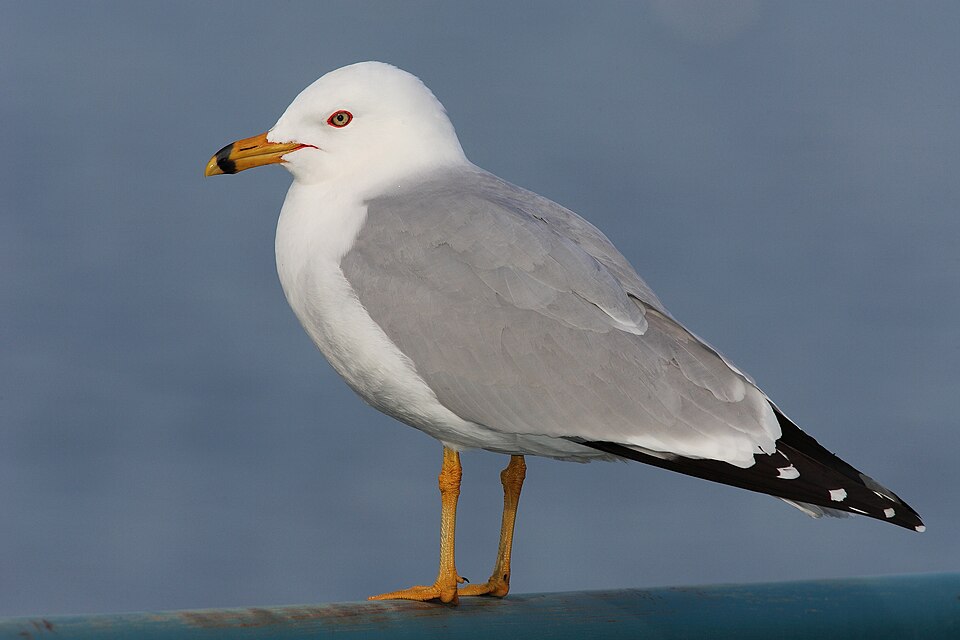
If you have ever eaten lunch outside near a shopping center, watched a ballgame, or strolled a city lakefront and had a tidy white-and-gray gull eyeballing your fries, odds are good you met a Ring-billed Gull. It is one of the most widespread and adaptable gulls in North America, and for many people it is simply "the seagull" even though it spends much of its life far from any sea. Compact, clean-looking, and bold around people, it thrives in the landscapes humans build: parking lots, landfills, golf courses, reservoirs, plowed fields, and fast-food drive-throughs.
The name comes from the crisp black band that wraps around the tip of its yellow bill, the single most useful field mark on an adult. Once nearly wiped out in parts of its range by egg collecting and persecution in the late 1800s, the species rebounded dramatically through the 20th century and is now hugely abundant. For backyard birders, it is a great "gateway gull": common enough to study repeatedly, and clean-cut enough that learning it makes the trickier large gulls far less intimidating.
The Ring-billed Gull is a medium-sized, slender gull with a rounded head, a fairly slim bill, and a graceful, buoyant flight. It sits noticeably smaller and daintier than a Herring Gull but bigger and bulkier than the small "hooded" gulls like Bonaparte's. Adults look immaculate, while younger birds wear a patchwork of brown and gray that changes over their first two to three years.
| Bill | Yellow with a sharp, complete black ring near the tip, the signature mark of adults. |
| Legs & feet | Bright yellow to yellow-green (not pink), helpful for separating it from Herring Gull. |
| Eye | Pale yellow iris with a thin reddish orbital ring, giving a stern, clear-eyed look. |
| Mantle & wings | Clean medium-gray back; black wingtips with bold white spots ('mirrors'). |
| Head & body | White, smudged with brown streaking on the head and neck in non-breeding (winter) plumage. |
| Size | Medium gull, clearly smaller and more delicate than a Herring Gull. |
Male vs. female
Male and female Ring-billed Gulls look essentially identical in plumage, so you cannot reliably sex them in the field by color or pattern. Males average slightly larger with a somewhat heavier head and bill, which can occasionally be noticed in a mated pair standing side by side, but this overlap is wide and unreliable for a lone bird. Both sexes show the same gray mantle, yellow ring-tipped bill, and yellow legs.
Juveniles
Young Ring-billed Gulls take about three years to reach full adult plumage and look very different along the way. Fresh juveniles are mottled brown and buff with a pink, dark-tipped bill and pinkish legs. By the first winter they show a gray back contrasting with brown-checkered wing coverts, a smudgy gray-brown wash on the head, a pink bill with a black tip, and a white tail crossed by a neat black band. Second-year birds look much more adult-like but retain some black in the wing and often a less clean bill pattern before the legs and bill brighten to full yellow.
Ring-billed Gulls are vocal and easy to learn. The most familiar sound is a high, slightly nasal "kee-yah" or "hyah-hyah" laughing series, thinner and higher-pitched than the deep bugling of a Herring Gull. When excited or squabbling over food, they give a rapid, yelping "ki-ki-ki-ki".
At colonies and in disputes you may hear the classic gull "long call," a drawn-out series of rising and falling notes delivered with the head thrown back, along with soft mewing and clucking contact notes between birds. Around people, the begging and jostling chorus is a constant background squeal anywhere food scraps appear.
Ring-billed Gulls breed across much of southern Canada and the northern United States, concentrated around the Great Lakes, the northern prairies, and interior lakes and rivers, with scattered colonies along parts of the Atlantic and Pacific coasts. They favor islands and shorelines of large lakes and rivers for nesting, often in dense, noisy colonies.
In fall they spread widely south and toward the coasts. In winter they become abundant across the southern and coastal United States, throughout the lower 48, into Mexico, and around the Gulf Coast, frequenting beaches, harbors, rivers, reservoirs, and inland cities. Many populations are strongly migratory, but in mild and urban areas birds may linger year-round wherever open water and reliable food persist.
This is the ultimate generalist. Ring-billed Gulls eat fish, insects, earthworms, rodents, grain, berries, and aquatic invertebrates, and they are famous scavengers of human food, French fries, bread, popcorn, and anything dropped in a parking lot or stadium. They follow plows for exposed grubs and worms, glean fields, patrol landfills, and snatch flying insects in the air during hatches.
Their feeding behavior is opportunistic and clever. They will wade, swim, dip to the surface, plunge shallowly, walk lawns probing for invertebrates, and pirate food from other birds. Their boldness around people is a learned, highly profitable strategy, which is exactly why they cluster wherever crowds and food intersect.
Ring-billed Gulls nest in colonies, sometimes enormous ones, on low islands, gravel bars, dikes, and bare or sparsely vegetated ground near water. The nest is a shallow scrape lined with grasses, twigs, debris, and feathers. Both members of the pair help build it and both share incubation and feeding duties.
A typical clutch is two to three eggs, olive to buff with dark blotches, and the species raises a single brood per year. Eggs hatch after roughly three to four weeks, and the downy, mottled chicks stay near the nest, fed by both parents. Colony life is loud and territorial, with adults vigorously defending their small patch of ground from neighbors and intruders.
The Ring-billed Gull is not a feeder bird, and it is best not to deliberately attract it. It comes readily to dropped food, but feeding gulls is discouraged: it concentrates birds unnaturally, creates nuisance flocks, fouls patios and lots, and habituates birds to junk food that is bad for them. If you want to enjoy them, the better approach is to go where they already gather and watch them closely.
- Skip the handouts, feeding gulls human food is unhealthy for them and quickly turns a few birds into an aggressive, messy flock.
- Look for them at lakefronts, reservoirs, large parking lots, and athletic fields, especially in fall and winter.
- Bring binoculars to a loafing flock and practice aging birds, sorting first-winter, second-year, and adult plumages is excellent ID training.
- In farm country, scan flocks following plows and freshly tilled fields, where they feed on exposed worms and grubs.
- If gulls are a nuisance on your property, remove accessible food and trash rather than feeding them elsewhere, the fix is reducing the food source.
- Herring Gull: Larger and bulkier with pink legs and a red spot (not a black ring) on a heavier yellow bill; takes four years to mature.
- California Gull: Slightly larger with a darker gray mantle, dark eye, greenish-yellow legs, and a bill marked with both a red and a black spot rather than a clean ring.
- Mew Gull: Smaller and gentler-faced with a short, unmarked or faintly marked yellow bill, a dark eye, and a more dove-like head.
- Bonaparte's Gull: Much smaller and daintier with a thin black bill, pink legs, and a black hood in summer or a black ear-spot in winter.
Why is it called a Ring-billed Gull?
Because adults have a distinct black band, or ring, that encircles the tip of the otherwise yellow bill. It is the quickest way to identify an adult, though young birds do not yet show the clean ring.
How do I tell a Ring-billed Gull from a Herring Gull?
Check size, legs, and bill. Ring-billeds are clearly smaller with yellow legs and a black ring on the bill. Herring Gulls are larger and bulkier with pink legs and a red spot near the bill tip instead of a ring.
Are Ring-billed Gulls only found near the ocean?
No. They are largely an inland gull, breeding around the Great Lakes and northern prairie lakes and wintering widely across the interior and coasts. You will see them at reservoirs, rivers, fields, and parking lots far from any seawater.
Should I feed the gulls in parking lots?
It is best not to. Feeding creates large, aggressive nuisance flocks, spreads mess and droppings, and exposes birds to unhealthy human food. Enjoy watching them, but let them forage naturally.
How long do Ring-billed Gulls live?
They are fairly long-lived for a bird their size. Many reach well into their teens, and banded individuals have been recorded living into their twenties.