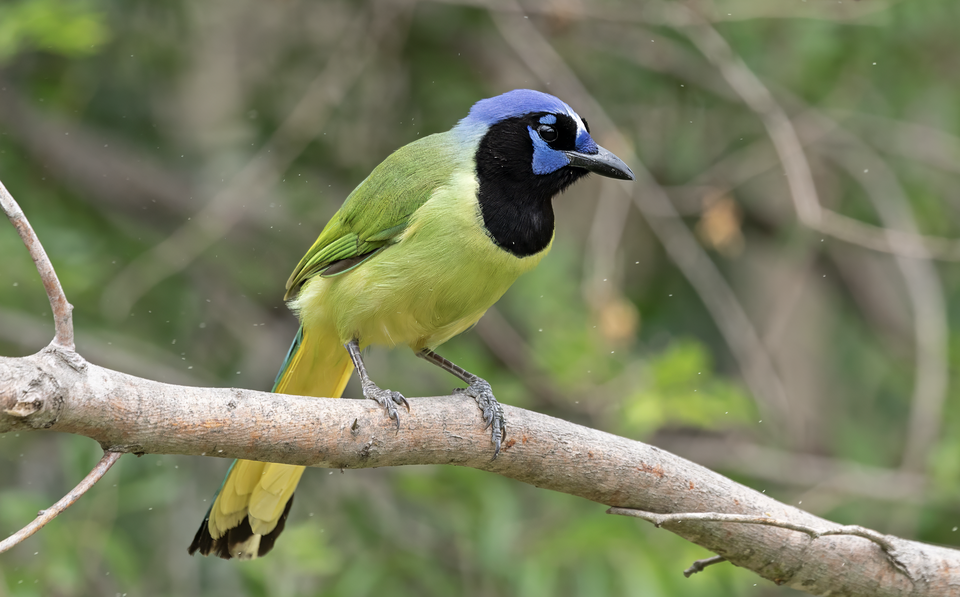
Few North American birds look as improbable as the Green Jay. With a body of soft lime and yellow-green, a sky-blue and black face, and a bright yellow flash on the outer tail, it looks like a parrot that wandered in from the tropics. In the United States it is essentially a South Texas specialty, found only in the dense thorn forest and oak woodlands of the lower Rio Grande Valley. For birders, seeing one is often the whole reason for a trip south, and a flock raiding a feeding station is one of the great spectacles of American birding.
Green Jays are loud, social, and endlessly curious, traveling in noisy family groups through the brush. They are intelligent corvids in the same family as crows, ravens, and other jays, and they show the cleverness you would expect, including the use of tools in the wild. Despite the gaudy plumage, they melt into the dappled green shade of the brush surprisingly well, and you will often hear a flock long before you pick one out.
The Green Jay is a medium-sized, long-tailed jay with a stout black bill and a rounded crown. Its silhouette is typical jay shape, but the color combination is unmistakable: bright green back and wings, yellowish underparts, a black bib and mask, blue on the crown and around the eye, and a long tail that flashes yellow on the outer feathers in flight.
| Back and wings | Vivid lime to grass green, the most striking feature |
| Head pattern | Black throat and bib, black mask, with patches of bright blue on the forehead, crown, and around the eye |
| Underparts | Pale yellow-green to yellowish, blending into the green of the back |
| Tail | Long; central feathers green, outer feathers bright yellow, very obvious when fanned or in flight |
| Bill and eye | Stout black bill; dark eye set in the black mask |
| Size | About robin-sized in body but longer-tailed, slightly larger and chunkier than a Blue Jay |
Male vs. female
Males and females look alike. The sexes share the same green back, blue-and-black face, yellow underparts, and yellow-edged tail, so you cannot reliably tell them apart in the field by plumage. Males average a touch larger, but this is not something you can judge on a single bird. Behavior at the nest is the most practical clue: only the female incubates, so a bird sitting tight on eggs is almost certainly the female.
Juveniles
Juvenile Green Jays look much like adults but slightly duller and softer overall, with the blue on the head less vivid and more limited, and the black facial markings less crisp. Fledglings have a fleshy gape at the corners of the bill and beg loudly from accompanying adults. Young birds often stay with their parents well into their second year, helping at the nest, so a typical family group contains a mix of bright adults and slightly washed-out younger birds.
Green Jays are vocal and varied, with a repertoire that can be startling the first time you hear it. The most distinctive call is a rapid, dry, rattling cheh-cheh-cheh-cheh or tink-tink-tink, often given in an excited burst. They also produce a ringing, bell-like or electric ringgg, a nasal scolding, and a remarkable mechanical clack or rattle that sounds almost like a small machine.
Like other corvids, they are excellent mimics and will imitate other birds, including the scream of a Gray Hawk, apparently to scatter competitors or sound the alarm. A flock moving through the brush keeps up a constant, conversational chatter, so listen for that busy, dry rattling as your first sign that Green Jays are nearby.
The Green Jay has a split distribution. The northern population reaches the United States only in the lower Rio Grande Valley and adjacent brush country of southernmost Texas, then continues down through eastern Mexico. A second, separate population lives in the Andes and highlands of Central and South America from Colombia south to Bolivia; some authorities split that southern group as a distinct species, the Inca Jay.
Green Jays are non-migratory and stay on their territories year-round. They do not wander far, which is exactly why birders travel to spots like Bentsen-Rio Grande Valley, Estero Llano Grande, and Santa Ana to find them. The species has expanded its U.S. range modestly in recent decades, but seeing one almost always means a trip to deep South Texas.
Green Jays are true omnivores. They eat a wide range of insects and other arthropods, spiders, small vertebrates, and they readily take seeds, nuts, acorns, berries, and other fruit. At times they will scavenge and even visit road-killed carcasses. Their diet shifts with the seasons, leaning more on invertebrates when prey is abundant and more on plant food in leaner months.
They forage actively through the brush at all levels, from the ground up into the canopy, gleaning, probing, and prying. Famously, Green Jays have been documented using a small stick as a tool to pry insects from under bark, one of the few wild birds known to do so. They also cache food, hiding items to eat later, a habit shared with many other jays.
Green Jays nest in the dense thorn scrub and woodland edges they favor. The nest is a fairly loose, open cup of twigs, thorny sticks, and stems, lined with finer rootlets, moss, and leaves, placed in a shrub, small tree, or tangle of vegetation, usually low to moderately high and well hidden.
The female incubates a clutch of roughly three to five eggs, while the male helps feed her and, later, the nestlings. A notable feature of Green Jay biology is cooperative behavior: young from the previous year often remain with the family and help defend the territory, though the parents typically drive off these helpers before the next breeding attempt. Pairs generally raise a single brood per year.
If you live within the Green Jay's narrow South Texas range, you genuinely can attract them; outside that range, you will not see one at a backyard feeder no matter what you offer. Within range, they are regular and enthusiastic feeder visitors, especially where native brush is kept nearby.
- Offer peanuts (in or out of the shell), sunflower seeds, and corn on platform or hopper feeders; Green Jays love peanuts.
- Put out fruit and suet such as orange halves, other soft fruit, and suet or peanut butter blends, which they take readily.
- Keep native thornscrub and brush on or near your property; cover and natural food matter as much as the feeder.
- Provide a water source such as a shallow bath or dripper, which is a strong draw in the hot, dry South Texas climate.
- Expect them in noisy family groups rather than singly, and be patient; once a flock adds you to its rounds, they often return daily.
- Remember this only works in the lower Rio Grande Valley and nearby South Texas; elsewhere, the Green Jay simply is not present.
- Blue Jay: Blue and white with a crest, never green; overlaps only marginally in eastern Texas and is unmistakable up close.
- Green Kingfisher: Also green and found in the same South Texas rivers, but has a huge dagger bill, sits over water, and lacks the blue face and yellow tail.
- Painted Bunting: A small finch-like bird; the male is multicolored with a blue head and green back, but it is tiny, short-tailed, and lacks the jay's black mask and shape.
Where can I see a Green Jay in the United States?
Only in deep South Texas, in the lower Rio Grande Valley and nearby brush country. Reliable spots include Bentsen-Rio Grande Valley State Park, Estero Llano Grande, Santa Ana National Wildlife Refuge, and the National Butterfly Center. They are year-round residents there and do not migrate.
Are Green Jays rare?
Globally they are common and listed as Least Concern. They feel rare to most U.S. birders only because their range barely reaches the country, being confined to southernmost Texas. Within that area they are one of the most common and conspicuous birds in the brush.
How can I tell a male Green Jay from a female?
You usually can't by sight. Males and females have identical plumage, and males are only slightly larger on average. The best clue is behavior at the nest, since only the female incubates the eggs.
What do Green Jays eat, and will they come to feeders?
They are omnivores that eat insects, spiders, small animals, seeds, nuts, and fruit. Within their South Texas range they readily visit feeders, especially for peanuts, sunflower seeds, corn, suet, and fruit such as orange halves.
Why is the Green Jay green when most jays are blue?
Jay colors come largely from the way feather structure scatters light combined with pigments. In the Green Jay, that structural blue overlaps with yellow pigment to produce green, which doubles as excellent camouflage in the dappled, leafy thornscrub where it lives.