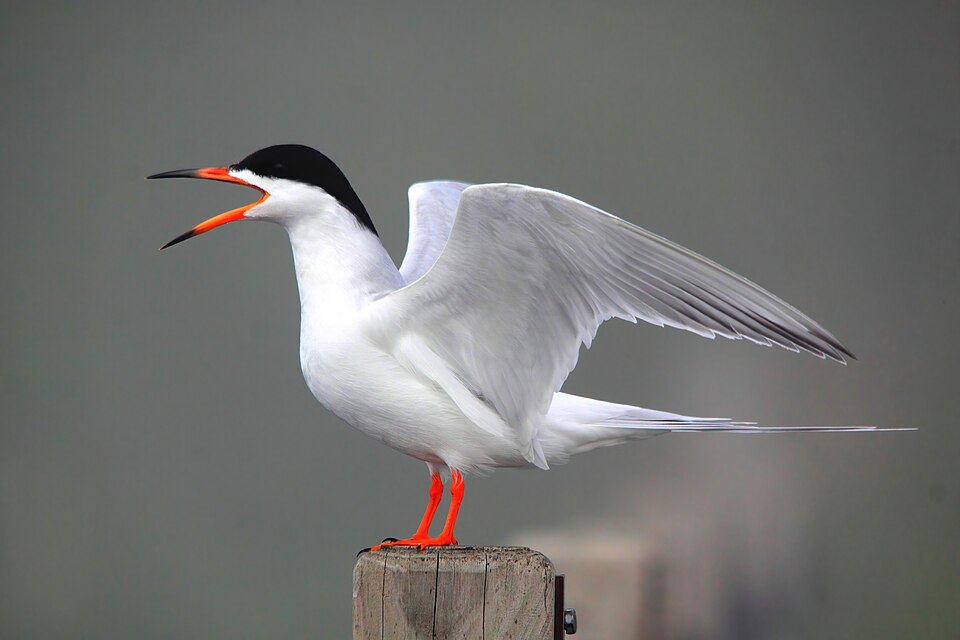
The Forster's Tern is the only tern that nests almost entirely within North America, and it has staked out a niche that sets it apart from its seagoing cousins: the freshwater and brackish marsh. While most terns are creatures of open coast and rocky island, this slim, pale, fork-tailed bird hunts over cattail sloughs, prairie wetlands, and coastal salt marshes, dipping to the surface to snatch small fish and dragonflies. It is named for the German naturalist Johann Reinhold Forster, who sailed with Captain Cook, though for more than a century after its description it was repeatedly confused with the very similar Common Tern.
For many inland birders, Forster's is the default "marsh tern" of spring and fall, coursing back and forth on long, pointed wings with a buoyant, almost lazy grace before folding up and plunging. It is widespread and reasonably common, and its split breeding range, interior prairies and pothole country in summer, the Gulf and southern coasts in winter, means a lot of people see it on migration without ever quite pinning down what they are looking at. Learning its few reliable marks turns a frustrating "tern, probably" into a confident call.
Forster's Tern is a medium-sized, elegant tern: trim body, long narrow wings, and a deeply forked tail whose streamers extend past the wingtips when the bird is perched. In silhouette it reads as a "classic" tern, so identification leans heavily on plumage details, especially the color of the primaries and, in non-breeding birds, the shape of the dark head pattern.
| Breeding head & bill | Crisp black cap; orange bill with a black tip; orange-red legs |
| Wingtips | Upper primaries are silvery-frosty and paler than the rest of the wing, a key separator from Common Tern |
| Underparts | Clean white below, with at most a faint gray wash; never the gray belly of breeding Common Tern |
| Tail | Long, deeply forked; gray tail with white outer edges (Common shows the reverse) |
| Non-breeding head | White crown with a bold, isolated black mask through the eye and ear, not a connected cap across the nape |
| Size & shape | Slim, long-winged, with tail streamers projecting beyond folded wings at rest |
Male vs. female
Male and female Forster's Terns look alike in the field. The sexes share the same plumage, bill color, and proportions, and there is no reliable visual way for a birder to tell them apart at a distance. Males average very slightly larger with a marginally heavier bill, but this overlaps so broadly that it is meaningless without a bird in the hand. During courtship, behavior is the better clue: the male typically carries a small fish in his bill during display flights and ceremonial walks, presenting it to the female.
Juveniles
Juvenile Forster's Terns are washed with warm gingery-brown above when freshly fledged, with pale feather edges giving a scaly look that fades through late summer. They quickly take on a plumage close to the winter adult: white below, pale gray above, with a dark bill and that distinctive black eye-and-ear mask. The mask is the giveaway at any young age, it stays as a discrete dark patch around the eye rather than wrapping around the back of the head, which is exactly how the bird looks in non-breeding adult plumage. First-winter birds also show a dark leading edge to the inner wing.
Forster's Tern is not a songbird, and its voice is one of the quickest ways to separate it from the Common Tern once your ear is trained. Its common call is a low, harsh, descending kerr or zaar, nasal and grating, often likened to a short burst of static or a hoarse "raspberry." It is noticeably lower and rougher than the higher, more clipped kip notes of Common Tern.
Around the colony and when alarmed, birds give a sharper, repeated kit-kit-kit and a drawn-out, almost laughing series. The overall impression is grumpy and buzzy rather than musical. If a marsh tern flushes from a slough giving a single rough, downslurred note, Forster's should be your first guess.
Forster's Tern has a distinctly two-part distribution. In the breeding season it occupies interior marshes across the northern Great Plains, the prairie-pothole region of the Dakotas and the Canadian prairies, the Great Basin, and parts of the West and upper Midwest, plus scattered colonies along the Atlantic and Gulf coasts. In winter it withdraws to the southern coasts, the southeastern U.S., the Gulf of Mexico, California, and south into Mexico and Central America, where it becomes a common sight over bays, estuaries, and beaches.
Across most of the continent's interior and along the East Coast, it is best known as a migrant, passing through in spring (roughly April-May) and again in late summer and fall. Because it lingers later in fall and arrives earlier in spring than many terns, a tern seen at the edges of the season at an inland lake or marsh has a good chance of being this species.
Small fish are the core of the Forster's Tern's diet, taken by the classic tern method: the bird hovers or quarters into the wind a few yards above the water, fixes on a target, then plunge-dives bill-first to seize prey at or just below the surface. Unlike some terns it often makes shallow, splashy dips rather than deep plunges, and it readily picks food right off the surface film.
What makes Forster's stand out is its appetite for insects. Over marshes it hawks dragonflies, damselflies, and other flying insects on the wing, snapping them out of the air with quick, agile turns, and it also gleans aquatic insects and small crustaceans from the water. This flexibility, fish when fishing is good, insects when it is not, helps explain why it thrives in shallow inland wetlands where strictly fish-eating terns would struggle.
Forster's Terns nest in loose colonies in marshes, often alongside gulls, grebes, and other terns. The nest is a simple affair built on or just above the water: a pad or mound of dead marsh vegetation placed on a floating mat of reeds, on a muskrat lodge, on matted cattails, or sometimes on bare ground or wrack on a coastal island. Because nests sit so low, flooding from wind-driven water and rising tides is a real and frequent threat to eggs and young.
The female typically lays three buff to olive eggs blotched with brown, and both parents share incubation for around three to three-and-a-half weeks. Chicks are downy and semi-precocial, soon clambering about near the nest while parents continue to feed them fish. Pairs usually raise a single brood per season but will re-lay if a clutch is lost to flooding or predators, which happens often enough that timing of a successful nest can vary widely within a colony.
Forster's Tern is not a backyard or feeder bird, it will never visit a seed feeder, a suet cage, or a birdbath, and there is nothing you can put in a yard to draw one in. It is a wetland specialist that needs open shallow water with fish and insects, so the way to "attract" it is to go where it lives and protect that habitat.
- Visit shallow freshwater and brackish marshes, prairie wetlands, lake edges, and coastal estuaries during migration and summer, that is where you will find them, not in yards.
- Bring binoculars and a scope: terns hunt over open water and rarely come close, so optics make identification possible.
- Time it right, look in spring (April-May) and late summer through fall at inland sites, and in winter along the Gulf and southern coasts.
- Support wetland conservation and water-level management at local refuges, since low floating nests are highly vulnerable to flooding and habitat loss.
- Scan mixed flocks of terns carefully, Forster's often migrates and roosts alongside Common and other terns, so it is a 'pick it out of the crowd' bird.
- Avoid disturbing marsh colonies in summer; flushing nesting terns exposes eggs and chicks to heat and predators.
- Common Tern: Most easily confused species. Common shows darker, smudgier primaries (Forster's are frosty-pale), a gray-washed belly when breeding, and in winter a black cap that connects around the nape instead of an isolated eye-mask. Voice is higher and clipped versus Forster's low rasp.
- Arctic Tern: Grayer below with shorter legs, very long tail streamers, and an all-red bill (no black tip) when breeding. Pelagic and far-northern; rarely overlaps with Forster's marsh habitat.
- Roseate Tern: Paler overall with a mostly black bill, very long white tail streamers, and a faint pink flush below. Coastal and far less common; lacks Forster's frosty primaries and rough call.
- Sandwich Tern: Larger and lankier with a long black bill tipped yellow and a shaggy crest. A coastal bird that does not haunt freshwater marshes the way Forster's does.
How do you tell a Forster's Tern from a Common Tern?
Check the wingtips and head. Forster's has frosty, silvery upper primaries that look paler than the rest of the wing, while Common Tern's primaries look darker and dingier. In winter, Forster's wears an isolated black mask around the eye and ear, whereas Common's black extends around the back of the head. Breeding Common Terns also show a gray belly; Forster's stays clean white. Voice helps too: Forster's gives a low, harsh rasp, Common a higher, clipped note.
Where do Forster's Terns live?
They breed mostly in interior North American marshes, the prairie-pothole region, Great Basin, and parts of the West and Midwest, plus scattered Atlantic and Gulf coast colonies. In winter they move to the southern U.S. coasts, the Gulf of Mexico, California, and into Mexico and Central America. Many inland birders see them only on spring and fall migration.
What do Forster's Terns eat?
Mainly small fish caught by plunge-diving or shallow surface dips. They are also notable insect hunters, hawking dragonflies and other flying insects over marshes and picking aquatic insects and small crustaceans from the water. This mix lets them thrive in shallow wetlands where fish supplies vary.
Are Forster's Terns rare or endangered?
No. They are listed as Least Concern and remain common across their range. Local populations can be vulnerable because their low, floating marsh nests flood easily and they depend on healthy wetlands, so wetland loss and water-management problems are the main regional concerns.
Will Forster's Terns come to a backyard or feeder?
No. They are wetland birds that eat live fish and insects over open water and have no interest in feeders, seed, or yards. To see one, visit marshes, lake shores, and coastal estuaries with binoculars during the right season.