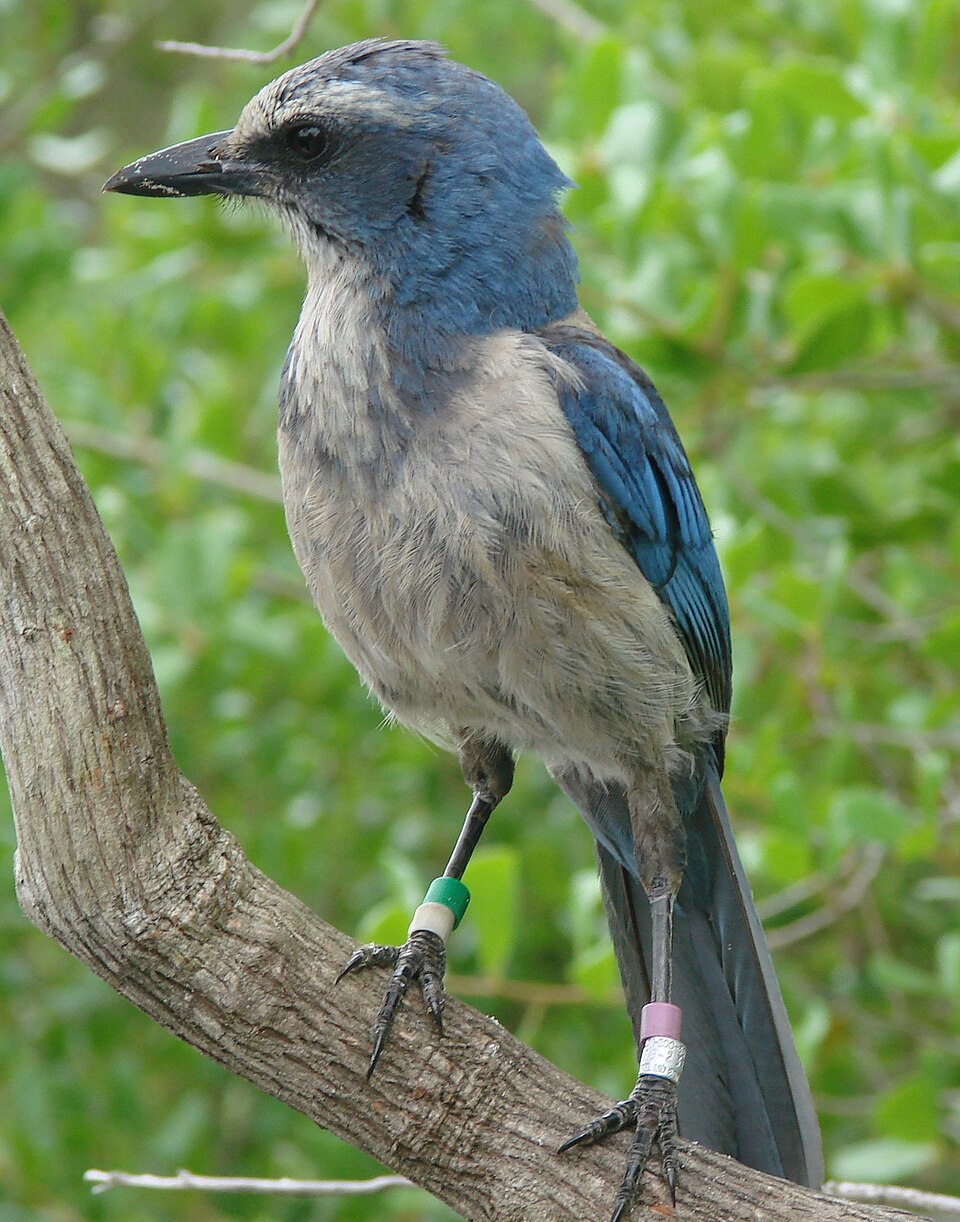
The Florida Scrub-Jay holds a title no other bird in the United States can claim: it is the only bird species that lives exclusively within a single state. Found nowhere on Earth except the dry, sandy scrub of peninsular Florida, this crestless cousin of the familiar Blue Jay is a charismatic, ground-loving bird with a bold streak and a remarkable social life. Birders travel from across the country to places like Merritt Island, Oscar Scherer State Park, and the scrub ridges of central Florida just to spend an afternoon with one.
What makes the species so beloved, and so studied, is its family structure. Florida Scrub-Jays live in tight, year-round family groups in which grown offspring stay home for a year or more to help their parents raise the next batch of chicks. Decades of research on color-banded birds at Archbold Biological Station have made this one of the best-understood birds in the world. Sadly, that research also documents a steep decline: the scrub-jay depends on a fire-maintained habitat that has been paved, farmed, and fire-suppressed into fragments, and the bird is now listed as Threatened under the U.S. Endangered Species Act.
A Florida Scrub-Jay is roughly Blue Jay-sized but built differently, slimmer, longer-tailed, and notably crestless, giving the head a smooth, rounded look. It often perches boldly atop a low oak or a fence post, tail dangling, surveying its territory. The combination of a clean blue-and-gray body with no crest and no black face mask is distinctive, and within its tiny range there is really nothing else like it.
| Head & nape | Soft blue forehead and crown blending into a pale-bordered blue 'necklace' across a whitish throat; smooth, crestless head |
| Back | Distinctly gray (not blue) saddle on the back and mantle, a key field mark separating it from Blue Jay |
| Wings & tail | Bright blue, unmarked, lacking the black bars and white spots of a Blue Jay |
| Underparts | Pale gray to whitish breast and belly, with a faint dusky-blue streaked band across the upper chest |
| Face | Whitish forehead streaking and a pale eyebrow; no black mask |
| Bill & legs | Stout black bill and black legs |
Male vs. female
Males and females look essentially identical in the field, both show the same blue, gray, and white pattern, and you cannot reliably tell them apart by plumage. Males average slightly larger and heavier, and during the breeding season the female develops a bare, wrinkled brood patch on her belly for incubating eggs, which only she does. Behaviorally, the male is the one that typically takes a high, exposed sentinel perch to watch for predators while the rest of the family forages below. For practical backyard or trailside identification, treat the sexes as the same.
Juveniles
Young Florida Scrub-Jays are easy to pick out for their first few months. Fresh juveniles have a dull, smoky brown-gray head and neck instead of the adult's blue, lacking the crisp blue crown and necklace entirely. As they molt into their first winter the blue gradually comes in, and by their first spring they are hard to distinguish from adults. Because juveniles and yearling "helpers" stay with the family group, you will often see a mix of brown-headed young birds and full-color adults moving together through the scrub.
Florida Scrub-Jays are not true songsters; instead they communicate with a rich vocabulary of harsh, low-pitched calls. The most familiar is a rough, scratchy kreesh or shreeep, often delivered in a rising, raspy series that carries across open scrub. Compared with the clear, bell-like jay-jay of a Blue Jay, the scrub-jay's voice is lower, burrier, and more guttural.
Listen for soft, conversational notes among family members as they forage, and a distinct sharp scolding rattle when a hawk or human gets too close. The sentinel bird gives quiet contact notes to keep the group informed, then erupts into loud, urgent alarm calls at the first sign of danger. Breeding females also produce a low, hiccuping "hiccup" call that is unique to their sex.
The Florida Scrub-Jay is found only in peninsular Florida, nowhere else in the world. Its strongholds are the ancient sand ridges of the central peninsula (the Lake Wales Ridge and surrounding areas), the Atlantic coastal scrub around Merritt Island and the Space Coast, and scattered patches of suitable oak scrub down to the Gulf Coast. The species needs a very specific habitat: low, open stands of scrub oak roughly waist- to head-high, on well-drained sandy soils, with patches of bare sand for caching acorns.
It is one of the most sedentary birds in North America. Florida Scrub-Jays do not migrate, and individuals typically spend their entire lives within or near the territory where they were born, many never travel more than a mile or two. This reluctance to disperse across unsuitable habitat is part of why the species has declined so sharply as its scrub has been fragmented by development and citrus groves.
Florida Scrub-Jays are omnivores with a strong seasonal rhythm. Acorns from scrub oaks are the cornerstone of their diet, especially in fall and winter. Like other jays, they are dedicated cachers, a single bird may bury thousands of acorns in the open sand each autumn, pushing them in one at a time and remembering the locations to dig them up through the lean months. The acorns they forget help regenerate the very oak scrub they depend on.
In the warmer months they shift heavily to animal prey: grasshoppers, beetles, caterpillars, spiders, and other arthropods gleaned from foliage and the ground. They will also take small vertebrates such as lizards, frogs, snakes, and the occasional nestling or egg, and they are quick to exploit fruit and berries when available. Most foraging happens low, hopping on the ground and through the open understory rather than high in trees.
Florida Scrub-Jays are cooperative breeders, one of the defining features of the species. A monogamous, long-term pair holds a permanent territory, but they are frequently assisted by "helpers", their own grown offspring from previous years who delay leaving home to help defend the territory, watch for predators, and feed the new chicks. A family group may include the breeding pair plus one to six helpers.
The nest is a bulky open cup of twigs lined with fine rootlets and palmetto fiber, built low, usually only three to ten feet up, and well hidden in a dense scrub oak. The female builds the nest and is the only one to incubate, sitting on a typical clutch of 3 to 4 pale, greenish or pinkish, speckled eggs for about 17 to 19 days. Both parents and any helpers feed the nestlings. Because the open scrub offers little cover, nest predation by snakes and other jays is high, and pairs often raise only one successful brood per year.
This is not your typical backyard feeder bird, and it is important to be honest about that. Florida Scrub-Jays only live in specific scrub habitat within Florida, so unless your property borders or contains native oak scrub, you simply will not get them at a feeder. Where they do occur near homes they can become remarkably tame, but feeding them is strongly discouraged.
- Do not hand-feed them. It is illegal to harass or feed this federally Threatened species without a permit, and supplemental food causes jays to breed too early, when there are not enough insects to feed their chicks, lowering survival.
- The real way to 'attract' them is habitat. If you own land within their range, preserving and restoring native oak scrub with patches of open sand is the single most valuable thing you can do.
- Support prescribed fire. Scrub-jays need periodically burned, low scrub; fire suppression lets habitat grow too tall and renders it unusable, so back land managers who use controlled burns.
- Keep cats indoors and drive slowly near scrub preserves, free-roaming cats and road collisions are real threats to these ground-foraging, low-flying birds.
- Visit them respectfully at protected sites like Merritt Island NWR, Oscar Scherer State Park, or Lyonia Preserve, where you can enjoy wild scrub-jays without disturbing them.
- Blue Jay: The Blue Jay has a prominent crest, a black necklace and face markings, and bold black-and-white bars and spots on the blue wings and tail. The scrub-jay is crestless, has a gray back, and shows plain unmarked blue wings.
- California Scrub-Jay: Nearly identical in shape but ranges are far apart (West Coast vs. Florida). The California Scrub-Jay is a deeper, brighter blue with a more sharply defined blue chest band; there is essentially no overlap to confuse them in the field.
- Woodhouse's Scrub-Jay: An interior-West species with duller, grayer plumage and a faint, smudgy breast band. It never occurs in Florida, so range alone separates it from the Florida Scrub-Jay.
Where is the best place to see a Florida Scrub-Jay?
Reliable, accessible spots include Merritt Island National Wildlife Refuge near the Space Coast, Oscar Scherer State Park near Sarasota, Lyonia Preserve in Deltona, and the Lake Wales Ridge preserves in central Florida. Look in low, open oak scrub in the early morning, and scan for a bird sitting sentinel on a bush top.
Why is the Florida Scrub-Jay so special?
It is the only bird species found exclusively within one U.S. state, it lives nowhere on Earth but Florida. It is also famous among scientists for its cooperative family life, in which grown young stay home to help raise their siblings, making it one of the most thoroughly studied birds in the world.
Is it the same as a Blue Jay?
No. They are related but different species. A Blue Jay has a crest, a black necklace and face pattern, and white-spotted, black-barred blue wings and tail. A Florida Scrub-Jay is crestless, has a gray back, plain blue wings, and a pale throat bordered by a soft blue band. Their ranges overlap in Florida, but the scrub-jay sticks to dry oak scrub.
Can I feed Florida Scrub-Jays in my yard?
You should not. They are federally Threatened, and feeding them is both discouraged and generally illegal without a permit. Worse, supplemental food causes them to nest too early in the year, before insect prey is abundant, which reduces chick survival. The best help is protecting and restoring native scrub habitat.
Why are Florida Scrub-Jays endangered?
They depend on a narrow, fire-maintained scrub habitat that has been heavily lost to housing, citrus groves, and fire suppression. Because the birds rarely disperse across unsuitable land, fragmented populations become isolated and decline. Florida Scrub-Jay numbers have dropped sharply, and the species is listed as Threatened federally and Vulnerable by the IUCN.