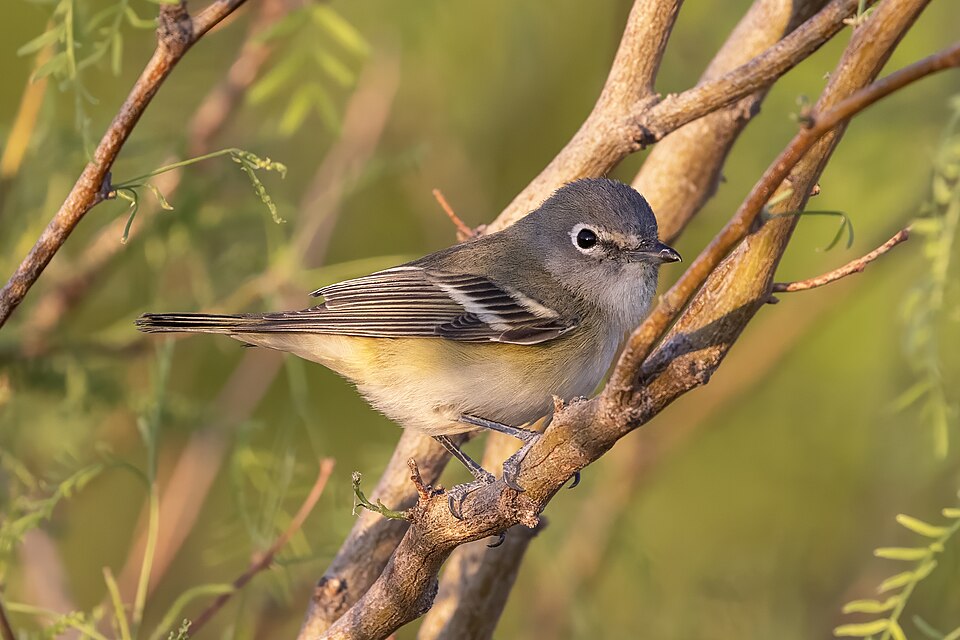
Cassin's Vireo is a small, deliberate songbird of the western United States and Canada, the kind of bird you usually hear long before you spot it. It moves slowly through the mid-levels of mixed and oak woodlands, picking insects from leaves and twigs while delivering a patient, burry song from cover. For decades it was lumped together with the Blue-headed Vireo and Plumbeous Vireo under a single name, the "Solitary Vireo," and only in the late 1990s did ornithologists formally split the three. That history explains why Cassin's looks like a slightly washed-out, intermediate version of its eastern and Rocky Mountain cousins.
It is named for John Cassin, a 19th-century Philadelphia ornithologist who described many western North American birds. Today Cassin's Vireo is a reliable summer resident across the Pacific states and the interior West, favoring dry, open conifer and oak forests on hillsides and canyon slopes. While it is not a backyard feeder bird, it is a rewarding find for birders who learn its song and watch the foliage carefully.
Cassin's Vireo is a compact, big-headed vireo with a stout, slightly hooked bill and a fairly short tail. Its overall impression is one of soft contrast: a grayish hood, bold white "spectacles," and a yellow-tinged body. It is chunkier and more sluggish than a warbler, and the thick bill helps separate it from those daintier birds at a glance.
| Head | Gray crown and nape blending into the back, never sharply contrasting |
| Spectacles | Bold white eyering connected to a white loral stripe, forming clean 'spectacles' |
| Throat | Whitish throat that contrasts only weakly with the gray cheeks |
| Flanks & sides | Washed with pale yellow-olive, most visible on the sides and under the wings |
| Wings | Two whitish wingbars and yellow-edged flight feathers on dark wings |
| Bill | Thick, blue-gray, with a small hook at the tip |
Male vs. female
Males and females look essentially identical, so you cannot reliably sex a Cassin's Vireo in the field by plumage. Both sexes show the same gray hood, white spectacles, and pale yellow sides. Males tend to do most of the persistent singing, especially early in the breeding season, so a bird belting out song from a perch is more likely to be a male, but appearance alone will not tell you which is which.
Juveniles
Freshly fledged and first-fall birds look much like adults but are typically a touch brighter and cleaner overall, with crisper wingbars and a fresher yellow wash on the sides. The gray of the head is often a little browner and less crisply defined in young birds, and the spectacles may appear slightly more diffuse. By their first spring they are difficult to separate from adults in the field.
The song is the best way to find this bird. Cassin's Vireo sings short, burry, two- and three-note phrases with distinct pauses between them, in a deliberate, almost questioning back-and-forth pattern often written as "chu-wee... cherio... chu-wee?" Compared with the clearer, sweeter phrases of the Blue-headed Vireo, Cassin's phrases are noticeably hoarser and rougher, as if the bird has a slight cold. The unhurried, talking-to-itself cadence carries well through dry forest.
Its scolding call is a harsh, descending chatter or rattle, often given when an observer gets too close to a nest or fledglings. You may also hear short, nasal "nyaah" notes between bouts of song.
Cassin's Vireo breeds across the western United States and into southern British Columbia, from the Pacific Coast ranges and Sierra Nevada eastward through the interior mountains of the Great Basin, the Rockies of the inland Northwest, and south into the highlands of the Southwest. It favors dry montane and foothill woodlands, especially mixed pine-oak and oak forests on slopes.
It is a medium-distance migrant. In fall it leaves the breeding grounds and winters mainly in western Mexico, with smaller numbers in the Southwest borderlands. Spring migrants return to the West Coast and interior breeding sites from roughly April into May, and southbound movement runs through late summer and into autumn.
Cassin's Vireo is primarily insectivorous, feeding on caterpillars, beetles, true bugs, moths, and other small arthropods gleaned from foliage. It forages methodically, hopping along branches and peering at the undersides of leaves, sometimes hovering briefly to snatch prey from a leaf tip. The pace is slow and deliberate, very different from the restless flitting of warblers.
In late summer and on the wintering grounds it supplements its diet with small fruits and berries, which provide energy for migration. It tends to forage at mid-canopy heights, working oaks and conifers from the inside out.
The nest is a neat, deep cup suspended hammock-like in the fork of a horizontal branch, usually placed several feet to a couple of dozen feet up in an oak or conifer. Both members of the pair help build it, weaving together bark strips, grasses, plant fibers, and spider silk and often decorating the outside with lichen or bits of leaf for camouflage.
A typical clutch is three to five eggs, white with fine dark speckling, and the pair usually raises one brood per season, occasionally attempting a second. Both sexes share incubation duties, which is unusual and characteristic of this group of vireos, and both parents feed the nestlings. Like many open-cup nesters, Cassin's Vireos are frequent hosts to Brown-headed Cowbird parasitism.
Cassin's Vireo is not a feeder bird and will not come to seed, suet, or sugar water. It is an insect-eating woodland specialist, so the way to "attract" it is to provide or protect the habitat it needs rather than to put out food. If you live near dry oak or pine-oak woodland in the West, you have a real chance of hosting one.
- Preserve mature oaks and conifers on your property; this bird forages and nests in the mid-levels of those trees.
- Avoid broad insecticide spraying, which removes the caterpillars and other arthropods it depends on.
- Plant or keep native trees and shrubs that support a healthy insect population rather than ornamental exotics.
- Provide a clean, shallow water source or dripper; vireos will visit water to drink and bathe even when they ignore feeders.
- Learn its hoarse, deliberate song so you can detect it by ear during the breeding season.
- Keep cats indoors and reduce nest predation pressure in wooded yards.
- Blue-headed Vireo: Eastern counterpart with a bluer, more sharply contrasting gray hood, cleaner white throat, and brighter yellow sides; its song is clearer and sweeter, less burry.
- Plumbeous Vireo: Rocky Mountain cousin that is almost entirely gray and white with little or no yellow; bulkier and grayer overall, with a similar but rougher song.
- Hutton's Vireo: Smaller, plainer, and overall olive with a broken eyering rather than full spectacles; lacks the gray hood and resembles a Ruby-crowned Kinglet.
- Warbling Vireo: Plainer face with a pale eyebrow instead of spectacles, no wingbars, and a long rambling warble rather than burry paired phrases.
How do I tell a Cassin's Vireo from a Blue-headed Vireo?
They look very similar, but Cassin's is washed-out by comparison: its gray hood blends into the back instead of contrasting sharply, the throat is duller, and the colors are softer overall. Range helps a lot, since Cassin's is a western bird and Blue-headed is eastern. The song is the clincher: Cassin's phrases are hoarse and burry while Blue-headed's are clearer and sweeter.
Is Cassin's Vireo the same as the Solitary Vireo?
It used to be. The old 'Solitary Vireo' was split into three species in the late 1990s: Cassin's Vireo in the West, Blue-headed Vireo in the East, and Plumbeous Vireo in the interior mountains. Older field guides may still list it under the Solitary Vireo name.
Will Cassin's Vireo come to my bird feeder?
No. It eats insects and some fruit gleaned from trees and shrubs and does not visit seed, suet, or nectar feeders. The best way to encourage it is to keep native trees, avoid pesticides, and offer a water source.
Where and when can I see a Cassin's Vireo?
Look in dry oak and pine-oak woodlands across the western U.S. and southern British Columbia during the breeding season, roughly April through August. Most birds migrate to western Mexico for the winter, so summer is your best window in the U.S. and Canada.
What does a Cassin's Vireo sound like?
Listen for short, two- and three-note burry phrases delivered slowly with clear pauses between them, in a deliberate back-and-forth pattern. The rough, slightly hoarse quality is the giveaway compared to other vireos. Its alarm call is a harsh descending chatter.