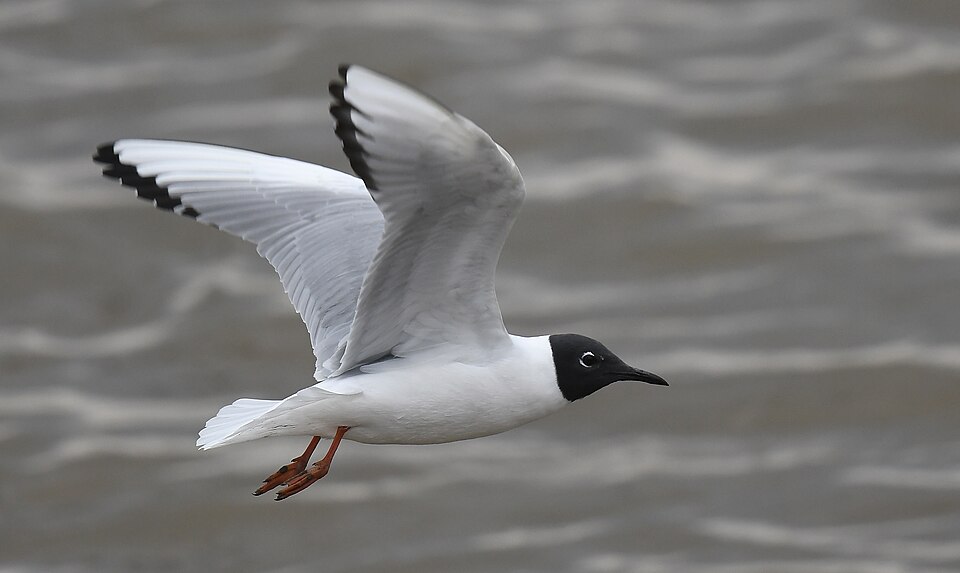
Bonaparte's Gull is one of North America's smallest and most graceful gulls, a bird that looks and behaves more like a tern than the hulking "seagulls" most people picture. Buoyant, quick on the wing, and quick to change direction, it dances over water snapping up insects and small fish with a lightness the big gulls can't match. In breeding plumage it wears a slaty-black hood that gives it a clean, almost formal look, and in flight it flashes a brilliant white triangle along the leading edge of the wing that is the surest way to pick it out of a crowd.
It is also the oddball of the gull world in one important way: instead of nesting on the ground in raucous colonies like most gulls, Bonaparte's Gull nests in spruce trees in the boreal forest of Canada and Alaska. That single habit sets it apart from nearly every other gull on the continent. The species was named not for the emperor but for Charles Lucien Bonaparte, a nineteenth-century ornithologist and nephew of Napoleon. Birders see them mostly on migration and in winter, when they gather by the hundreds or thousands on lakes, rivers, bays, and coastlines across the U.S.
Think small, slim, and buoyant. Bonaparte's Gull is noticeably smaller than a Ring-billed Gull, with a thin black bill, a rounded dove-like head, and narrow, pointed wings that drive a light, fluttering, tern-like flight. The single best field mark in any plumage is the long white wedge along the outer leading edge of the upperwing, which flashes from a great distance.
| Wing flash | Long white triangular wedge along the leading edge of the outer wing, visible in flight in all plumages, the key mark |
| Hood (breeding) | Clean slaty-black hood covering the whole head, with a thin broken white eye-ring |
| Ear spot (nonbreeding) | White head with a neat dark spot behind the eye; hood is lost in winter |
| Bill | Thin, all black and rather short, never the heavy yellow bill of larger gulls |
| Legs | Orange-red in breeding adults, duller pinkish-orange in winter |
| Size & flight | Small and slim with buoyant, tern-like, almost butterfly-light wingbeats |
Male vs. female
Males and females look essentially alike in both plumage and color, so you cannot reliably sex a Bonaparte's Gull in the field. Males average a touch larger and may show a slightly heavier bill, but the overlap is wide enough that this is only useful when a mated pair stands side by side. For all practical birding purposes, treat the sexes as identical and focus instead on separating breeding from nonbreeding plumage and adults from young birds.
Juveniles
First-year birds are easy to tell from adults. They lack the black hood (showing only the dark ear spot), and they carry a bold blackish M or zigzag pattern across the upperwings, a narrow black band across the tip of the tail, and brownish smudging on the crown and back. The white leading-edge wedge is still present but is broken up by the dark wing markings. Through their first summer and fall they gradually molt toward the cleaner adult pattern, losing the tail band and wing markings by their second year.
Bonaparte's Gull is not a songbird, but it is vocal, especially in flocks and on the breeding grounds. The typical call is a low, nasal, slightly grating note often rendered as a rough cheer or greh, drier and buzzier than the squeals of larger gulls. Birders sometimes describe it as a soft, ternlike rasp.
When a flock is feeding or jostling, the calls run together into a babble of nasal eh-eh-eh and churring notes. The overall impression is quieter and softer than a colony of Ring-billed or Herring Gulls, fitting for such a delicate bird.
Bonaparte's Gull breeds across the boreal forest belt of Alaska and western and central Canada, nesting near bogs, ponds, and lakes within reach of spruce trees. It is a long-distance migrant: in spring and fall huge numbers funnel through the interior, staging on the Great Lakes, large rivers, and reservoirs, where flocks can number in the thousands at favored spots like the Niagara River.
In winter the species spreads to both coasts and the southern interior, common along the Atlantic and Pacific coasts, the Gulf of Mexico, and on ice-free inland lakes and rivers. A small but regular number cross to western Europe, where the species is a sought-after rarity. Most birders in the Lower 48 encounter it during migration and winter rather than the breeding season.
This is an opportunistic feeder with a strong taste for small live prey. In summer on the breeding grounds it eats large numbers of insects, flying ants, midges, beetles, dragonflies, often plucking them from the air or the water's surface in graceful, tern-like sallies. Around water it takes small fish, crustaceans, and aquatic invertebrates.
On migration and in winter, Bonaparte's Gulls often feed in tight, swirling flocks over schools of small fish or where currents and tidelines concentrate prey. They hover and dip to the surface, make shallow plunge-dives, and pick items while swimming. Unlike many big gulls, they rarely scavenge at dumps or scrounge for handouts, preferring to hunt active prey.
Bonaparte's Gull is famous among gulls for nesting in trees. Pairs build a platform of sticks, twigs, moss, and lichen on a horizontal branch of a spruce or other conifer, usually low to moderately high above the ground and near water. They nest as solitary pairs or in loose, scattered groupings rather than the dense ground colonies typical of most gulls.
The female typically lays around three eggs, olive to buff and marked with darker blotches. Both parents share incubation, which lasts roughly three and a half weeks, and both feed the downy chicks. The young remain near the nest tree before fledging in a few weeks. The pair raises a single brood each year, timed to the brief boreal summer.
Bonaparte's Gull is not a backyard or feeder bird, so there is nothing to put out that will draw one to a typical yard. It is a bird of open water, and the way to enjoy it is to go where it gathers rather than to attract it.
- Go to the water. Scan large lakes, reservoirs, big rivers, and coastal bays during migration (roughly April-May and October-November) and through winter, when flocks concentrate on open water.
- Time it with the Great Lakes and rivers. Inland staging sites like the Niagara River and large reservoirs can hold spectacular concentrations in late fall, among the best places to study the species.
- Look for the wing flash. Pick the flock apart by watching for the bright white leading-edge triangle and the light, fluttery, tern-like flight that sets this gull apart from heavier species.
- Watch for feeding frenzies. Swirling, low-flying groups dipping to the surface often mark a school of small fish, a reliable way to find Bonaparte's Gulls along coasts and big rivers.
- Bring a scope. Birds often rest and feed well offshore, so a spotting scope turns distant white specks into identifiable gulls.
- Black-headed Gull: Larger with a dark reddish bill and red legs; in breeding plumage the hood is chocolate-brown, not black, and the underside of the outer wing shows dusky gray rather than clean white.
- Little Gull: Even smaller, with rounded wingtips and blackish underwings (dark below, not the white wedge); often mixes into Bonaparte's flocks where careful scanning pays off.
- Ring-billed Gull: Much larger and bulkier with a yellow black-ringed bill and no white wing wedge; never shows a dark hood and flies with heavier, slower wingbeats.
- Franklin's Gull: Similar small hooded gull of the interior, but shows a bolder white eye-arc, dark wingtips with white spots ('string of pearls'), and lacks the long white leading-edge wedge.
How do I tell a Bonaparte's Gull from a regular seagull?
Bonaparte's Gull is much smaller and slimmer than common gulls like Ring-billed or Herring, with a thin black bill instead of a heavy yellow one. In flight it shows a bright white triangle along the leading edge of the wing and flies with light, fluttery, tern-like wingbeats. Breeding adults also wear a clean black hood, which the big gulls never have.
Why is it called Bonaparte's Gull?
It was named for Charles Lucien Bonaparte, a French-American ornithologist of the early 1800s who was a nephew of Napoleon. He did important work cataloging American birds, and the gull honors him, not the emperor himself.
Do Bonaparte's Gulls really nest in trees?
Yes, and it makes them unusual among gulls. They build stick nests on the branches of spruce and other conifers in the boreal forest of Canada and Alaska, usually near water, rather than nesting on the ground in big colonies like most gulls.
When and where can I see Bonaparte's Gulls?
Most birders see them during spring and fall migration and in winter, on large lakes, reservoirs, rivers, bays, and coastlines across the U.S. Inland staging spots like the Great Lakes and the Niagara River can hold thousands in late fall.
What is the difference between a Bonaparte's Gull and a Black-headed Gull?
Black-headed Gull is larger, has a dark reddish bill and red legs, and in breeding plumage shows a chocolate-brown hood rather than the Bonaparte's clean black one. In flight, the Black-headed Gull shows dusky gray on the underside of the outer wing, while Bonaparte's looks clean white underneath.