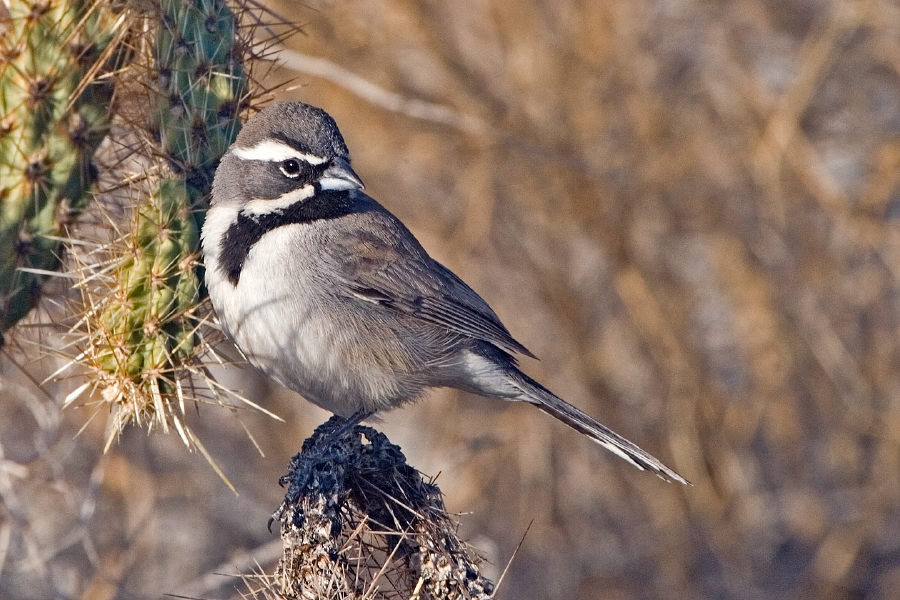
The Black-throated Sparrow is one of the most handsome small birds of the arid American Southwest, and one of the easiest sparrows to identify once you've seen it. Where most sparrows ask you to squint at subtle streaks and tones, this one wears a clean, almost formal pattern: a soft gray head split by two bold white stripes, a jet-black throat and upper breast like a bib, and a plain unstreaked belly. Birders sometimes call it the "desert sparrow," and the nickname fits, it thrives in the kind of hot, rocky, sparsely vegetated country that sends most birds looking for shade.
Found across the deserts and dry scrublands of the western United States and much of Mexico, the Black-throated Sparrow is remarkably tough. It can go long stretches without drinking free water, getting much of its moisture from insects and seeds, which lets it occupy creosote flats and cactus slopes where few other songbirds linger through the heat of the day. Its bright, tinkling song carries surprisingly far across the open desert, and a perched bird on a yucca stalk or boulder is one of the small pleasures of birding in the Southwest.
This is a small, slim, neatly proportioned sparrow with a fairly long, rounded tail and a small, conical seed-eater's bill. Its silhouette is unremarkable, it's the head pattern that gives it away. At any distance you'll notice the contrast of a dark face and throat against pale gray upperparts and clean, whitish underparts.
| Throat & breast | Solid jet-black bib covering the chin, throat, and upper breast, the single best field mark |
| Face stripes | Two crisp white stripes on each side of the face: one above the eye (supercilium) and one along the lower cheek (malar) |
| Head & upperparts | Soft, plain brownish-gray crown and back, unstreaked and clean-looking |
| Underparts | White to grayish-white belly and flanks, with no streaking |
| Tail | Blackish tail with white outer corners, most visible in flight or when fanned |
| Bill & legs | Small dark conical bill; dark grayish legs |
Male vs. female
Males and females look essentially alike, the sexes are not safely told apart in the field. Both show the same black bib and bold white face stripes. If anything, some females average a slightly smaller or less extensive black throat patch, but the difference is subtle and overlapping, so you generally cannot reliably sex a Black-throated Sparrow by sight.
Juveniles
Juveniles are noticeably plainer and can briefly puzzle birders, because they lack the trademark black bib. Instead, young birds show a whitish or pale throat and fine dusky streaking across the breast and sides, on a generally browner, duller body. They do, however, usually hint at the pale face stripes of the adult, and they molt into the clean black-and-white adult pattern by their first fall, so streaky-breasted birds are seen mainly in summer.
The song is a bright, musical, tinkling phrase that often begins with a couple of clear notes and runs into a fast, silvery trill, frequently written as cheet-cheet-churrrr or tink-tink-tink-trrrrr. It has a sweet, almost bell-like or "tinkling glass" quality that carries well across open desert, and males often deliver it from an exposed perch such as a yucca, ocotillo, or the top of a low shrub.
Calls include a thin, high tsip or seet and soft tinkling contact notes given as birds move through brush. The overall voice is delicate and high-pitched, matching the small, trim build of the bird.
The Black-throated Sparrow is a bird of the arid West. Its range covers the desert Southwest of the United States, including much of Arizona, New Mexico, Nevada, southern California, southwestern Utah, west Texas, and parts of Colorado and Oregon, and extends south through the deserts and dry scrub of much of Mexico, including the Baja California peninsula. It favors creosote flats, rocky desert slopes, cactus and yucca scrub, sagebrush, and other open, sparsely vegetated arid country.
Northern populations are largely migratory, withdrawing southward in fall and returning in spring, while birds in the warmer southern parts of the range are mostly resident year-round. In some years birds wander north or east of the normal range, occasionally turning up as rarities well outside the deserts.
Black-throated Sparrows eat a mix of seeds and insects, shifting with the seasons. Through fall and winter they rely heavily on small seeds of desert grasses and weedy plants, foraging on the ground and low in shrubs. In spring and summer, insects and other small arthropods become a much larger part of the diet, especially for feeding nestlings, this protein-rich prey also helps meet their water needs.
One of the species' most impressive traits is its tolerance of dry conditions. It can survive long periods without drinking, extracting moisture from insects and green vegetation, which allows it to remain active in baking desert habitat that many birds avoid. When water is available, though, the birds will readily come to drink.
Nesting takes place in spring and into summer, with timing often tied to rainfall and the resulting flush of vegetation and insects. The nest is a small, somewhat loose open cup of grasses, fine plant stems, and bark strips, lined with finer material such as plant down, fur, or feathers. It's typically placed low, often less than a few feet off the ground, tucked into a desert shrub, cholla or other cactus, or a clump of low vegetation that offers some shade and concealment.
The female lays a clutch of about three to four pale, unmarked bluish-white eggs and does most of the incubation, while both parents feed the young. In good years pairs may raise more than one brood, taking advantage of seasonal rains that boost desert food supplies.
The Black-throated Sparrow is primarily a desert bird rather than a typical feeder visitor, so you won't usually draw it to a suburban backyard far from suitable habitat. But if you live in or near the desert Southwest, it can absolutely be encouraged onto your property.
- Offer water. A low, shallow bird bath or dripper is one of the most reliable ways to attract them, especially in hot, dry weather.
- Scatter small seeds. White millet or mixed small seeds offered on the ground or a low platform suits their ground-foraging habits better than tube feeders.
- Keep native desert plants. Creosote, mesquite, cholla, and native grasses provide the seeds, insects, and low cover this sparrow depends on.
- Leave some open ground. They forage in open, sparsely vegetated areas, so an over-manicured or heavily watered lawn is far less appealing than natural desert.
- Avoid pesticides. Insects are crucial spring and summer food, particularly for nestlings, so a chemical-free yard supports them.
- Live near the right habitat. Honestly, location matters most, properties bordering open desert scrub have a real shot; those deep in green suburbia usually don't.
- Sagebrush Sparrow: Also a gray-headed desert sparrow, but lacks the black bib; shows a single white eye-ring, a dark central breast spot, and a habit of running with its tail cocked.
- Five-striped Sparrow: A rare, range-restricted sparrow of steep grassy slopes in extreme southern Arizona; darker gray with extra white face stripes and a small dark breast spot rather than a full black throat.
- Lark Sparrow: Bigger, with a bold chestnut-and-white head pattern, a dark central breast spot, and a rounded white-cornered tail; lacks the solid black throat.
- Black-chinned Sparrow: Slim gray sparrow with a pink bill and (in males) only a small black chin patch, not a broad black bib, and no bold white face stripes.
What does a Black-throated Sparrow look like?
It's a small, slim gray sparrow with a clean black throat and upper breast, two bold white stripes on the face, a plain gray-brown back, and a white unstreaked belly. The combination of black bib and white face stripes makes it one of the easiest sparrows to identify.
Where do Black-throated Sparrows live?
They live in arid country across the desert Southwest of the United States, Arizona, New Mexico, Nevada, southern California, west Texas and nearby states, and south through much of Mexico, including Baja California. They favor creosote flats, rocky slopes, cactus and yucca scrub, and sagebrush.
How can you tell a male from a female Black-throated Sparrow?
You generally can't by sight. Males and females look essentially identical, both with the black bib and white face stripes. Any difference in the size of the black throat patch is subtle and overlapping, so the sexes are not reliably told apart in the field.
Do Black-throated Sparrows come to bird feeders?
They're mainly desert birds rather than typical feeder visitors, but in or near desert habitat they will come to shallow water and to small seeds like white millet offered on the ground or a low platform. Far from suitable habitat they're unlikely to show up.
What does the Black-throated Sparrow's song sound like?
It's a bright, tinkling, almost bell-like phrase, often starting with a couple of clear notes and running into a fast silvery trill, something like cheet-cheet-churrrr. The delicate, high-pitched voice carries well across open desert, usually from an exposed perch.