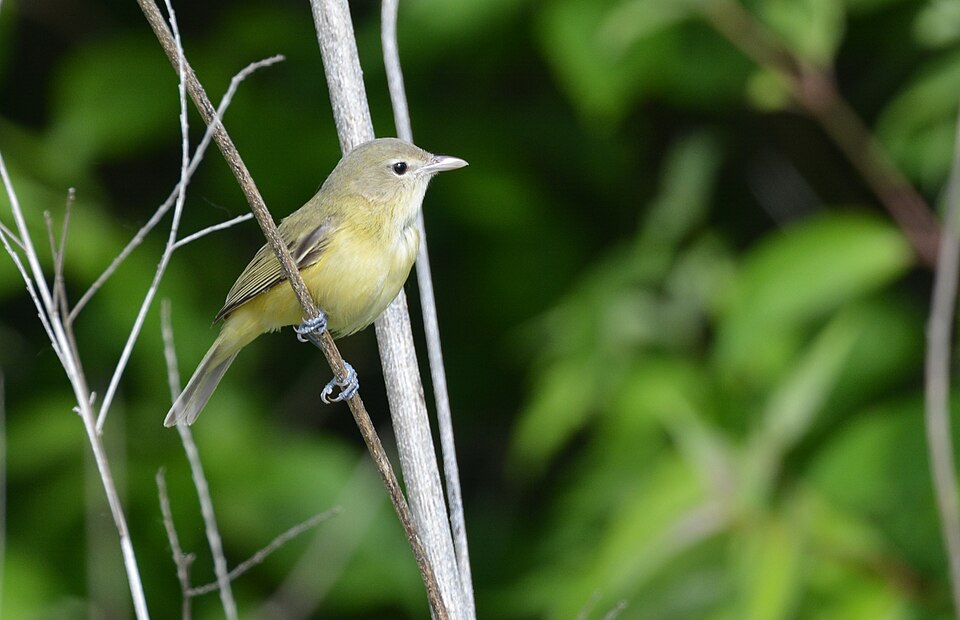
Bell's Vireo is one of those birds you almost always hear before you ever see it. Small, drab, and endlessly active, it lives deep inside tangled streamside thickets, mesquite, and brushy field edges, where it works through the foliage hunting insects and pouring out its rapid, scolding song. To the eye it is a study in understatement, gray-green above, washed pale below, with little obvious to grab onto. To the ear, it is unmistakable. For many western and midwestern birders, the bird is far more a voice than a face.
Named for the American naturalist John Graham Bell, who collected the first specimen along the Missouri River during a famous 1843 expedition, this vireo is a bird of low, dense cover rather than treetops. It is also a species of real conservation interest: the Least Bell's Vireo of southern California declined dramatically through the twentieth century as riparian habitat was lost and Brown-headed Cowbirds spread, and it remains federally endangered. Across most of its range, though, Bell's Vireo is still a familiar and welcome summer voice in the brush.
This is a small, slender, big-headed songbird with a fairly long tail it often flicks and twitches as it forages. The overall impression is plain and warbler-like, but the heavier, slightly hooked bill and the deliberate, peering way it moves through cover give away its vireo identity. Plumage is muted and varies geographically, so behavior, voice, and habitat are usually more useful than color.
| Overall color | Dull gray to gray-green above, whitish to pale yellow below; eastern birds greener, western birds grayer |
| Face | Faint pale spectacles, a thin eyering broken at the top, connecting to a short loral line; never bold or contrasting |
| Wingbars | One fairly distinct whitish lower wingbar and a fainter upper one; not as crisp as in many warblers |
| Bill | Short, fairly stout, slightly hooked at the tip, typical vireo bill, heavier than a warbler's |
| Tail | Long for the bird's size and often flicked or wagged, a useful habit at a distance |
| Size and shape | Tiny and compact with a rounded head; smaller and slimmer than a warbling vireo |
Male vs. female
Male and female Bell's Vireos look essentially identical in the field. Both sexes share the same plain gray-green-and-pale plumage, the same faint spectacles, and the same wingbars, with no reliable difference in color or size visible to a birder. In the breeding season the surest way to tell them apart is behavior: only the male sings the loud, persistent territorial song, often from a hidden perch within the thicket, while the female stays quieter and is more often detected by soft call notes near the nest.
Juveniles
Freshly fledged juveniles look much like dull adults but are even plainer and softer-feathered, often with buffier or grayer underparts and weaker, less defined wingbars. The spectacles are typically vague, and young birds can look almost featureless. By their first fall they have molted into a plumage closely matching adults, so out-of-season identification leans heavily on shape, habitat, and the bird's restless tail-flicking foraging style rather than plumage detail.
The song is the best field mark this bird has. It is a fast, husky, run-together jumble of scratchy notes delivered in two phrases, the first ending on a rising note and the second on a falling one, often transcribed as cheedle cheedle chee? ... cheedle cheedle chew! Birders frequently describe the rhythm as the bird asking a question and then answering it. The whole performance is hurried, slightly harsh, and unmusical compared with a warbling vireo, and males repeat it tirelessly through the heat of the day when most other birds have gone quiet.
Calls include a low, harsh, scolding chatter and dry chit notes used in alarm or between mates. When agitated near the nest, both sexes give a fussy, grating scold that betrays their presence even when the birds themselves stay buried in the brush.
Bell's Vireo is a summer breeder across a broad swath of the central and southwestern United States and into northern Mexico. Its range stretches from the lower Midwest and Great Plains south through Texas and the desert Southwest, with a separate western population in California and Arizona. Throughout this range it favors low, dense vegetation, riparian willow and mesquite thickets, brushy washes, hedgerows, and scrubby field edges.
It is a long-distance migrant, withdrawing entirely from the United States in winter. Most birds spend the cold months in western and southern Mexico and along the Pacific slope of Central America. Spring arrival on the breeding grounds is relatively late, often not until April or May, and southbound departure comes early, by late summer or early fall, so the bird's window on its nesting territories is fairly brief.
Bell's Vireo is almost entirely insectivorous during the breeding season. It gleans caterpillars, beetles, bugs, grasshoppers, spiders, and other small arthropods from leaves and twigs, working methodically through dense low foliage and frequently hovering briefly to pick prey from the undersides of leaves. Its movements are deliberate and peering rather than flitting, a classic vireo style, and it tends to stay well within cover rather than feeding in the open.
On migration and in winter it will take some small fruits and berries to supplement its insect diet, but it remains a foliage-insect specialist for most of the year. Because it forages low and inside thickets, it does much of its hunting out of sight, which is one more reason birders rely on the song to locate it.
The nest is a neat, deep little cup suspended hammock-style from a horizontal fork of a low branch or shrub, usually just a few feet off the ground in dense cover. Both members of the pair help build it, weaving together grasses, bark strips, leaves, and plant fibers and binding the whole thing with spider silk. The result is a tidy basket slung in the heart of a thicket, well hidden from above.
The female typically lays three to four eggs, white with fine dark speckling, and both parents share incubation and the feeding of nestlings. Pairs may raise more than one brood in a season. Bell's Vireo nests are heavily targeted by Brown-headed Cowbirds, and cowbird parasitism, combined with riparian habitat loss, was a major driver of the Least Bell's Vireo's decline in California, where cowbird control has been an important part of recovery efforts.
Bell's Vireo is not a feeder bird and will not visit seed, suet, or sugar water, it is an insect-eater that stays buried in dense low vegetation. You cannot really bait it in, but if you have the right habitat near you, you can make your property or local patch more attractive to it.
- Preserve or plant dense, low, brushy cover, willow thickets, mesquite, native shrubs, and tangled hedgerows are exactly what this bird needs.
- Protect streamside and wash vegetation; riparian thickets are prime Bell's Vireo habitat and are the most at-risk part of its range.
- Avoid clearing or 'tidying' brushy edges during the breeding season, when nests are hidden low in the tangle.
- Skip pesticides, the bird depends on a steady supply of caterpillars and other insects in the foliage.
- Learn the husky, question-and-answer song; in good habitat your ears will find this bird long before your eyes do.
- Discourage conditions that favor Brown-headed Cowbirds, such as heavily grazed or fragmented edges near nesting cover.
- Warbling Vireo: Larger and paler with a cleaner, plainer face and no real wingbars; sings a rolling, sweet warble rather than Bell's husky two-phrase jumble.
- Hutton's Vireo: Chunkier, with bolder spectacles and wingbars and a stouter bill; overlaps in oak scrub but lacks Bell's restless tail-flicking and hurried song.
- Gray Vireo: A plain gray vireo of arid scrub with a complete thin eyering and very faint wingbars; longer-tailed look and dry chaparral habitat help separate it.
- Tennessee Warbler: A migrant warbler that can look similarly plain and greenish, but it has a thin pointed bill, no spectacles, and flits more quickly than the deliberate vireo.
How do I tell a Bell's Vireo from a warbler?
Look at the bill and the way the bird moves. Vireos have a slightly heavier, hook-tipped bill and forage slowly and deliberately, peering at the undersides of leaves, while warblers have thin pointed bills and flit about quickly. Bell's Vireo also flicks its long tail and gives a husky, scratchy song unlike any warbler.
What does a Bell's Vireo sound like?
It sings a fast, husky, run-together jumble in two phrases, the first rising like a question, the second falling like an answer, often written as 'cheedle cheedle chee?' ... 'cheedle cheedle chew!' Males repeat it persistently, even in midday heat when other birds fall silent.
Where do Bell's Vireos live?
They breed in low, dense brush across the central and southwestern U.S. and into northern Mexico, riparian willow and mesquite thickets, brushy washes, hedgerows, and scrubby edges. They winter in western and southern Mexico and Central America.
Is the Bell's Vireo endangered?
The species overall is considered Least Concern, but the California subspecies known as the Least Bell's Vireo is federally endangered after severe declines from riparian habitat loss and cowbird parasitism. Recovery work, including habitat protection and cowbird control, has helped it rebound in parts of its range.
Will Bell's Vireos come to a backyard feeder?
No. They are insect-eaters that stay deep in low, dense vegetation and do not visit feeders. The best way to attract them is to maintain or restore brushy, native, streamside cover and avoid pesticides so insect prey stays abundant.
Why is it so hard to see a Bell's Vireo?
It forages low and inside tangled thickets and rarely perches in the open, so it stays out of sight even while singing loudly. Most birders locate it by ear first, then watch patiently for movement in the brush as the bird works through the foliage.