Best Birding Binoculars of 2026: A Complete Buyer's Guide
Good binoculars transform birding from squinting at distant blobs to seeing individual feathers, eye rings, and wing bars. But the market is overwhelming, prices range from $30 to $3,000+. Here's exactly what to buy at every budget level, based on what experienced birders actually use and recommend.
At a Glance
 Nikon Monarch M5 8x42 (Best Value)
 Vortex Crossfire HD (Budget Upgrade)
 Vortex Viper HD 8x42 (Enthusiast)
 Swarovski NL Pure 8x42 (Premium)
Product images and titles from Amazon. As an Amazon Associate we earn from qualifying purchases.
Quick Answer: What Should I Buy?
| Budget | Our Pick | Price | Best For |
|---|---|---|---|
| Under $100 | Nikon Aculon A211 10x42 | ~$90 | Beginners, casual birding |
| $100-300 | Nikon Monarch M5 8x42 | ~$250 | Serious beginners, best value |
| $300-600 | Vortex Viper HD 8x42 | ~$430 | Enthusiasts, sharp glass |
| $600-1000 | Maven C.2 8x42 | ~$650 | Advanced birders |
| $1000+ | Swarovski NL Pure 8x42 | ~$2,800 | The absolute best glass made |
What Do the Numbers Mean?
When you see "8x42" on binoculars, here's what it means:
- 8x = magnification power (8 times closer than naked eye)
- 42 = objective lens diameter in millimeters (bigger = brighter image)
For birding, 8x42 is the sweet spot. Enough magnification to see detail, wide enough field of view to find birds, bright enough for dawn and dusk. 10x42 gives more reach but a narrower view and more hand shake.
Our Picks
As an Amazon Associate we earn from qualifying purchases, at no extra cost to you.
The Monarch line has been the go-to recommendation for new birders for over a decade, and the M5 continues that tradition. Sharp edge-to-edge, close focus down to 8 feet, waterproof, and lightweight at 21oz. This is genuinely all the binocular most birders will ever need.
Pros: Excellent glass for the price, lightweight, comfortable eyecups, great close focus. Nikon's ED glass reduces color fringing.
Cons: Eye relief could be better for eyeglass wearers. Not as bright as $500+ bins at dawn/dusk.
If you're not sure birding is for you and don't want to spend much, these are surprisingly capable. Not waterproof and not as sharp at the edges, but perfectly usable for learning. Many birders started with these before upgrading.
Pros: Incredibly affordable, decent optics for the price, lightweight.
Cons: Not waterproof, softer edge sharpness, Porro prism design is bulkier.
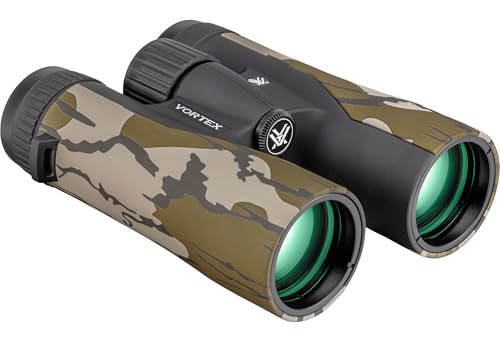
The Crossfire HD is the Vortex entry point that gets you their legendary lifetime warranty at a price closer to the Aculon. HD glass (fully multi-coated lenses, phase-corrected prisms) at $160 is genuinely excellent glass, not a compromise. Waterproof and fog-proof like all Vortex products. If you want the Vortex warranty but the Monarch M5 is out of budget, this is the pick.
Pros: Vortex unlimited lifetime warranty at a lower price point. HD glass is noticeably sharper than uncoated budget options. Waterproof.
Cons: Narrower field of view than the Monarch M5 and Viper HD. Heavier than its price tier competitors.
Where you start getting genuinely excellent optics. The Viper HD has a wide field of view, superb color accuracy, and Vortex's legendary unlimited lifetime warranty, no receipt needed, no questions asked. If it breaks, they fix or replace it. Period.
Pros: Outstanding glass, best warranty in the industry, wide FOV, excellent in low light.
Cons: Slightly heavier than competitors at 24.5oz.
The best binoculars ever made. Period. The NL Pure has the widest field of view of any binocular (9.1° at 8x), edge-to-edge sharpness that makes you question reality, and an ergonomic forehead rest that reduces fatigue during hours of use. This is what professional guides and lifers use.
Pros: Absolute best optics on Earth. Widest FOV. Perfect ergonomics. Life-changing glass.
Cons: The price. That's literally it.
What About Compact Binoculars?
Compact bins (like 8x25 or 10x25) are tempting because they're small and light. But for serious birding, they're a compromise, smaller objective lenses mean dimmer images, especially in the early morning and late afternoon when birds are most active. They're fine as a backup pair for hiking, but don't make them your only binocular.
Buying Tips
- Try before you buy if possible. Visit a local birding store or optics shop.
- Check the warranty. Vortex (unlimited lifetime) and Swarovski (10-year) offer the best.
- Don't forget the harness. A binocular harness ($15-30) distributes weight across your shoulders instead of your neck. Game-changer for all-day birding.
- Waterproof matters. You will get caught in rain. Spend the extra for sealed optics.
- Buy the best you can afford. Good binoculars last 20+ years. Cost per use drops fast.
The Bottom Line
For most birders, the Nikon Monarch M5 at ~$250 hits the sweet spot of quality, price, and weight. It'll serve you well for years. When (not if) you get hooked and want to upgrade, the Vortex Viper HD or Maven C.2 are excellent next steps.
The most important thing? Get outside and start looking up. The best binoculars are the ones you actually take with you.