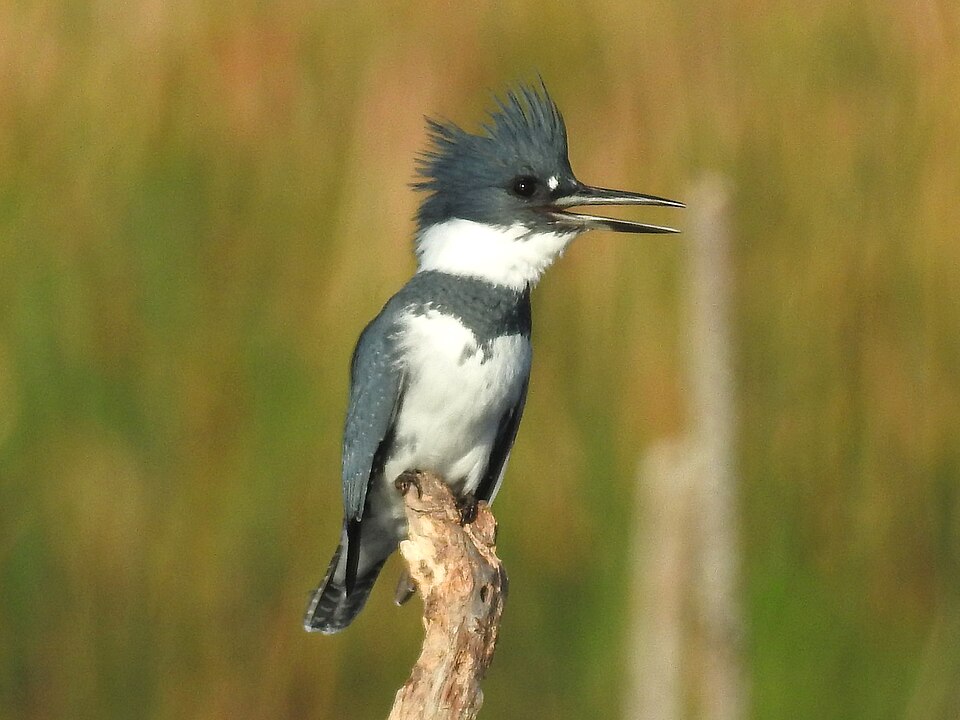
Few birds announce themselves as loudly as the Belted Kingfisher. Long before you spot one, you'll hear its dry, mechanical rattle clattering along a creek or shoreline as a stocky blue-gray bird rockets past on stiff wingbeats. With its oversized head, shaggy double-pointed crest, and heavy dagger of a bill, the kingfisher looks almost top-heavy, like a bird drawn by a child who got carried away with the head. It is one of the most widespread and recognizable waterside birds in North America.
This is a bird tied tightly to water. Kingfishers patrol rivers, lakes, ponds, estuaries, and even drainage ditches and stormwater retention ponds, hunting from a perch or by hovering before plunging headfirst after small fish. They are fiercely territorial, and a single bird will often defend a long stretch of bank, chasing off intruders with that ratcheting call. Belted Kingfishers are also unusual among North American birds in that the female is more colorful than the male, sporting an extra rusty band across her belly.
The Belted Kingfisher has an unmistakable silhouette: a compact body, very large head with a ragged crest, short legs, and a long, thick, pointed bill. In flight it looks front-heavy and flies with irregular, almost choppy wingbeats, frequently calling. Perched birds often pump their tails and raise the crest.
| Size & shape | Pigeon-sized but big-headed and large-billed, with a distinctive shaggy, double-pointed crest |
| Upperparts | Slate blue-gray head, back, wings, and a broad blue-gray breast band |
| Underparts | Clean white throat, white collar around the neck, and white belly |
| Bill | Long, heavy, black dagger-like bill built for grabbing slippery fish |
| Female mark | Adds a rusty-cinnamon band across the belly and flanks below the gray band |
| In flight | White wing patches flash; irregular, uneven wingbeats and a loud rattling call |
Male vs. female
This is one of the rare North American birds where the female is the showier sex. Both sexes share the blue-gray upperparts, white collar, and single blue-gray breast band. The female adds a second, rusty-chestnut band across the belly that often extends down the flanks. The male has only the gray band and clean white underparts below it. Once you learn this, telling the sexes apart is one of the easiest in birding.
Juveniles
Juvenile Belted Kingfishers resemble adults but look a bit messier, with rusty or cinnamon spotting and mottling mixed into the breast band regardless of sex. Young males may show a partial reddish wash that fades as they molt into clean adult plumage, which can briefly make sexing tricky. By their first winter, the rusty markings sort out into the adult pattern.
The signature sound is a loud, dry, mechanical rattle, a fast, harsh "kek-kek-kek-kek-kek" that sounds like a fishing reel being cranked or a wooden ratchet. It is one of the most distinctive sounds along North American waterways and is usually given in flight, often as the bird is flushed or defending territory.
The rattle varies in pace and intensity: a faster, more frantic version signals alarm or aggression, while a slower, more spaced-out version is used in milder situations. Both sexes call year-round, and the sound carries a surprising distance over open water.
Belted Kingfishers breed across nearly all of North America, from Alaska and across most of Canada south through the United States wherever there is suitable water with open, fishable surfaces and earthen banks for nesting. They are among the most widely distributed waterside birds on the continent.
Their movements are driven by ice. Birds that breed in the far north and across Canada migrate south in fall, since they cannot fish through frozen water. In the southern United States, along the coasts, and anywhere water stays open, they are year-round residents. In winter many push south into Mexico, Central America, and the Caribbean. A bird's presence in a given spot often depends simply on whether the water is open and stocked with small fish.
Small fish are the mainstay of the Belted Kingfisher's diet, minnows, sticklebacks, sculpins, young trout, and other species roughly two to five inches long. They hunt either from an exposed perch over the water, such as a snag, wire, or overhanging branch, or by hovering in midair before plunging headfirst with a splash to seize prey just below the surface. After a catch, a kingfisher typically returns to a perch and beats the fish against the branch to stun it before swallowing it head-first.
They are opportunistic and will also take crayfish, aquatic insects, tadpoles, frogs, small crabs, and occasionally small mammals or reptiles. Like owls, kingfishers cough up pellets of indigestible bones and scales, which accumulate beneath favored perches. Clear, calm water makes hunting easier, so kingfishers often struggle on muddy or wind-roughened waterways.
Belted Kingfishers are burrow-nesters, which sets them apart from most familiar birds. The pair digs a tunnel, typically three to six feet long, and sometimes longer, into a vertical or steeply sloping earthen bank, often along a river, lake, road cut, gravel pit, or quarry. Both sexes excavate, using their bills to dig and their tiny feet to kick out loose soil, and the tunnel slopes slightly uphill to a rounded nesting chamber at the end.
The female lays a clutch of glossy white eggs in the bare chamber. Both parents incubate and later feed the young, regurgitating fish to the nestlings. The chicks remain underground for several weeks before fledging, after which the parents continue teaching them to fish, sometimes dropping stunned prey into the water for the young to retrieve. Pairs are generally single-brooded but may re-nest if a first attempt fails.
The Belted Kingfisher is not a feeder bird, it won't visit seed, suet, or nectar, and it needs open water with small fish to survive. You can't lure one to a typical backyard, but if you have a pond, creek, or shoreline nearby, you can make your property kingfisher-friendly.
- Provide open water with healthy fish populations, a stocked pond, natural creek, or lakeshore is the single biggest draw.
- Leave bare perches over the water, such as dead snags, overhanging branches, or even a strategically placed post, so a kingfisher has a hunting lookout.
- Preserve natural earthen banks along streams and ponds, kingfishers need exposed vertical soil banks to dig their nesting burrows.
- Keep water clear and calm where possible; murky or heavily disturbed water makes it hard for kingfishers to spot and catch fish.
- Avoid lining every shoreline with riprap, lawn, or hard armoring, which removes both the perches and the digging banks kingfishers depend on.
- Green Kingfisher: Much smaller and greener above with no crest tufts; limited to the far southern U.S. and the Tropics, usually along smaller streams.
- Ringed Kingfisher: Noticeably larger and bulkier with an entirely rusty belly in both sexes; found mainly in south Texas. The Belted's underparts are mostly white.
- Blue Jay: Also blue, crested, and noisy, but slimmer, longer-tailed, with a small bill and woodland habits, never plunge-dives for fish.
How do you tell a male from a female Belted Kingfisher?
Look at the belly. Both sexes have a blue-gray band across the chest, but the female adds a second rusty-chestnut band across the belly and flanks. The male's underparts below the gray band are clean white. The female is the more colorful sex, which is unusual among birds.
What sound does a Belted Kingfisher make?
A loud, dry, mechanical rattle, a harsh 'kek-kek-kek-kek' that sounds like a fishing reel being cranked or a wooden ratchet. It usually calls in flight, especially when flushed or defending its stretch of water, and the sound carries well across open water.
Where do Belted Kingfishers nest?
They dig burrows into vertical earthen banks along rivers, lakes, road cuts, or gravel pits. Both parents excavate a tunnel three to six feet long that ends in a nesting chamber, where the female lays her white eggs directly on the bare soil.
What do Belted Kingfishers eat?
Mostly small fish two to five inches long, caught by diving headfirst from a perch or after hovering above the water. They also eat crayfish, aquatic insects, tadpoles, frogs, and the occasional small reptile or mammal, and they cough up pellets of bones and scales like owls do.
Can I attract a Belted Kingfisher to my yard?
Not with a feeder, they only eat live aquatic prey. But if you have a pond, creek, or shoreline with small fish, you can encourage them by leaving bare perches over the water, keeping the water clear, and preserving natural earthen banks where they can dig nest burrows.