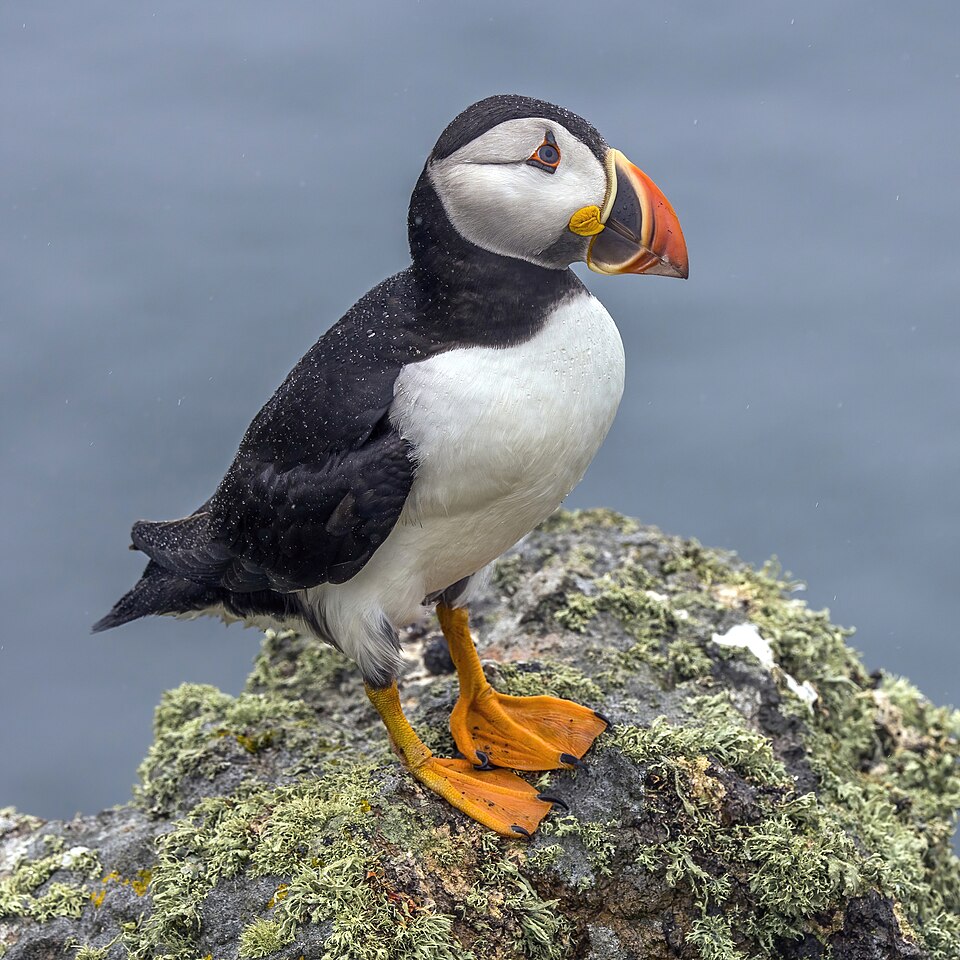
Few birds win hearts as quickly as the Atlantic Puffin. With its stubby, upright posture, snow-white cheeks, and a deep, brightly striped bill, it looks almost hand-painted, earning nicknames like "sea parrot" and "clown of the sea." Yet this charm hides a tough, supremely capable seabird. Puffins spend the great majority of their lives far out on the open North Atlantic, riding swells through gales and diving for fish, only coming ashore to breed on remote islands and grassy sea cliffs from late spring into summer.
Atlantic Puffins are members of the auk family (Alcidae), relatives of murres, guillemots, and the extinct Great Auk. They are the only puffin species found in the Atlantic, breeding from the eastern coast of North America across Iceland, the British Isles, and northern Europe. Watching a colony in full swing, with birds whirring in from the sea, bills crammed with silvery fish, is one of birding's great spectacles, and the reason so many people make pilgrimages to puffin islands each summer.
A breeding-plumage Atlantic Puffin is nearly unmistakable: a small, chunky, big-headed seabird that stands upright on orange legs, with a black back, white underparts, pale gray-white face, and an outsized triangular bill banded in red, yellow, and slate-blue. Size is deceptive, puffins are smaller than most people expect, only a little bigger than a robin in body, though their stout shape makes them look heavier.
| Bill (summer) | Large, flattened, triangular; banded red-orange at the tip, yellow in the middle, blue-gray at the base, with a yellow rosette at the gape |
| Face | Pale gray to whitish cheeks and throat sharply set off against a black crown and collar |
| Body | Black above, clean white below; compact and broad-chested, standing upright like a tiny penguin |
| Legs & feet | Bright orange, set far back on the body, giving a clumsy waddle on land |
| Eye | Small dark eye framed by red orbital ring and bluish-gray fleshy ornaments above and below, giving a sleepy, theatrical look |
| In flight | Whirring, fast wingbeats; chunky silhouette with orange feet trailing and rapid, low passes over the water |
Male vs. female
Male and female Atlantic Puffins look essentially identical in plumage and bill color, so you cannot reliably tell them apart in the field. Males average slightly larger overall, with a marginally deeper, longer bill and bigger head, but this is only apparent when a pair stands side by side, and even then it takes a practiced eye. At the nest, behavior is the better clue: males do more of the burrow digging and tend to be more aggressive in territorial squabbles, while both sexes share incubation and chick feeding.
Juveniles
Young puffins look noticeably plainer than adults. A chick (charmingly called a "puffling") is a dark, downy ball; by the time it fledges and heads to sea alone at night, it has a much smaller, narrow, dusky bill and a dingy, dark-gray face rather than the bright white cheeks of a breeding adult. First-year and immature birds keep this slim, dark bill and only gradually develop the deep, brightly colored bill plates over several years. Outside the breeding season, even adults shed the colorful outer bill sheath and grow darker, grayer faces, so winter birds at sea look far drabber than the postcard image.
Atlantic Puffins are nearly silent at sea but surprisingly vocal in the burrow. Their signature sound is a low, growling, almost comical moan, often written as a drawn-out "arr-arr-arr" or "ow-ow-ow," a bit like a distant chainsaw or a creaky door, or a muffled cow lowing underground. Birders sometimes describe it as a chuckling groan that rises and falls.
These calls carry up out of the nest chambers across a colony, producing an oddly muttering, mechanical chorus. Puffins do not have an elaborate musical song; their vocal life is built around these growls used in courtship and territorial defense, plus quieter contact sounds between mates. Away from the colony they are essentially mute.
Atlantic Puffins breed across the cold North Atlantic. In North America, colonies sit on islands off eastern Canada (Newfoundland and Labrador, the Gulf of St. Lawrence) and at restored sites in Maine, the southern edge of the breeding range. The vast majority of the world's puffins, however, nest in the eastern Atlantic: Iceland holds enormous colonies, with more on the Faroe Islands, around Britain and Ireland, Norway, and into the Arctic.
Outside the breeding season, from late summer through winter, puffins disperse widely across the open ocean, often hundreds of miles from land. They are true pelagic wanderers in winter, scattered singly or in loose groups far offshore, which is why land-based birders almost never see them between fall and spring. They return to colonies in April and May, and most have left again by August.
Atlantic Puffins are pursuit divers that hunt small schooling fish underwater, propelling themselves with their wings as if flying through the sea and steering with their feet. Favorite prey includes sand eels (sand lance), herring, sprat, capelin, and other small fish, supplemented by small crustaceans. Most dives are shallow and brief, but puffins can plunge well over a hundred feet when needed.
Their most famous trick is carrying many fish at once. Backward-facing spines on the roof of the mouth and a muscular, raspy tongue let a puffin hold one freshly caught fish in place while snapping up another, so it can return to the burrow with a dozen or more silvery fish dangling crosswise from its bill, sometimes far more. This lets a parent make fewer, more efficient trips to feed a hungry chick waiting underground.
Atlantic Puffins are colonial cliff- and island-nesters that prefer grassy slopes and turf where they can dig. Pairs are long-term, often reuniting at the same burrow year after year. The nest is typically a burrow a few feet long that the birds excavate in soft soil with their bills and feet, ending in a chamber loosely lined with grass and feathers; where soil is thin, they will use rock crevices instead.
The female lays a single egg, which both parents incubate in turn for around six weeks. The chick is then brooded and fed in the dark burrow for roughly six weeks more, growing fat on beakfuls of fish. Eventually the parents stop visiting, and the puffling slips out of the burrow alone at night and makes its way to the sea, where it will live entirely on the water for several years before returning to breed.
The Atlantic Puffin is not a backyard or feeder bird, and there is no realistic way to attract one to a garden. It is a pelagic seabird that only comes to land at remote island colonies. Instead of attracting puffins, the goal is knowing where and how to go see them responsibly.
- Visit a known colony in summer. Puffins are only ashore roughly April through August; plan a June or July trip to a reliable site such as the Maine seabird islands, Newfoundland's Witless Bay, Iceland, the Farne Islands, or Skomer in Wales.
- Take a dedicated puffin boat tour or seabird cruise. Many colonies are protected islands you can only view from a permitted vessel, which also gets you close without disturbing nests.
- Go early or late in the day. Puffin activity at the colony often peaks in the morning and evening when birds are coming and going with fish.
- Bring binoculars and stay on marked paths. Burrows are fragile and easily collapsed underfoot; keep well back from nesting slopes and never block birds' access to the sea.
- Support seabird conservation. Puffins are sensitive to overfishing of forage fish and to warming seas; donating to seabird restoration projects helps far more than any feeder ever could.
- Razorbill: Also a black-and-white auk, but larger and slimmer with a deep, blunt black bill marked by a thin white line, and a longer pointed tail; lacks the puffin's colorful bill and white face.
- Common Murre: A larger, more elongated auk with a slender, pointed dark bill and brown-black upperparts; stands more horizontally and lacks any bright bill color.
- Black Guillemot: In summer all black with a bold white wing patch and brilliant red legs and mouth; sharp thin bill and no colorful bill plates separate it easily from a puffin.
- Tufted Puffin: A Pacific relative, larger and dark-bodied with long golden head tufts in summer; ranges do not overlap with the Atlantic Puffin.
Where can I see Atlantic Puffins in the wild?
They breed at island colonies in the North Atlantic from spring through summer. In North America the best spots are off eastern Canada (such as Witless Bay, Newfoundland) and the restored seabird islands of Maine. In Europe, Iceland, the Faroes, Norway, and British sites like Skomer and the Farne Islands host huge colonies. Most puffin-watching is done by boat tour between April and August.
Why is the puffin's bill so colorful, and does it stay that way?
The bright red, yellow, and blue bill is breeding ornamentation used in courtship and territorial display. It's only this vivid in spring and summer. After breeding, puffins shed the colorful outer plates of the bill, leaving a smaller, duller bill, and their faces turn grayer, so winter birds look much plainer.
How many fish can a puffin hold in its beak at once?
A lot, commonly around ten to a couple of dozen small fish, and sometimes many more in a single load. Backward-pointing spines on the roof of the mouth and a rough tongue let the bird hold caught fish crosswise while still grabbing more, so it can bring a full beakful back to its chick.
Are Atlantic Puffins endangered?
They are currently classed as Vulnerable. While colonies can still number in the hundreds of thousands and the global population is large, numbers in parts of the range have declined due to overfishing of the small fish they eat, warming seas shifting their prey, and past hunting. They remain a conservation concern.
What is a baby puffin called and how does it leave the nest?
A puffin chick is called a puffling. It's raised in a dark burrow and fed fish by both parents for about six weeks. When it's ready, the parents stop feeding it, and the puffling leaves the burrow alone at night, heading straight to the sea. It then lives entirely on the open ocean for several years before returning to breed.